

Researchers at the Indian Institute of Science (IISc), in collaboration with University College London, have devised a machine learning (ML) approach to predict material properties using limited data. This breakthrough holds promise for discovering materials with specific properties, such as semiconductors, and addresses the challenges posed by expensive and time-consuming testing methods.
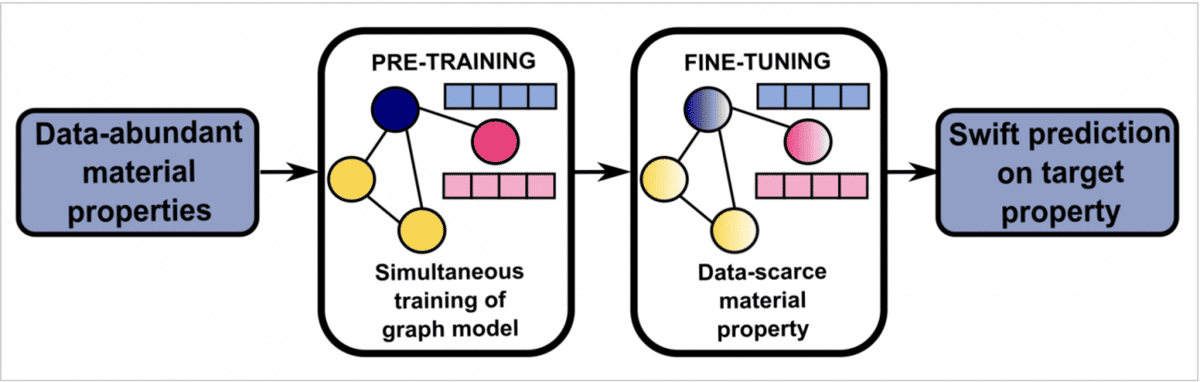
The research, led by Sai Gautam Gopalakrishnan, Assistant Professor at IISc’s Department of Materials Engineering, employs transfer learning- a technique where a model pre-trained on a large dataset is fine-tuned for smaller, target-specific datasets. Gopalakrishnan explains the concept using an analogy: a model trained to classify general images can later be fine-tuned for specialised tasks, such as detecting tumors in medical scans.
For their study, the researchers used Graph Neural Networks (GNNs), which work with graph-structured data, such as the three-dimensional crystal structures of materials. In GNNs, atoms are represented as nodes and bonds as edges, enabling the model to learn complex material properties effectively. The team optimised the GNN architecture and the size of the training data, freezing some layers of the model during pre-training to enhance efficiency.
The researchers also introduced a Multi-property Pre-Training (MPT) framework, training their model simultaneously on seven bulk material properties. This approach significantly improved the model’s predictive accuracy, enabling it to estimate material properties like the piezoelectric coefficient and even predict the band gap values of 2D materials it had not encountered before.
Source: IISc
Transform Semiconductor Field
The transfer learning-based model outperformed conventional models trained from scratch. Its applications extend beyond semiconductors, aiding in areas such as battery technology, where predicting ion mobility within electrodes could improve energy storage. Gopalakrishnan noted the model’s potential in supporting India’s semiconductor manufacturing ambitions by predicting the tendency of materials to form point defects.
This innovative method leverages rich, multi-property data to enhance predictions and represents a leap forward in materials science, offering solutions for industries reliant on advanced materials and energy technologies.
- Google Launches Two New TPUs for Enterprise Agentic AI Workloads
- Mphasis Raises FY27 Growth Outlook After 9.2% Dollar Revenue Growth in Q2
- Adobe’s CX Enterprise Coworker Gets Embedded Within Leading AI Platforms
- Sarvam AI Appoints Ex-Google Cloud India MD Sashikumar Sreedharan as President and CBO
- EXL Acquires Aimpoint Digital, Adds 250 AI and Data Experts
- Coforge Joins SpaceX Network to Develop Industry-Specific Grok Applications