
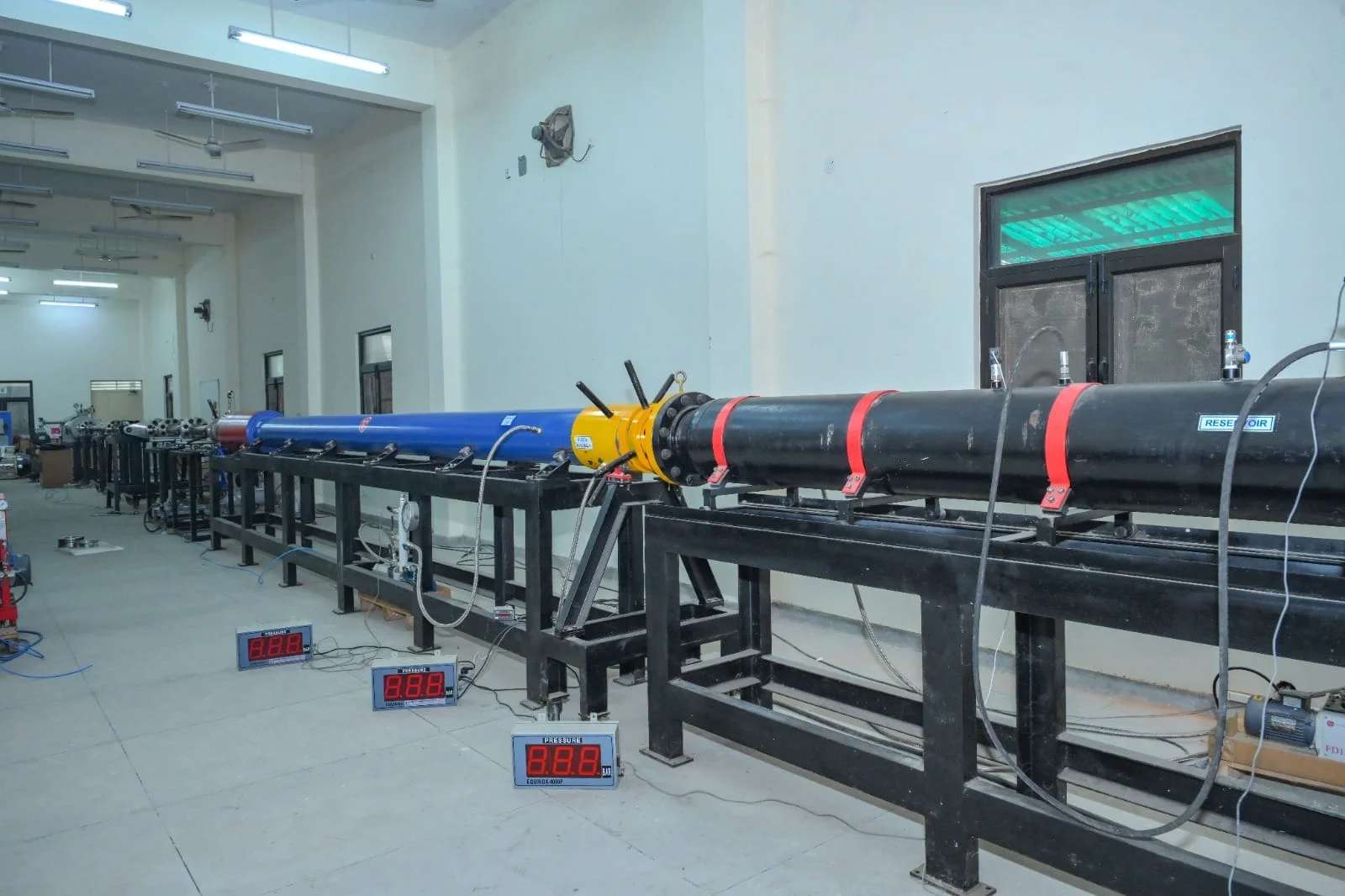
Indian Institute of Technology (IIT) Kanpur has achieved a significant milestone by successfully developing and testing India's inaugural Hypervelocity Expansion Tunnel Test Facility.
Named S2, this advanced facility positions India among a select group of nations with hypersonic testing capabilities. S2 can simulate flight speeds ranging from 3-10 km/s, replicating hypersonic conditions experienced during atmospheric entry of vehicles, asteroid entry, scramjet flights, and ballistic missiles.
"Nicknamed 'Jigarthanda', is a 24-meter-long facility indigenously designed and developed over a period of three years with funding and support from the Aeronautical Research and Development Board and the Department of Science and Technology, Government of India.
"It represents a tremendous achievement for IITK and a major capacity boost for India's space and defence sectors. With sophisticated hypervelocity testing capabilities now available domestically, India is better positioned to develop advanced hypersonic technologies and systems," IIT Kanpur said.
"Building S2 has been extremely challenging, requiring in-depth knowledge of physics and precision engineering. The most crucial and challenging aspect was perfecting the 'free piston driver' system, which requires firing a piston at high pressure between 20-35 atmospheres down a 6.5 m. compression tube at speeds of 150-200 m/s, and bringing it to a complete stop or 'soft landing' at the end," Professor Mohammed Ibrahim Sugarno, Associate Professor, Department of Aerospace Engineering and Centre for Lasers & Photonics at IIT Kanpur said.
- Chai Point Cuts Monthly AWS Bill by 58%
- Bengaluru AI Startup Simplismart Raises $14 Mn in NVIDIA-Backed Round
- Maya Research Releases Open-Weight Speech Model Supporting 12 Languages
- Anthropic Sued Over Alleged Use of Elvis Presley Songs to Train Claude, Denies Claim
- CoRover Lists Three BharatGPT Models On Government-Backed AIKosh Platform
- Cent Raises $15 Million to Expand AI-Powered Preventive Healthcare