

As the future of AI is agentic. Microsoft Research has released Magentic-One, a generalist multi-agent system that can solve open-ended tasks across various domains.
Available as an open-source tool on Microsoft AutoGen, Magentic-One intends to assist developers and researchers in creating agentic applications that manage complex, multi-step tasks autonomously.
Magentic-One employs a modular multi-agent architecture where a lead orchestrator agent coordinates with other specialised agents to tackle different subtasks. These agents include WebSurfer for web navigation, FileSurfer for file management, Coder for programming tasks, and ComputerTerminal for executing code.
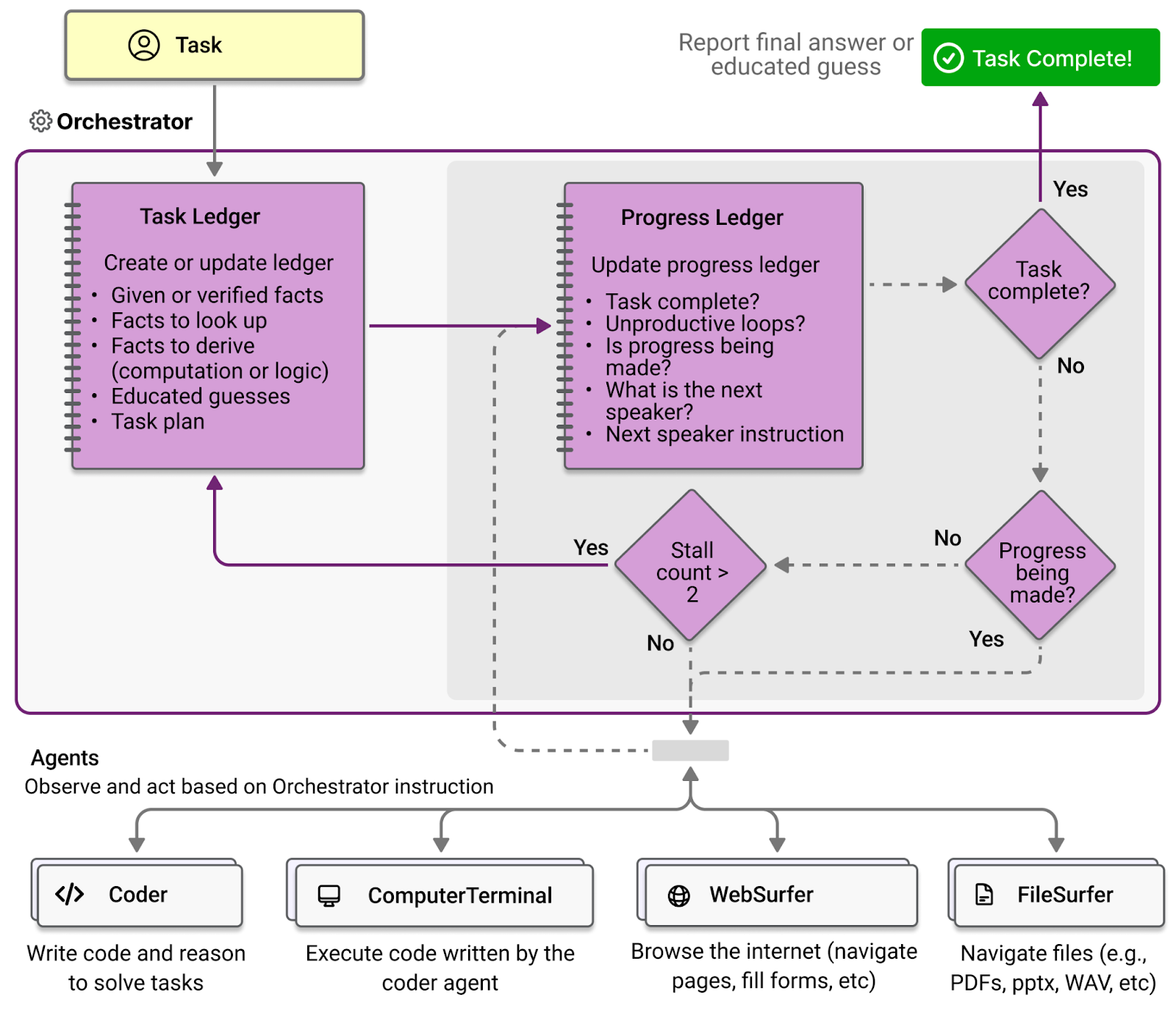
This division of responsibilities enables Magentic-One to handle tasks involving web browsing, file management, and coding, making it suitable for diverse applications in software engineering, data analysis, and scientific research.
Magentic-One is designed to function as a flexible and scalable alternative to single-agent systems. It allows the addition or removal of agents without altering the system’s core structure.
“Magentic-One’s plug-and-play design further supports easy adaptation and extensibility by enabling agents to be added or removed without altering other agents or the overall architecture, unlike single-agent systems that often struggle with constrained and inflexible workflows,” said the company in its blog post.
Microsoft’s AutoGen framework facilitates this adaptability, supporting the integration of various large language models (LLMs) and small language models (SLMs) to meet specific cost and performance requirements. The system is currently tested with GPT-4o and OpenAI’s o1-preview for certain tasks, though it remains model-agnostic.
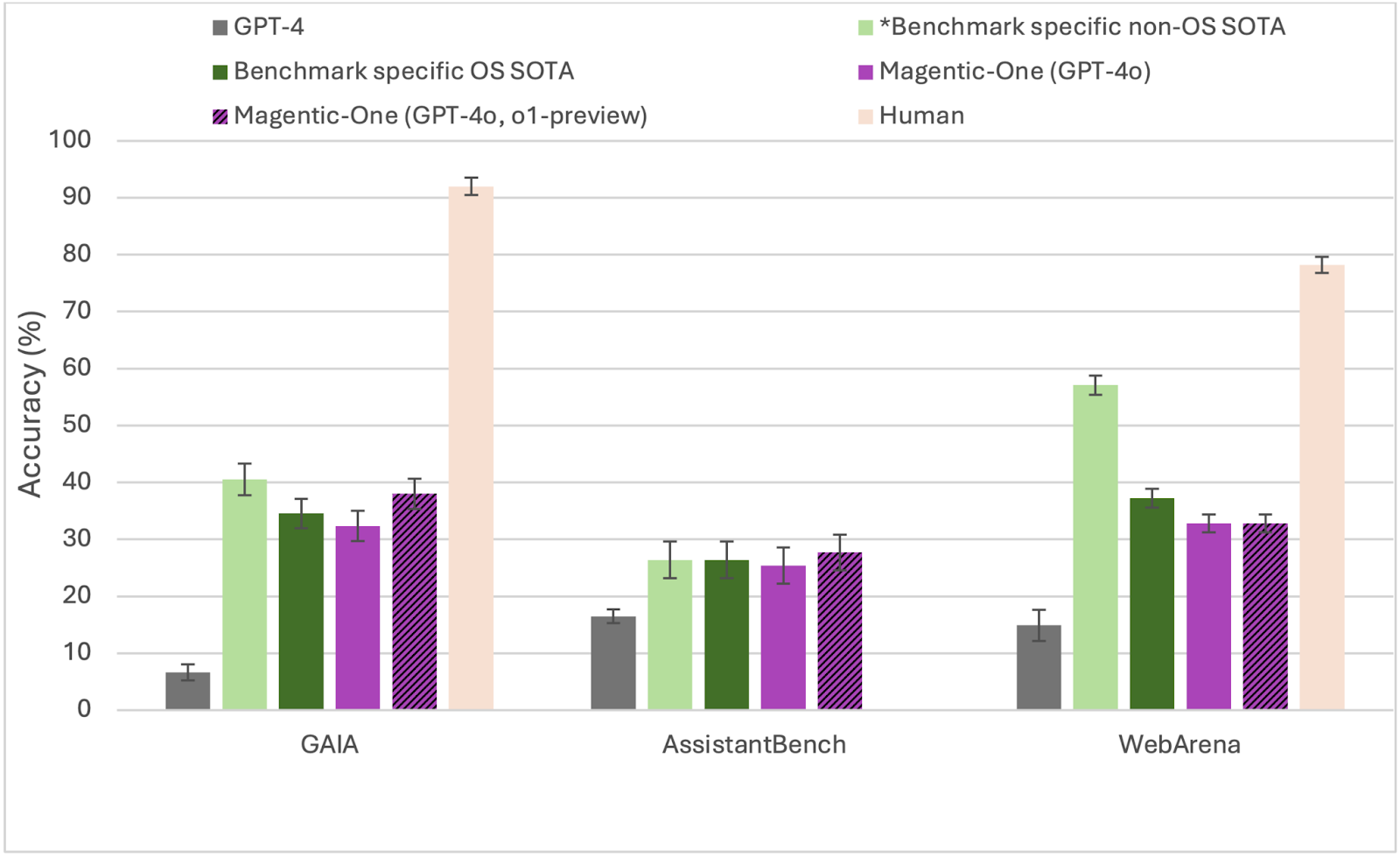
To evaluate Magentic-One’s effectiveness, Microsoft has introduced AutoGenBench, a tool for assessing agentic performance on benchmarks like GAIA, AssistantBench, and WebArena. These benchmarks, which include multi-step planning and tool usage, have shown Magentic-One achieving competitive results against state-of-the-art methods, according to Microsoft data from October 2024.
Several open-source multi-agent frameworks have been introduced recently. OpenAI launched Swarm, a framework for building, orchestrating, and deploying multi-agent systems.
Similarly, IBM has released the Bee Agent Framework, an open-source toolkit for building and deploying agent-based workflows at scale. Bee Agent, currently in its alpha stage, supports a wide range of AI models and offers enhanced compatibility with IBM Granite and Llama 3.2 models.
This framework is intended to help developers create effective agents with minimal adjustments to existing implementations while actively optimising for other popular LLMs.
- Meta Expands AI Age-Estimation Tech to Protect Teens on Instagram
- Meta to Introduce Muse AI Agent in India Starting With ₹1,799 Plan: Report
- Trump Defends Jensen Huang Amid NVIDIA Probe
- Google Launches Two New TPUs for Enterprise Agentic AI Workloads
- Mphasis Raises FY27 Growth Outlook After 9.2% Dollar Revenue Growth in Q2
- Adobe’s CX Enterprise Coworker Gets Embedded Within Leading AI Platforms