Key takeaways
- Microsoft aims to develop a quantum supercomputer within the next decade using topological qubits for enhanced performance.
- The company introduced Azure Quantum Elements to accelerate scientific discovery through AI and quantum technologies.
- Copilot for Azure Quantum will enable researchers to conduct simulations and visualise data using natural language.
- Microsoft's recent advancements include a new Majorana-based qubit, promising increased stability and scalability for quantum computing.
Microsoft is ready to build its quantum supercomputer. In the virtual event, Azure Quantum: Accelerating Scientific Discovery, Satya Nadella said the company’s goal is to make the discovery quicker. For this, the company has announced its roadmap for building one using the topological qubits, which the company has been working on for some years now.
Krysta Svore, Microsoft’s VP of advanced quantum development, told TechCrunch that even though there are a lot of milestones ahead, it will take less than a decade for the company to build its quantum supercomputer, which would be able to perform one million quantum operations per second.
Moreover, the company has also announced Azure Quantum Elements, for accelerating scientific discovery using AI and quantum on high-performance computing. This also includes a Copilot for Azure Quantum that will allow researchers to generate quantum simulations, calculations, querying and visualising data for better answers in natural language.
Last year, Microsoft made a major breakthrough in quantum computing. Researchers developed a new type of Majorana-based qubit, which is a fundamental component of quantum supercomputers. These qubits are more stable and easier to scale up resulting in the need for fewer of them.
Microsoft took an early initiative in this technology and has now published a new research paper, reviewed by peers in the American Physical Society's Physical Review B. This paper confirms that Microsoft has successfully reached its initial goal on the path towards building a quantum supercomputer. However, the time it took for the company to reach just the first milestone presents questions on the 10-year roadmap with noise physical qubits.
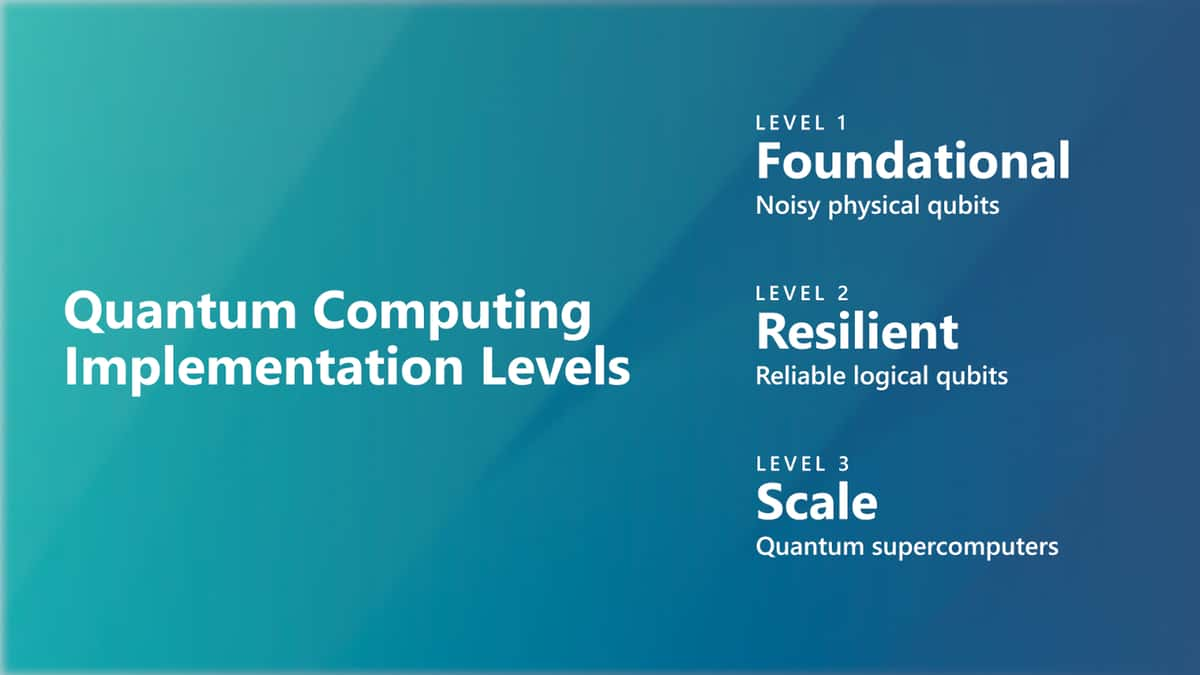
The next step for the company is to build hardware-protected qubits to make it more resilient. These qubits are expected to be less than 10 microns on a side and able to perform one qubit operation in less than a microsecond. Then the next step for the company is to scale these smaller qubits into a supercomputer.
For ensuring a quantum-safe future, Microsoft is proactively speaking with customers and inviting participants to contribute to support the transition.
Spotted an error? Tell our editors. Read our editorial standards and corrections.