
The compounds behind someone’s terrible odour are not known to science. But it turns out that it’s not just them. Mapping any compounds to the scents they make is harder than it looks. A team in the US has set out to solve the problem, creating a ‘principal odour map’ to decode how our brains perceive scents. This research not only bridges the gap in humans’ understanding of the sense of smell but can also change the way we recognise olfactory perceptions.
In vision, we understand the mappings between physical properties and colour perception. In the audition, we can identify the relationship between physical vibrations and pitch perception. However, the connection between chemical structures and olfactory percepts has remained a mystery.
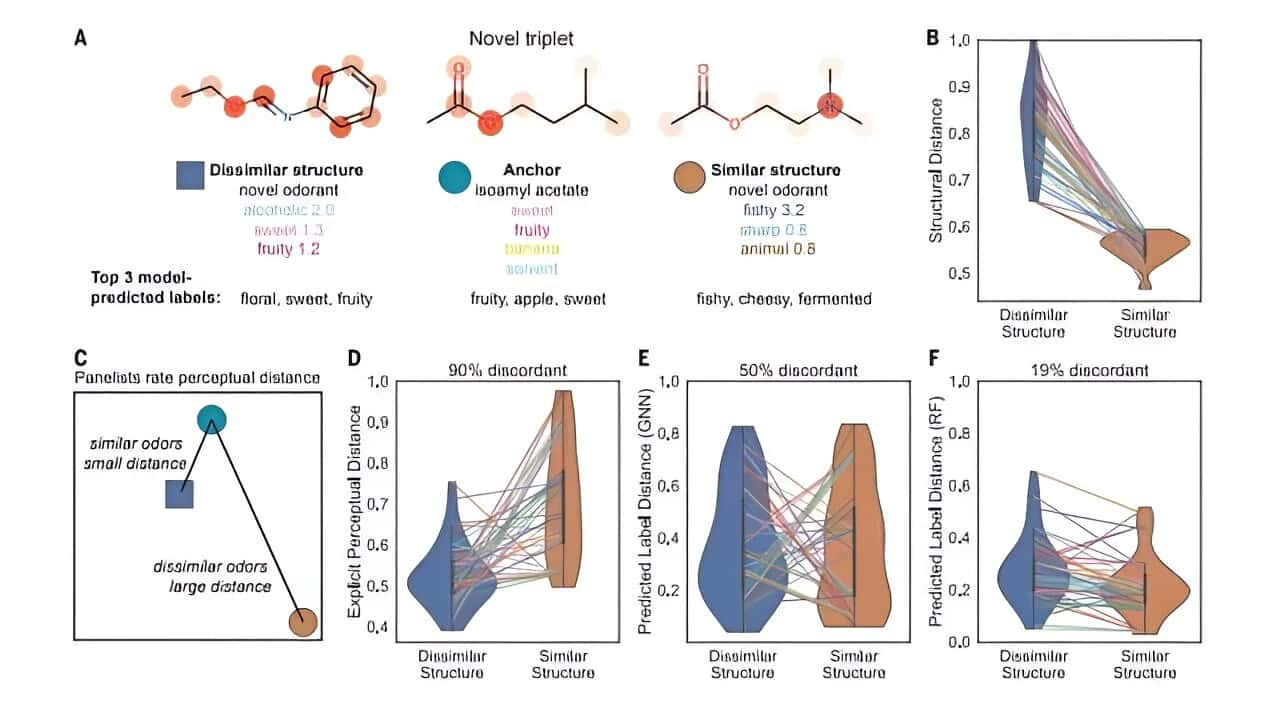
This long-standing problem has been solved via machine learning. Brian K Lee and his team developed a neural network-based model capable of mapping chemical structures to odour perceptions, creating the "Principal Odor Map" (PoM). They used a dataset containing 5,000 known odorants, each having odour labels to train their ML model, pushing the boundaries of our understanding of the sense of smell.
To validate their findings, they conducted a prospective challenge, demonstrating that the model's predictions closely mirrored human ratings for novel odorants. The POM they created preserved the intricate perceptual relationships, outshining traditional structure-based maps and pointing the way forward for olfactory science.
The team also compared a graph neural network (GNN) model to a traditional count-based fingerprint model for predicting odour preferences. The GNN model emerged as the frontrunner, either matching or surpassing human panellists' ratings for 55% of the odour labels.
A discovery along the way was impurities identification in chemical reactions as potential contributors to odour perceptions, with a significant 31.5% rate of contamination in the stimulus set. It was observed that the neural networks performed well for labels with clear structural determinants and training examples, while human panellists' performance varied based on their familiarity with the labels. Compared to human testers the model excelled in describing the smell of various molecules for 53% of the molecules tested.
- Amazon Warns Engineers Against AI Productivity Traps in Latest Memo
- Gnani AI Launches Prisma v3.0 Speech Recognition Model for 10 Languages
- Venttup Raises $3 Million To Expand Precision Manufacturing
- Articul8 Launches Bivia To Help Enterprise AI Agents Make Decisions
- NVIDIA Launches Open-Weight Transcription Model for 40 Languages
- Sarvam AI Rolls Out Indus Cowork to 2,500 Maharashtra Govt Officials