
On Thursday, a group of researchers from ServiceNow released a new foundational model, StarVector, that helps generate Scalable Vector Graphics (SVG) from text and image inputs.
Juan A. Rodriguez, an AI researcher at ServiceNow Research, announced on X about the model release and its code.
StarVector is a multimodal large language model (MLLM) designed for Scalable Vector Graphics (SVG) generation from images or text instructions. It addresses the limitations of previous SVG generation methods that often produced artifacts and struggled with SVG primitives beyond path curves.
I’m excited to announce that 💫StarVector has been accepted at CVPR 2025! Over a year in the making, StarVector opens a new paradigm for Scalable Vector Graphics (SVG) generation by harnessing multimodal LLMs to generate SVG code that aesthetically mirrors input images and text.… pic.twitter.com/zTquIdq3n9
— Juan A. Rodríguez 💫 (@joanrod_ai) March 20, 2025
The research paper stated that StarVector works directly in the SVG code space, leveraging visual understanding to apply accurate SVG primitives for compact, precise outputs.
To train StarVector, the researchers created SVG-Stack, a large-scale dataset of 2 million samples. They also introduce SVG-Bench, a benchmark across ten datasets and three tasks: Image-to-SVG, Text-to-SVG generation, and diagram generation.
StarVector's architecture integrates an image encoder to project images into visual tokens and a transformer language model to learn the relationships between instructions, visual features, and SVG code sequences. This enables StarVector to perform image vectorisation and text-driven SVG generation, producing more compact and semantically rich SVGs.
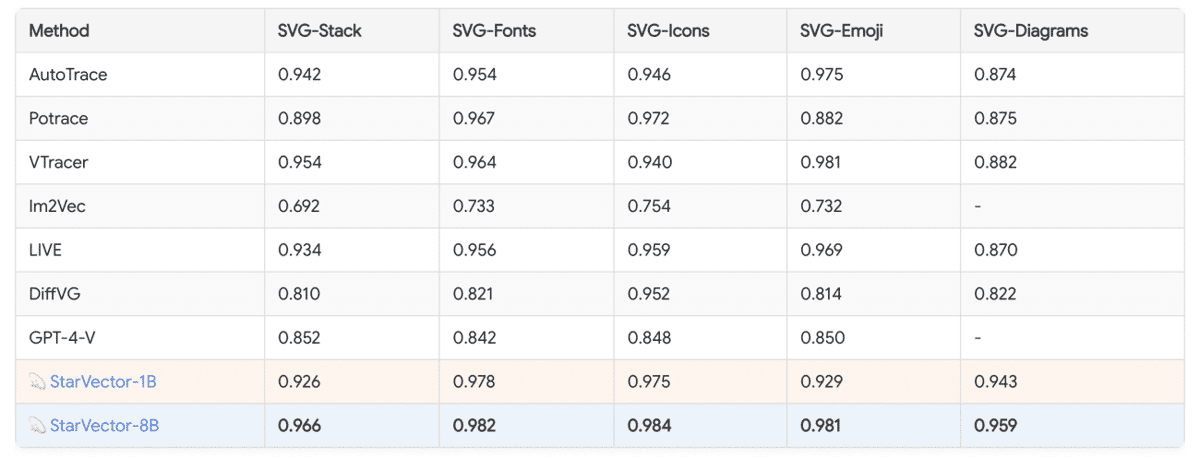
StarVector demonstrates strong performance compared to existing models in image-to-SVG and text-to-SVG tasks. As per the benchmark results, the model outperformed models like GPT-4 Vision (2023), and Potrace.
Rodriguez mentioned that even with the advancements in the model, it hallucinates, sometimes producing inaccurate details. He added that they are actively working on improving and tackling such challenges.
The model is available on Hugging Face, and its code is open-sourced on GitHub under Apache 2.0 licence.
- OpenAI Introduces ChatGPT Wallet for Agent-Led Payments
- ReNew Pledges ₹80,000 Cr for Green Data Centre to Fuel India’s AI Push
- Mars Opens Hyderabad GCC With Genpact to Expand Digital, AI Capabilities
- Shield AI Opens Bengaluru Engineering Office to Build Defence Autonomy Software
- Adobe, Google Expand AI Partnership Across Creative and Productivity Tools
- Google Launches Gemini 4 Hydrogen for Faster Coding and AI Workflows