Key takeaways
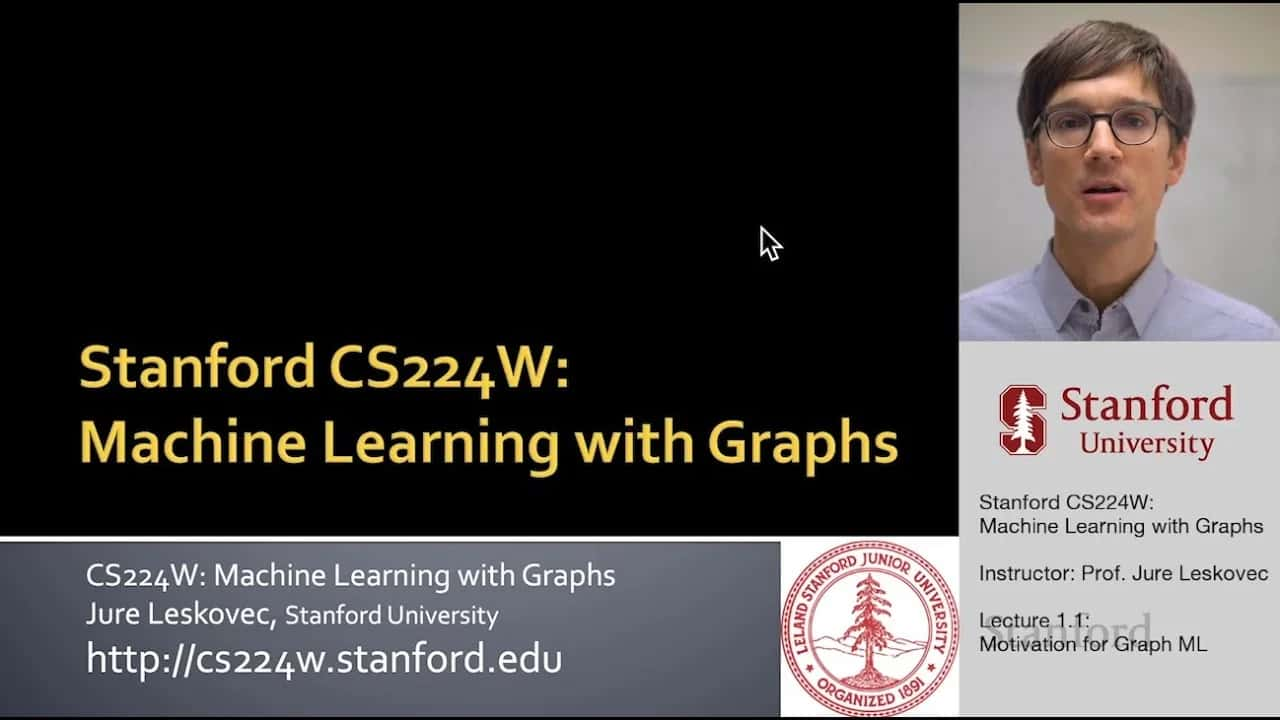
- Stanford University will offer a free online course on Machine Learning with Graphs from autumn 2022.
- The course addresses computational and algorithmic challenges related to massive graphs and their analysis.
- Key topics include Graph Neural Networks, algorithms for the World Wide Web, and social network analysis.
- Students are required to have a basic understanding of computer science, probability theory, and linear algebra.
- Recitation sessions will help students build the necessary background for the course.
Stanford University’s Machine Learning with Graphs course will be available online for free from the fall of 2022.
Complex data can be represented as a graph of relationships between objects. Such networks are a fundamental tool for modelling social, technological, and biological systems. The course focuses on the computational, algorithmic, and modelling challenges specific to the analysis of massive graphs. By means of studying the underlying graph structure and its features, students are introduced to machine learning techniques and data mining tools apt to reveal insights on a variety of networks.
The topics covered in the course include representation learning and Graph Neural Networks; algorithms for the World Wide Web; reasoning over Knowledge Graphs; influence maximisation; disease outbreak detection and social network analysis.
The pre-requisites for the course include:
1. Knowledge of basic computer science principles, sufficient to write a reasonably non-trivial computer program (e.g., CS107 or CS145 or equivalent are recommended)
2. Familiarity with the basic probability theory (CS109 or Stat116 are sufficient but not necessary)
3. Familiarity with the basic linear algebra
The recitation sessions in the first weeks of the class will give an overview of the expected background.
Stanford University recommended Graph Representation Learning, Networks, Crowds, and Markets: Reasoning About a Highly Connected World and Network Science as optional reading.
Spotted an error? Tell our editors. Read our editorial standards and corrections.