
Garry Tan, President & CEO of Y Combinator, took to X to announce this expansion and also lauded the partners for making this happen. “@daltonc, @harjtaggar, @snowmaker, and all the YC partners worked very closely with me to make this happen — we're trying to be as responsive as possible to all the future founders in the world,” he said.
Built on the vision of making something people want, the SF-based startup accelerator runs between June-September (summer session) and January-April (winter session), but from 2025, a spring session will follow the winter one. Last month, AIM noted that the reason behind this expansion is to keep up with the influx of ideas and developments happening in AI.
Why 4 Cohorts?
Jared Friedman, Partner at Y Combinator, shared the company’s philosophy behind this expansion. For one, it would increase the access and availability of the YC community to more founders. “Previously, if you quit your job in June and wanted to start YC right away, you'd have to wait until January for the next batch,” he added to this.
Secondly, this would enable YC to make the batch size smaller, and more personalised, while also maintaining its vast network which is one of its strengths. Thirdly, it aims to spread out the batches to avoid attention concentration, especially for the press and the seed funding ecosystem. This change has been in the works for a long time, but owing to operational constraints, it didn't materialise.
“This is an exciting change. Progress in AI is happening so fast that 4-6 months between batches is an eternity; and the batches also get better because YC itself gets more batch iteration cycles. This is like shipping more often,” said Jimmy E. Chan, founder of Dropbase AI and YC W20, weighing in on this change.
With Less than 1% Acceptance Rate, What Makes YC so Famous among Founders?
Founded in 2005, the San Francisco-based Startup School is one of the foremost places for entrepreneurs across the world. Sam Altman’s first venture, Loopt, was also part of the YC program in 2011. Even OpenAI originally began at YC Research, before Elon Musk and Altman chose a different path. Since its inception, YC has invested in over 4,500 companies, including Airbnb, Meesho, Zepto, Dropbox, Stripe, Reddit, among others.
Recently, AIM wrote about the strategies to get into YC. As of early 2024, YC has funded over 4,500 startups with a combined valuation of more than $600 billion. For context, in the Winter 24 batch, 260 companies were chosen from over 27000 applications. A singular reason for its popularity is perhaps how YC programs do not require formal degrees, and are contingent on the founders and their ideas. Contrary to traditional college applications, Garry recently shared on X how they are working towards incubating those who “desire the outcome of a great startup.”


YC & Indian Startups
With the surge of AI-based startups in the past few years, it is interesting to note that YC24 batch was filled with Indian AI startups, focused on LLMOps, AI agents, AI coding, and cybersecurity.
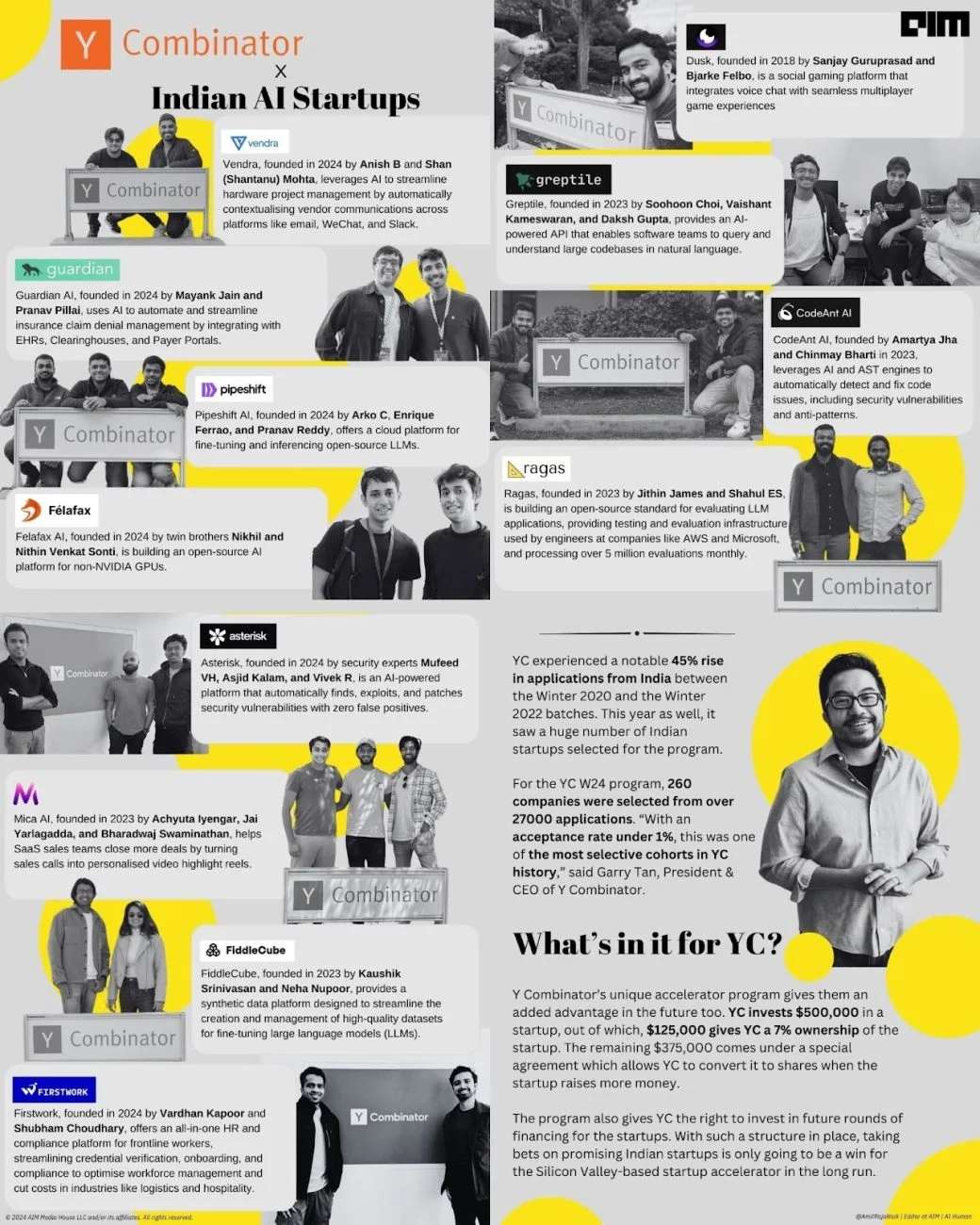
YC also experienced a 45% increase in applications from India between the Winter 2020 and the Winter 2022 batches. Notable startups like Zepto, Meesho, Razorpay, and Groww - have all hit unicorn status - and are backed by YC.
- Coforge Revenue Rises 54% as AI Engineering and Deal Bookings Gain Momentum
- Tech Mahindra Partners With SpaceXSI to Bring AI Into Software Engineering
- Infosys AI Revenue Rises 29% in Q2, FY27 Growth Guidance Cut
- LTM Launches BlueVerse Industrial AI Lab in Chennai
- Chariot Launches Speech Recognition Model for 10 Indian Languages
- Meta Expects Up To $145 Billion In Capex As AI Investments Expand