
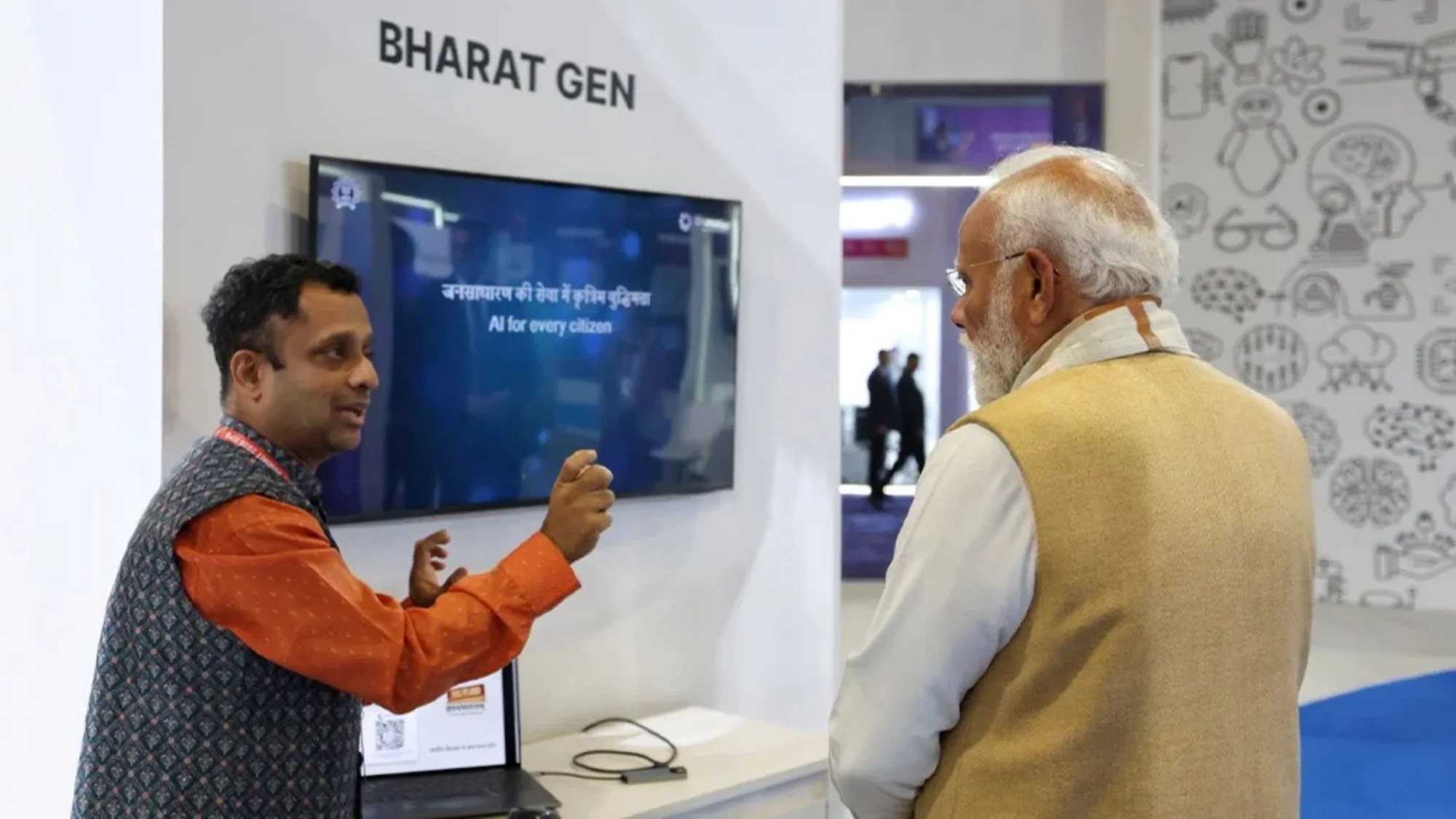
BharatGen’s model launch on the second day of the India AI Impact Summit was positioned not merely as a product unveiling, but as a national mission.
After a year of anticipation and recognition under the IndiaAI Mission as one of 12 sovereign models, BharatGen’s LLM debut was among the summit’s most closely watched moments.
Alongside Param2 17B—a sovereign multilingual AI model built to operate across 22 Indian languages—BharatGen launched Patram, described as India’s first vision-language document foundation model, designed to unlock Indic documents and power the next phase of Indic document intelligence.
It also introduced Sooktam, a text-to-speech model built on a 150M-parameter voicebox architecture. Designed to deliver expressive, speaker-conditioned output, Sooktam aims to move beyond mechanical narration towards more natural performance.
Moreover, Shrutam, a Hindi automatic speech recognition model, was also unveiled. Trained on over 2,000 hours of diverse, India-centric audio data, the model is engineered to navigate the linguistic variations and accents of spoken Hindi.
At the foundation of BharatGen’s models lies data—22 trillion tokens collected and curated through partnerships that focused not only on access but also on improving data quality and collection practices. The first phase of training preserved global knowledge, while the second deepened grounding in Indian languages and cultural contexts.
The result is a mixture-of-experts architecture with 17 billion parameters, of which 2.4 billion are active at any given time—a design choice intended to balance capability with computational efficiency. The model supports all 22 scheduled Indian languages, handles code-mixing, and demonstrates advanced reasoning across subjects, including mathematics.
“Benchmark results place the model at par with leading systems in both English and Indian languages. A 128K token version is in development to handle longer contexts, alongside reinforcement learning enhancements,” said Prof Ganesh Ramakrishnan, Principal Investigator and Board Member at BharatGen.
Innovation extends beyond text into speech, with speaker-conditioned text-to-speech systems leveraging phonetic similarities across Indian languages.
“Artificial Intelligence is no longer optional; it will shape every sphere of life. India must learn fast and learn continuously. BharatGen reflects a sovereign, whole-of-government and whole-of-science effort across IITs and ministries, building multilingual AI beyond the 22 scheduled languages, expanding data inclusion, and enabling strong public-private collaboration for national progress,” Dr Jitendra Singh, Union Minister of State for Science and Technology, said.
More than a milestone, the launch was described as the beginning of a longer journey — one that seeks to combine research excellence, policy backing and national ambition into a distinctly Indian AI future.
S Krishnan, Secretary, MeitY, opened with a candid observation. “Most large language models today are next-word predictors, trained predominantly on English text scraped from the internet. But human cognition is not text alone. It is multimodal—shaped by sight, sound, touch and action,” he reminded the audience.
India’s effort, he argued, must move beyond borrowed architectures towards multilingual, multimodal systems grounded in Indian realities.
Krishnan explained why India chose to build its own models rather than rely solely on open-source systems developed elsewhere. “Models trained largely on global internet data cannot fully represent India’s linguistic diversity or guarantee fairness in Indian contexts. Sovereignty, therefore, is not a slogan but a necessity.”
Under the IndiaAI Mission, chaired by Ajay Kumar Sood, Chief Scientific Adviser to the Indian government, and supported by multiple ministries, 12 foundation models are already underway. Among them, BharatGen stands out as a publicly funded sovereign model backed by significant government investment—and framed, at its launch, as a strategic step towards technological self-determination.

Your reaction
Discussion
What's your take on this story?
No comments yet — be the first to share your view.