Data Centres Are a ‘Necessary Evil’, Karnataka Reviewing Policy: Priyank Kharge
By C P Balasubramanyam ·
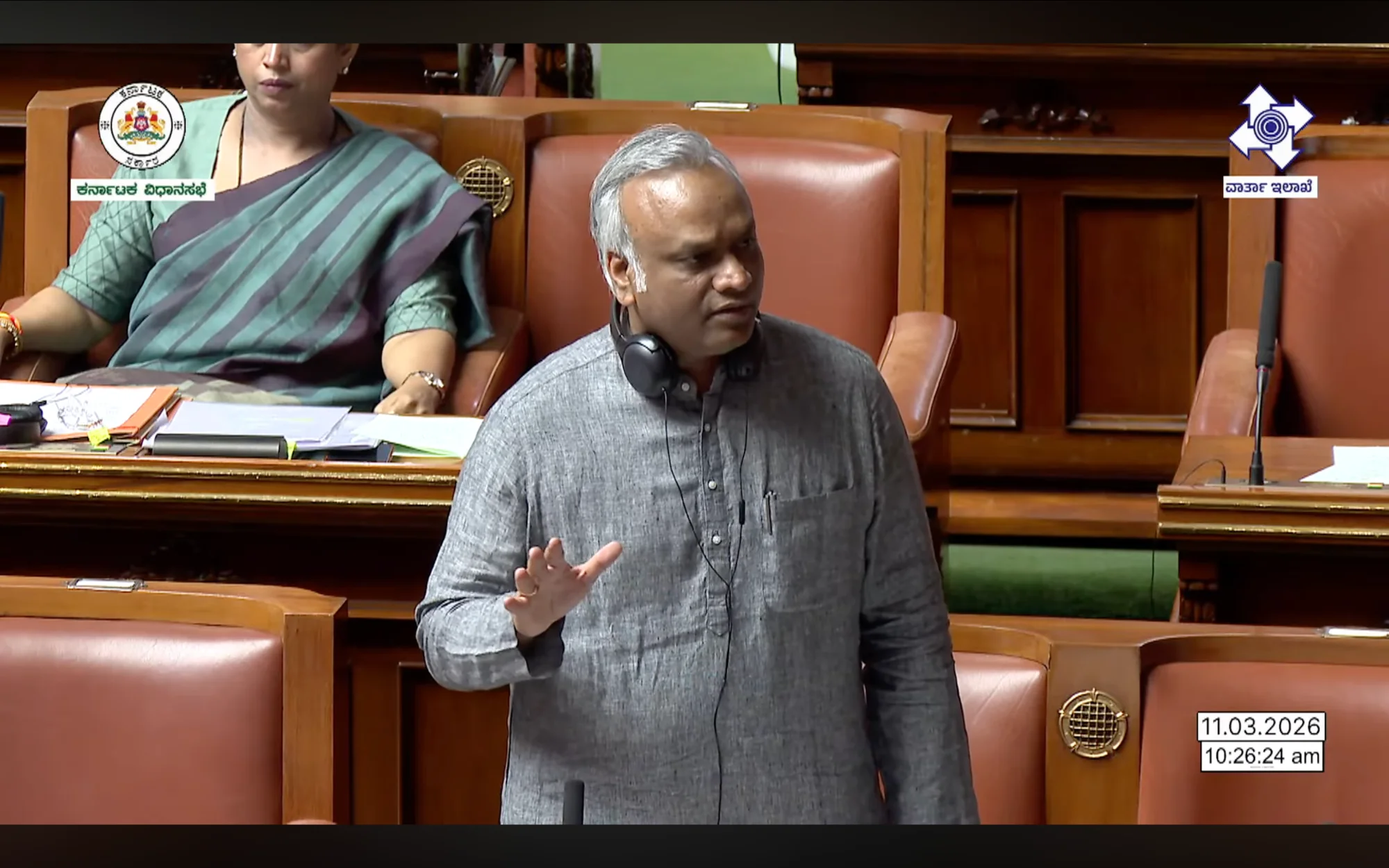
Karnataka is reviewing its data centre policy and exploring a sustainable framework for future facilities, with the state’s IT-BT Minister Priyank Kharge describing data centres as a “necessary evil” due to their high energy and water consumption.
He delivered the remarks in the Legislative Assembly during the Karnataka Budget Session after BJP MLA Dheeraj Muniraj urged the government to create a dedicated data centre park in north Bengaluru’s Doddaballapur region, which he represents.
He asserted that the absence of such provisions was forcing operators to rely on private land arrangements, creating challenges for companies. He also mentioned that cities Mumbai, Hyderabad, Chennai, and Delhi currently rank ahead of Bengaluru in terms of data centre presence.
Responding to the query, Kharge said Karnataka already has 32 operational data centres and is reassessing its policy framework.
“We already have a data centre policy. We are reviewing it as well, because it is a necessary evil,” Kharge said.
“Be it for AI, ML and emerging tech, data centres (DCs) are required. But DCs are also heavy water and energy guzzlers,” he remarked.
Kharge said the government is therefore considering a new sustainable data centre policy. “To address this, we are also considering forming a Sustainable DC policy, because our previous policy is two to three years old.”
Explaining further, Kharge said that the cost of establishing a data centre would be around Rs 70 crore per MW.
“And 1 acre is required for 1 MW of DC. And we have to spend 25 million litres per MW per year. If you ask ChatGPT five questions, 500 ml of water would go for it,” he illustrated.
“This is why we are relooking at the policy with a focus on sustainability."
However, Kharge indicated that Bengaluru may not be suited for hyperscale facilities due to water scarcity.
Instead, the government plans to focus on smaller facilities in the city. “We are focusing on edge and small, medium, and large data centres rather than hyperscalers. That is below 40 MW; beyond that, it comes under hyperscalers.”
Beyond Bengaluru, the government is also looking at coastal regions for future data centre investments.
“More than Bangalore, our focus is on Mangalore and the Karavali region because of subsea cable access,” Kharge said, adding that the state government is in discussions with private companies and the Department of Telecommunications (DoT) regarding subsea cable landing infrastructure.
“They have told us that it is not in the scope of the Union government, but if private companies can do it, they will cooperate. I am working towards it individually and through the government,” he said.
Kharge said Karnataka intends to prioritise sustainability while expanding the sector.
“We are ahead in startups, emerging tech, and FDI. With respect to DCs, we are taking the sustainable route, bringing a good policy and then accelerating,” he said.
Responding to Google investing $15 billion to build an AI hub and a gigawatt-scale data centre in Vishakhapatnam, Andhra Pradesh, and Bengaluru losing out, Kharge said it’s important to also count the cost that comes with attracting such investments.
“AP government has given ₹22,000 crore subsidy for that one project—25% land subsidy; Re 1 less for every unit of power consumed for 15 years; 10% state GST reimbursement for 10 years; 100% exemption of stamp duty; 10% capital subsidy on plant and machinery for 15 years. But the job generation in this project is just 1,500,” he remarked, adding that data centres are important, but there are better ways to attract investments.