Engineer Teaches His Dog to Vibe Code Games Using Claude Code
By Mohit Pandey ·
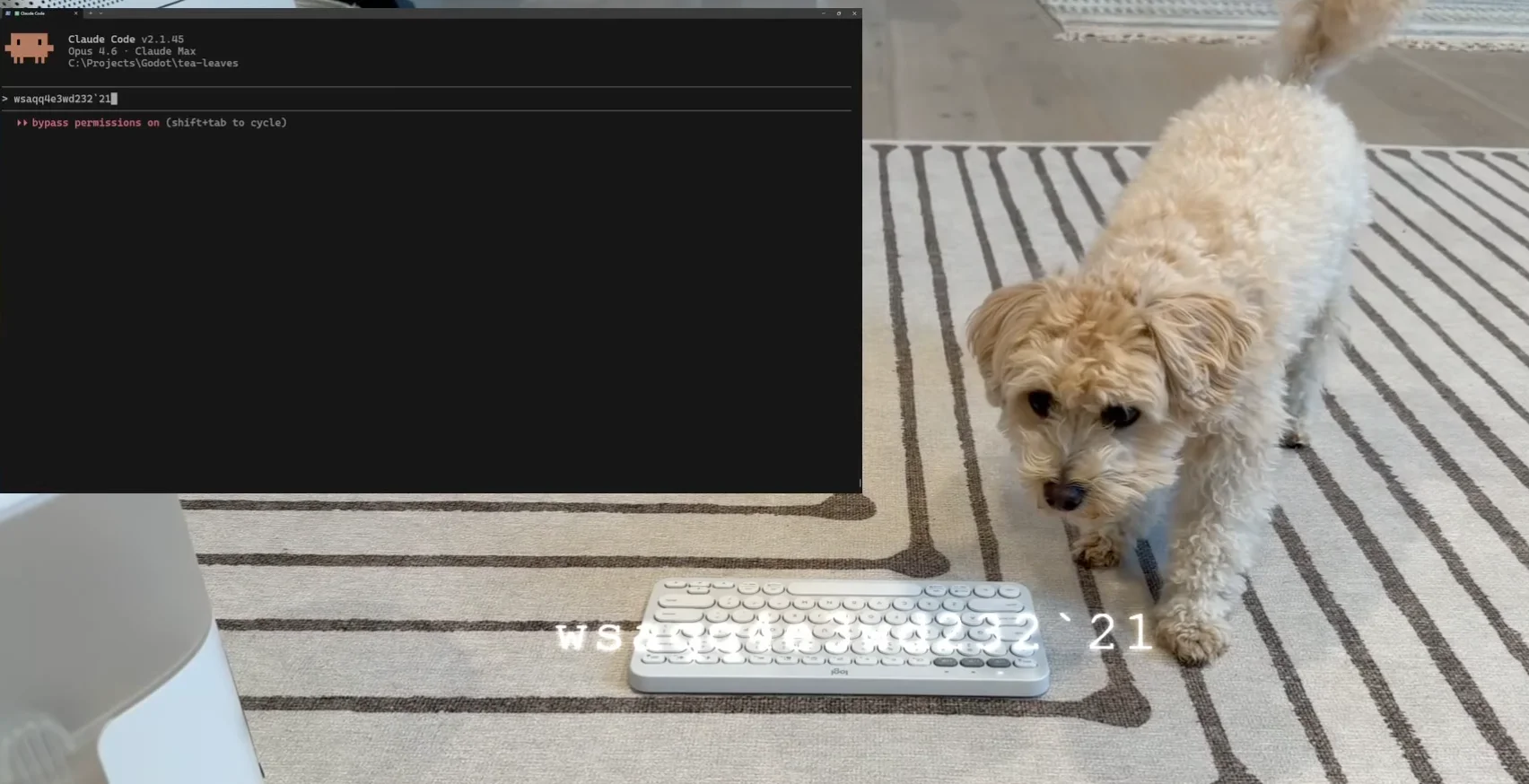
Caleb Leak, a former research engineer at Meta who was laid off in January, has built an automated AI game development system powered by his nine-pound cavapoo, Momo, turning random paw swipes into fully playable video games.
The project, now trending on Hacker News, combines Claude Code, a Raspberry Pi 5, a Bluetooth keyboard, and a smart pet feeder to produce complete Godot 4.6 games in a couple of hours.
The system works by routing Momo’s keystrokes through a Raspberry Pi that broadcasts them to a custom Rust application called DogKeyboard. The app filters out special keys and forwards the remaining input to Claude Code. Once enough characters are typed, the system automatically submits the input. When Claude finishes building or updating a game, a chime alerts the dog. A Zigbee-connected Aqara C1 smart pet feeder then dispenses treats as a reward.
All games are built in Godot 4.6, with game logic written entirely in C#.
According to Leak, each session results in a playable build that includes minimum functional requirements, such as working audio, directional controls, at least one obstacle or enemy, and a visible player character. Early builds often failed basic usability checks, prompting the addition of structured prompts and automated validation tools.
The breakthrough came from prompt engineering and automated feedback loops. The engineer instructed Claude to interpret nonsensical keyboard input as “cryptic genius game ideas” from an eccentric designer.
Instead of rejecting random strings, Claude was required to convert them into meaningful game mechanics. Over time, a checklist of mandatory features was embedded into the prompt to improve reliability.
The system also integrates automated testing tools. Claude can launch games, take screenshots, and analyse them to confirm that title screens render correctly. It can simulate gameplay by sending timed input sequences such as directional movement and firing actions.
If errors are detected, such as broken UI or missing health bar updates, Claude revises the code, rebuilds the game, and retests autonomously.
Training of Momo took approximately two weeks, with sessions lasting around 10 minutes twice daily. The dog was conditioned to associate paw swipes with a chime and food reward. The system now requires at least 16 characters before dispensing treats.
Since January, Momo has generated a range of playable titles, including rhythm games, puzzle experiments, 3D action games, and boss fights spanning six stages.
The most recent game, Quasar Saz, features dynamic audio and multiple levels. Earlier projects revealed recurring stylistic repetition, which the engineer traced to Claude’s persistent memory file. Resetting project memory before each new game increased creative variation.
The project accidentally began in December when the dog typed on a keyboard during a procedural mesh generation task. After the January layoffs at Meta eliminated the engineer’s role, he revisited the idea as a technical experiment.
Leak argues that the experiment highlights a broader point about AI-assisted development. According to him, the constraint is not idea quality but feedback quality. Game reliability improved most when Claude gained the ability to see its own output, test its own mechanics, and lint its own files.
All tools used in the system, including DogKeyboard and validation scripts, have been open-sourced. The engineer is now encouraging others to experiment with similar feedback-driven workflows, with or without a dog involved.