
Key takeaways
- The Indian government is considering a significant investment for the National Frontier AI & Compute Fund to support AI companies.
- The proposed fund aims to provide long-term capital for infrastructure essential for developing frontier AI technologies.
- Current funding options for frontier AI development in India are limited, necessitating the establishment of the new fund.
- The NFAICF will be regulated by SEBI and aims to fill the financing gap for AI research and commercialisation.
- A recent meeting included key stakeholders from the Indian AI ecosystem to discuss the fund's potential impact.
The Indian government, under the IndiaAI Mission, is exploring a ₹15,000–20,000 crore anchor investment for a proposed National Frontier AI & Compute Fund (NFAICF), according to a proposal note reviewed by AIM.
The proposed fund aims to provide long-term risk capital to India’s frontier AI companies as well as finance GPU clusters, specialised data centres, and other infrastructure required to build and scale these models. The proposal is still under consultation, with the final size, structure, governance, and role of government capital yet to be decided.
The proposed fund was discussed in a closed-door meeting on ‘Financing India’s Frontier & Compute Ecosystem’ in Delhi on September 24.
The session was hosted by Mohammed Y Safirulla K, Director, IndiaAI Mission; Sudeep Shrivastava, COO, IndiaAI Mission; and Saurabh Vijay, Chief Executive Officer, IndiaAI Mission. The meeting was attended by several Indian AI startups and AI ecosystem stakeholders, including Vivek Raghavan of Sarvam AI, PeakXV MD Rajan Anandan, and S Krishnan, Secretary, Ministry of Electronics and Information Technology.
According to a study by research institute Epoch AI, training large frontier models could cost more than $1 billion per run by 2027. The government says costs at this level could put frontier AI development beyond the reach of existing Indian venture capital and grant-based funding.
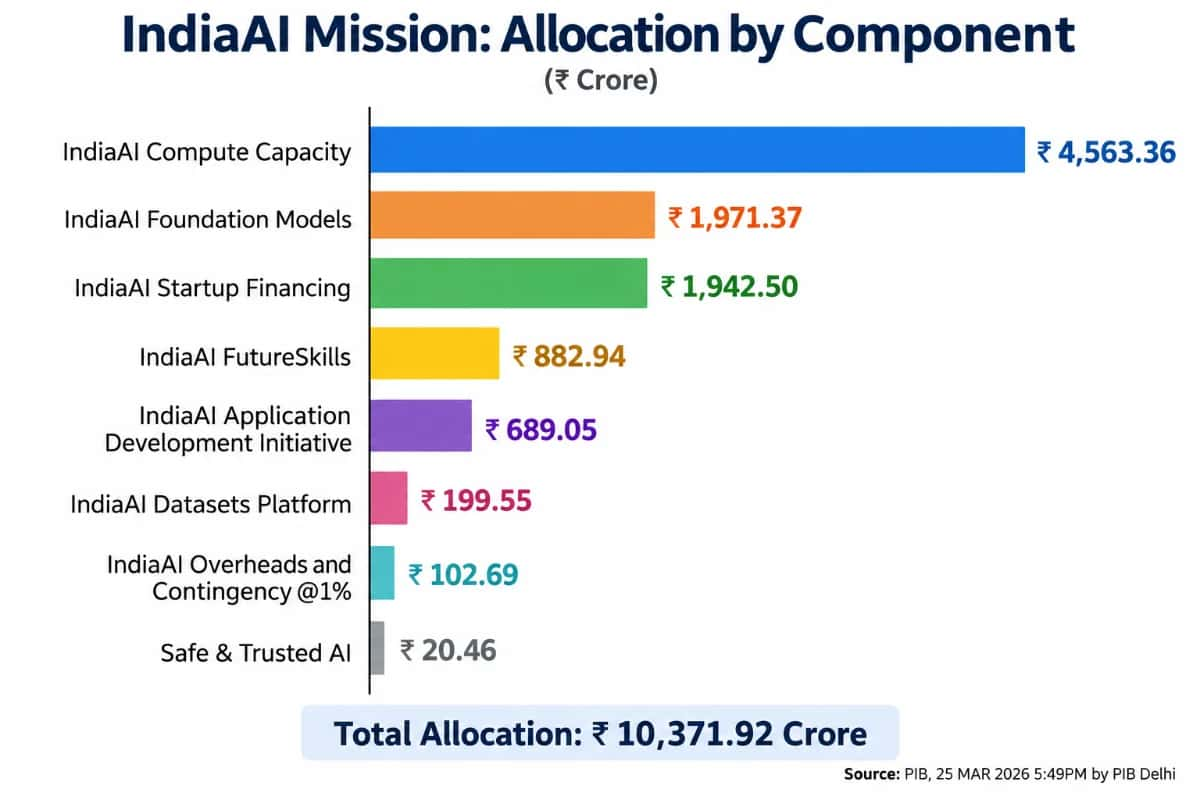
While the IndiaAI Mission offers access to subsidised compute and funding for indigenous foundation models through its ₹10,372 crore outlay, the government notes that there is currently no dedicated domestic equity vehicle to back frontier AI development.
That’s where it is trying to position NFAICF. The proposed fund intends to address the financing gap with patient capital over long-horizon research, development, and commercialisation cycles.
The NFAICF is being structured as a SEBI-regulated Category I Alternative Investment Fund. The investment decisions will be made by an Investment Committee comprising experts in technology, investment, infrastructure, and finance.
The proposed fund could consider different investment instruments, including venture and growth equity, convertible instruments, infrastructure equity, fund-of-funds commitments, and direct co-investments, depending on the company or infrastructure project.
The aim of the fund is two-fold.
The first is providing long-term capital to foundation model builders, specialised AI systems, and other strategically important AI technologies. The second is financing GPU clusters, specialised data centre capacity, and other AI compute infrastructure, while accounting for rapidly changing hardware, utilisation, power requirements, and demand visibility.
The government is considering linking compute investments to actual demand from AI companies and research institutions through capacity commitments, utilisation arrangements, or pre-agreed commercial terms. It estimates that this can reduce the risk of stranded or underused infrastructure.
The stakeholders are also examining secondary-market mechanisms that could give investors an exit without forcing companies into premature outcomes, given the decade-long investment horizons in traditional deeptech companies.
The government is also considering a follow-on and co-investment capability so the fund can participate in later rounds alongside private investors when strategically important companies need more capital.
The proposal is now being tested with frontier AI companies, data centre operators, cloud providers, GPU providers, domestic VCs, private equity funds, pension and insurance investors, multilateral institutions, and policymakers. The final design remains subject to stakeholder feedback and further assessment.
Spotted an error? Tell our editors. Read our editorial standards and corrections.