

Anthropic has revealed that the Claude desktop and the web app are now 3x faster.
This is a result of the company’s two-week sprint last month, which merged over 3,000 changes to improve the “core user experience” of Claude on desktop and the web app, based on user feedback.
“Users had been telling us it was slow, and they were right,” said Anthropic in a blog post.
The company focused on four user journeys that account for 95% of platform activity.
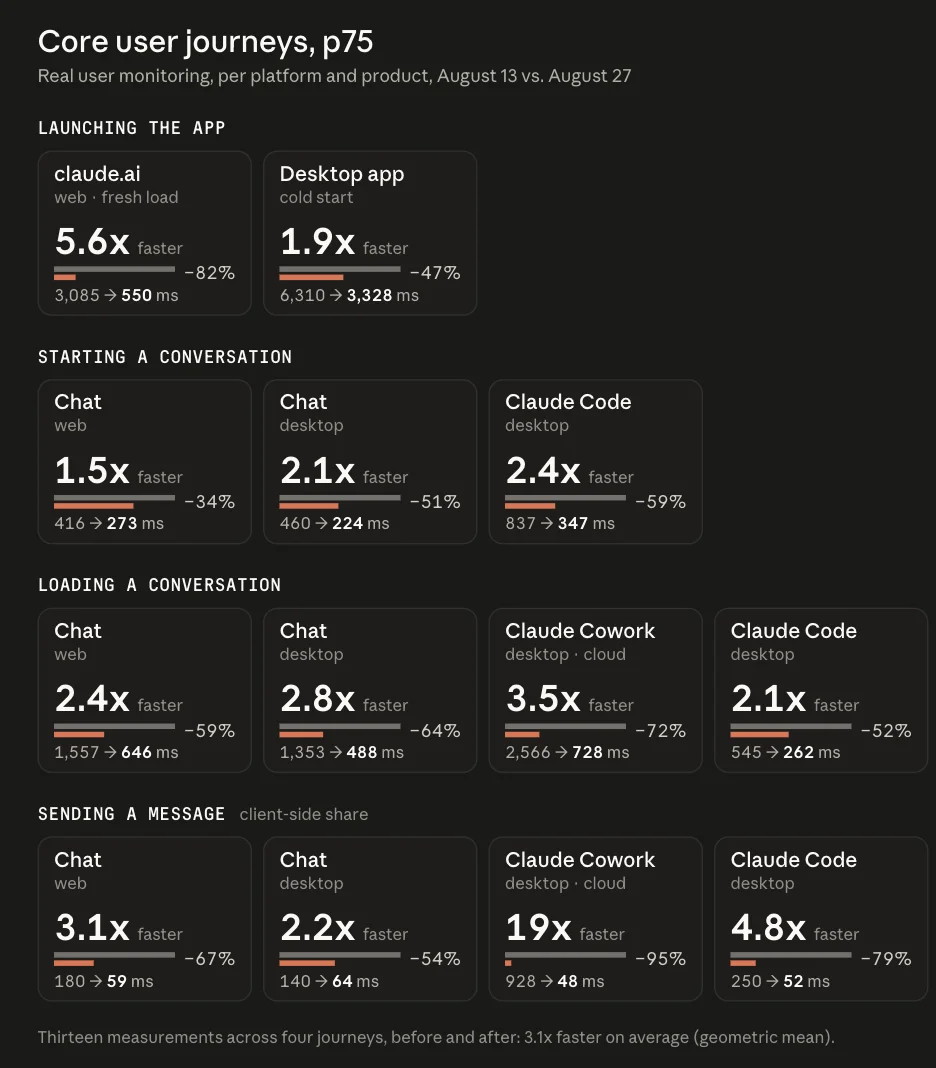
At the 75th percentile, a fresh Claude.ai load reaching a typeable page fell from 3.1 seconds to 0.55 seconds, while starting a Claude Code session dropped from 0.8 seconds to 0.3 seconds.
Loading a Claude Cowork cloud session fell from 2.6 seconds to 0.73 seconds. Anthropic estimates the improvements save tens of thousands of user-hours of waiting each day.
Among other improvements, sending a message in a Claude Cowork cloud session became 19× faster, falling from 928 milliseconds to 48 milliseconds.
For Claude Code, sending a message became 4.8× faster, dropping from 250 milliseconds to 52 milliseconds.
Anthropic says it used Claude Tag, its Slack-based tool that allows teams to delegate tasks to Claude, during the sprint.
Claude Tag can access selected tools, data and codebases and work on tasks asynchronously within Slack. It was running an internal research model comparable to Opus 5.5.
“Claude found bottlenecks, built benchmarks, shipped improvements, and watched every deploy. We steered by setting goals, making tradeoffs, and approving every change,” said Anthropic.
One key idea was to give Claude more to measure. Engineers created benchmarks for CPU instruction counts, React commits, JavaScript function calls, style recalculations and DOM mutations, then used them to test whether lab improvements translated into real-world gains. “Anything we could count, Claude could climb,” said Anthropic.
In one example, Claude found that a routine assembling a conversation’s message tree was resolving the same message ID three times. Fixing it cut CPU instructions by 48% and wall-clock time by 78%. Another optimisation reduced instructions in Claude Code’s status-line scanner by 31%, cutting execution time by 44%.
Claude also found less obvious slowdowns. In one case, it discovered that certain characters, such as em dashes and curly quotes, could make highlighting code blocks take about a second and briefly freeze the page. A roughly 20-line code change fixed the issue.
It also identified layout shifts in Claude’s sidebar that existing metrics had missed, tracing them to elements such as late-loading headers and scrollbar changes.
“Today, claude.ai and the desktop app are about 3x faster than they were in early August, and the ratchets should keep them there,” said Anthropic. “But we’re not done: the 95th percentile, other journeys, and very long conversations still have room to improve.”

Your reaction
Discussion
What's your take on this story?
No comments yet — be the first to share your view.