
OpenAI’s GPT-5.6 Sol has achieved the highest score in ReactBench, a newly introduced benchmark designed to evaluate AI coding agents on realistic React development tasks rather than synthetic programming problems.
The benchmark, released by the team behind React Doctor and React Scan, measures whether models can both implement new React features and fix existing code without introducing performance, accessibility or maintainability issues.
It evaluated GPT-5.6 through Codex CLI, Claude models through Claude Code, GLM 5.2 through GLM CLI and Kimi K2.7 Code through Kimi Code.
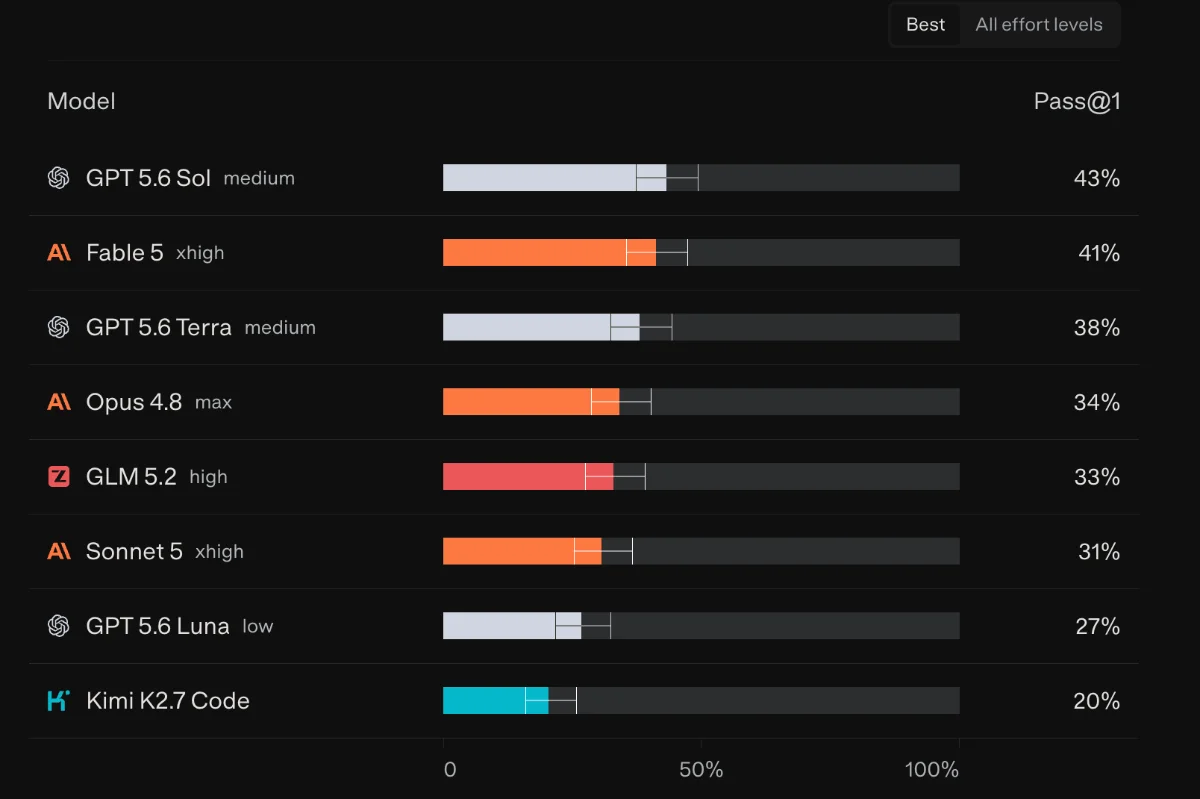
Across the benchmark’s 51 curated tasks, GPT-5.6 Sol achieved a pass@1 score of 43%, narrowly ahead of Anthropic’s Claude Fable 5 at 41%.
Unlike conventional coding benchmarks, ReactBench does more than verify test-suite results. It also uses React Doctor, an open-source verifier with more than 400 rules that cover React-specific correctness, performance, accessibility and maintainability.
Models must pass hidden behavioural tests without introducing new React Doctor issues.
The researchers said the benchmark remains challenging for current frontier models. Even GPT-5.6 Sol’s best configuration solved fewer than half of all benchmark tasks.
They also cautioned that “the differences among the leading configurations are too small to identify a clear winner with confidence”, despite GPT-5.6 Sol recording the highest observed score.
The report also compared inference costs. Across evaluated configurations, Claude Fable 5 averaged approximately $7.97 per rollout, compared with $1.37 for GPT-5.6 Sol, making Fable about 5.8 times more expensive on average.
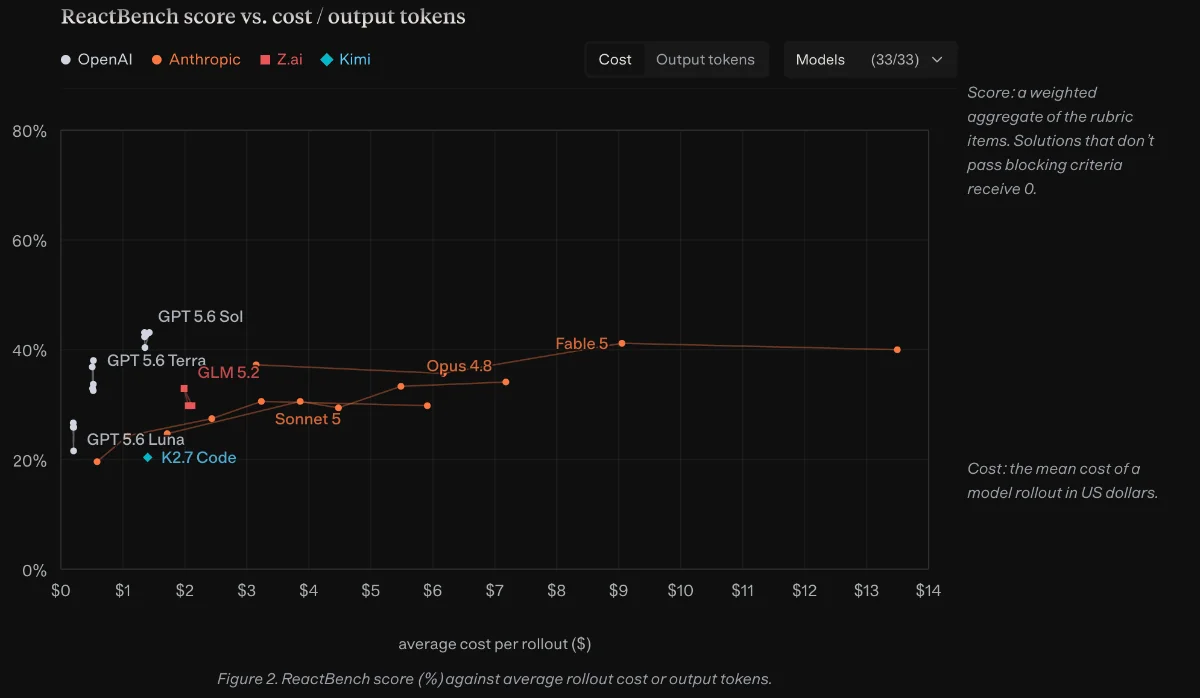
The authors highlighted GPT-5.6 Terra as offering the strongest cost-performance trade-off, scoring 38% while costing roughly one-third as much as Sol’s highest-performing configuration.
Beyond ranking models, the benchmark analyses the kinds of mistakes coding agents make. Across 4,455 ‘Write React’ trials, the evaluated models introduced 1,194 graded React issues, with bugs, including security-related findings, accounting for 77.5% of them.
The most common errors involved incorrect list rendering and misuse of React Hooks. The study also found that models typically failed differently depending on the task: feature implementation tasks were more likely to fail behavioural tests, while refactoring tasks more often passed functionality tests but introduced new React quality issues.
ReactBench’s dataset is built from merged pull requests across open-source React repositories. The released version contains 51 tasks derived from more than 23,000 candidate pull requests after automated filtering, manual review and validation.
To reduce potential benchmark contamination, most tasks were sourced from repositories with fewer than 20,000 GitHub stars and from pull requests merged after February.

Your reaction
Discussion
What's your take on this story?
No comments yet — be the first to share your view.