
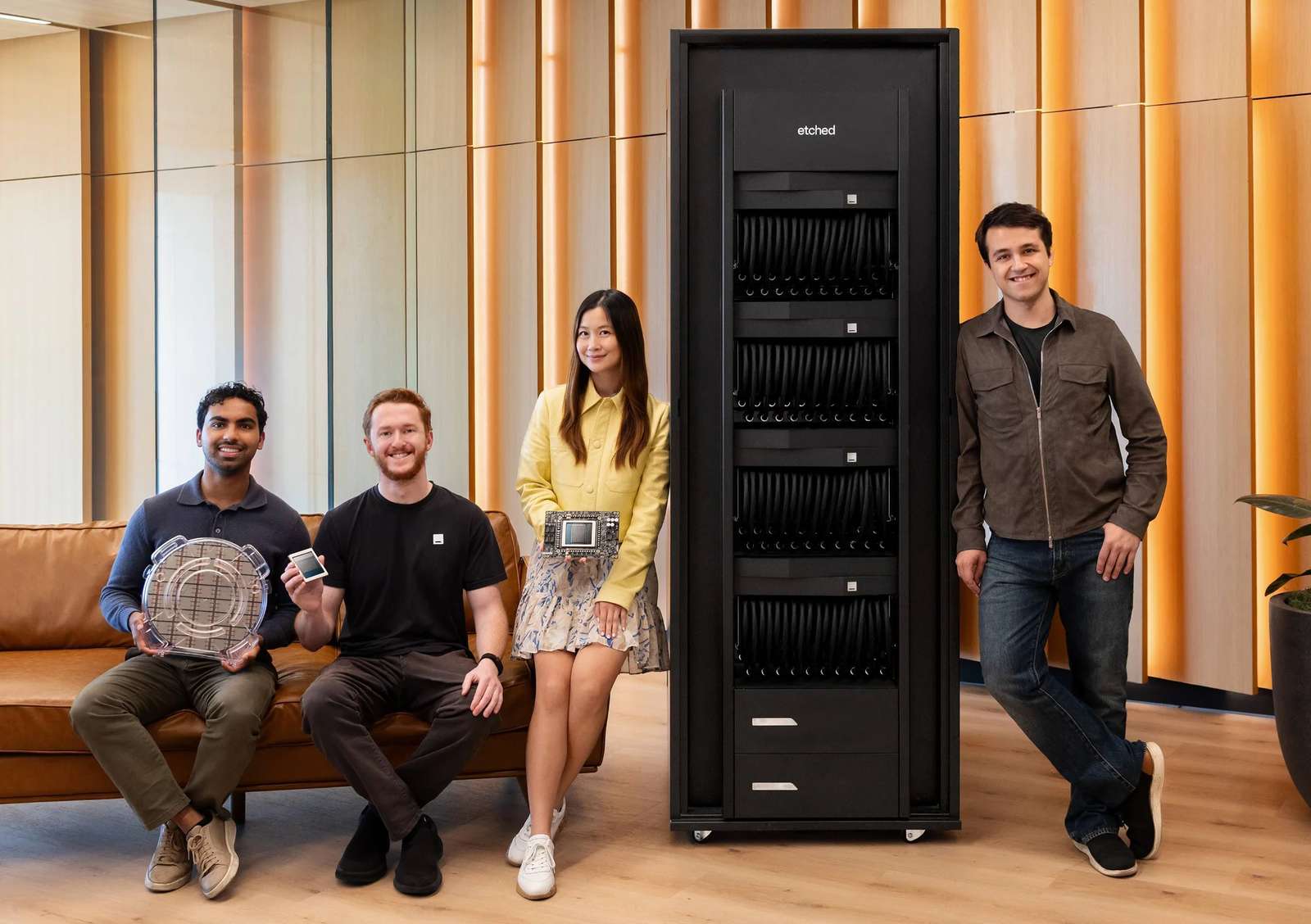
AI hardware company Etched has shipped its first inference rack to trading firm Jane Street and raised $700 million in a recent funding round, the company said in a statement. Jane Street led the round, valuing Etched at $21 billion.
The San Jose-based startup said the funding will help accelerate production as it works towards gigawatt-scale deployment. The round includes Kleiner Perkins, Sequoia Capital, Andreessen Horowitz, Peter Thiel, Tiger Global, and Blackstone.
Jane Street’s investment follows its testing of Etched’s chip. “We tested the chip and are pleased with the early results,” the trading firm said.
“Etched’s unique approach to inference delivers the precision we will need to support our most demanding workloads,” Jane Street added. The firm said it now has its own Etched rack running in its data centre.
We've raised $700M at a $21B valuation from Jane Street, Kleiner Perkins, Sequoia, A16Z, Peter Thiel, BCV, and Blackstone.
We're also excited to share that we've shipped our first rack to Jane Street. pic.twitter.com/MFlF2xSw0B
— Etched (@Etched) August 18, 2026
The startup said less than 1% of the world has access to frontier models. It argues that wider access will require new hardware designed for large-scale inference. Its latest funding gives it capital to turn that thesis into deployed infrastructure. Jane Street’s first rack also gives Etched a live customer deployment after months of chip development and testing.
The move comes as AI infrastructure companies focus more heavily on inference. Investors are increasingly looking at the cost and energy required to serve models at scale.
Etched now faces the challenge of turning its specialised architecture into a larger production fleet. The company said its next phase will require factories, supply chains, and software to operate that fleet.
“The racks won’t build themselves,” Etched said as it invited engineers to join the company’s expansion.
The shipment marks a shift for Etched, which has built its business around specialised hardware for transformer inference. Its approach involves hardcoding the transformer architecture into silicon rather than relying on general-purpose GPUs.
The strategy targets inference, where AI models process user requests after training. Etched has argued that specialised hardware can improve performance and efficiency by removing some of the flexibility built into GPUs.
The company’s earlier work centred on Sohu, its transformer-specific ASIC. Etched positioned the chip as an alternative to NVIDIA’s GPUs for transformer workloads. Its latest announcement shows the company moving that strategy into customer deployments.
Etched’s valuation has also risen sharply. The company reached a $10.3 billion valuation in July after raising $300 million. The latest round more than doubles that valuation within weeks.
The company now prepares to scale beyond its first customer rack. The next phase will involve new factories, global supply chains, and fleet software.
It also launched the world’s first-ever transformer supercomputer, burning transformer architecture directly into the core of chips. It said the system achieved unprecedented performance metrics, notably in tokens per second.
The startup also plans to develop self-improving kernel agents as it scales its infrastructure and aims to run inference at gigawatt scale.
- Amazon Warns Engineers Against AI Productivity Traps in Latest Memo
- Gnani AI Launches Prisma v3.0 Speech Recognition Model for 10 Languages
- Venttup Raises $3 Million To Expand Precision Manufacturing
- Articul8 Launches Bivia To Help Enterprise AI Agents Make Decisions
- NVIDIA Launches Open-Weight Transcription Model for 40 Languages
- Sarvam AI Rolls Out Indus Cowork to 2,500 Maharashtra Govt Officials