
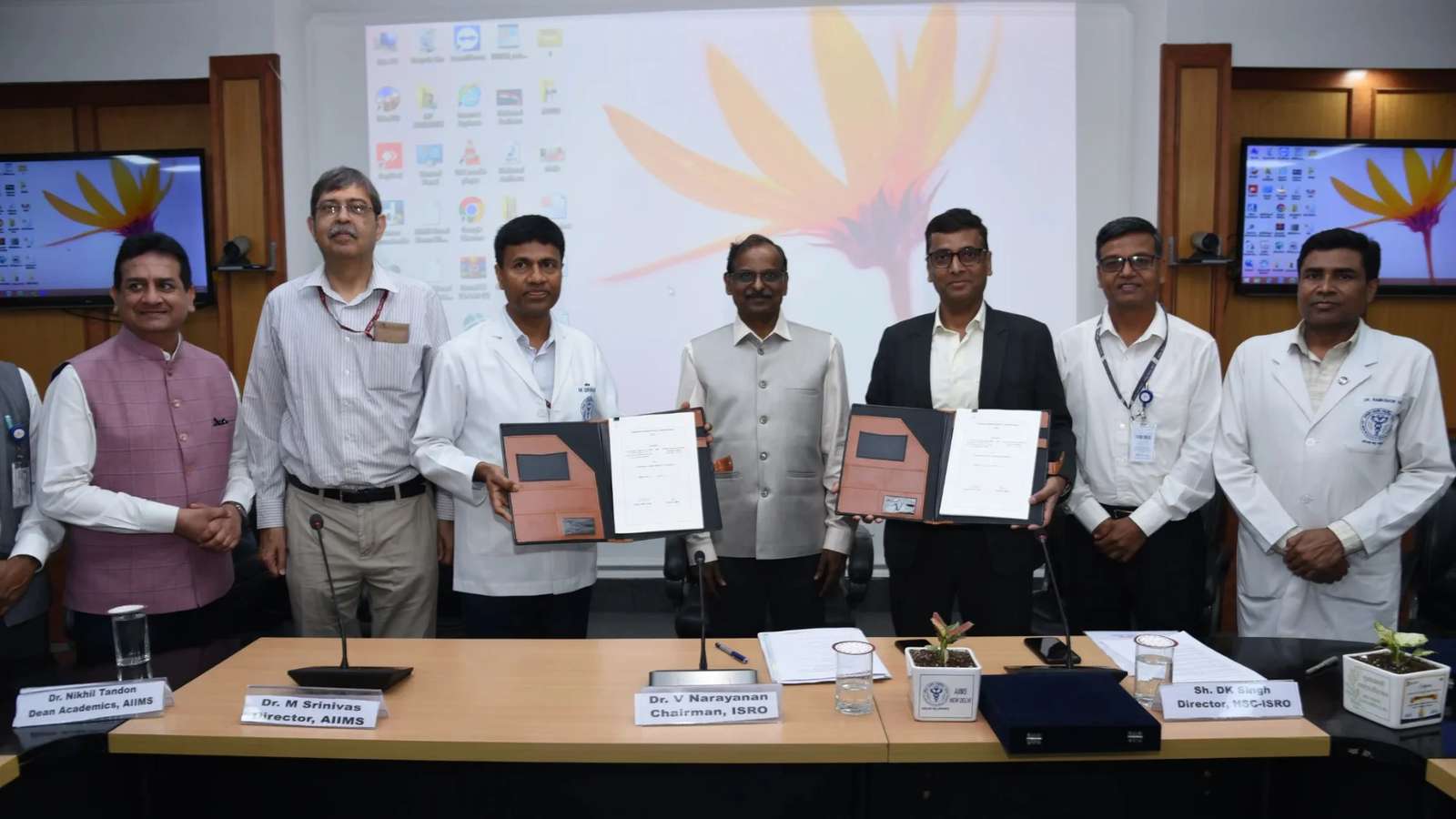
The Indian Space Research Organisation (ISRO) has signed a memorandum of understanding with the All India Institute of Medical Sciences (AIIMS), New Delhi, to collaborate on space medicine and research.
The agreement aims to support studies that improve human health, performance, and safety during space missions.
The MoU was signed by Dinesh Kumar Singh, Director of the Human Spaceflight Centre at ISRO, and Dr M Srinivas, Director of AIIMS.
ISRO and AIIMS will conduct ground and space-based studies to address medical challenges during long-duration missions. These include future missions linked to the Bharatiya Antariksh Station and crewed missions to the Moon.
The partnership will focus on building expertise in space medicine and developing medical devices, procedures, and protocols. These efforts aim to maintain human health and performance in extreme space environments and microgravity.
Researchers will study areas such as human physiology, behavioural health, immunology, and the gut microbiome. The collaboration will also examine neuroscience, nutrition, metabolic health, and musculoskeletal atrophy linked to microgravity.
The programme will also explore infectious disease control and countermeasures for human health in space. ISRO said the work could also contribute to healthcare research on Earth.
V Narayanan, Chairman of ISRO and Secretary of the Department of Space, witnessed the signing. Through the collaboration, both institutions aim to strengthen interdisciplinary research and long-term cooperation.
The initiative will support India’s human spaceflight programme and expand research opportunities for scientists in the country.
- In a Stunning Fall, Jensen Huang Resigns as NVIDIA Chief After 33 Years
- Space Tech Startup Astrome Bags ₹64 Cr RDI Fund for AI Satellite Network
- Siemens Wants to Continue NVIDIA Partnership Even If Jensen Huang is Ousted
- LTM Integrates AI Tool to Fix Quantum Computing Errors on IBM
- Chariot Launches Multilingual TTS Model with Support for 11 Indian Languages
- Lenovo Unveils New AI, HPC Servers With AMD’s 6th Gen EPYC Processors