
Z.ai has revealed that the mystery Ox Alpha model that surged to the top of model usage charts over the last few days is GLM-5.3-Flash, a 320-billion-parameter multimodal model with 18 billion active parameters.
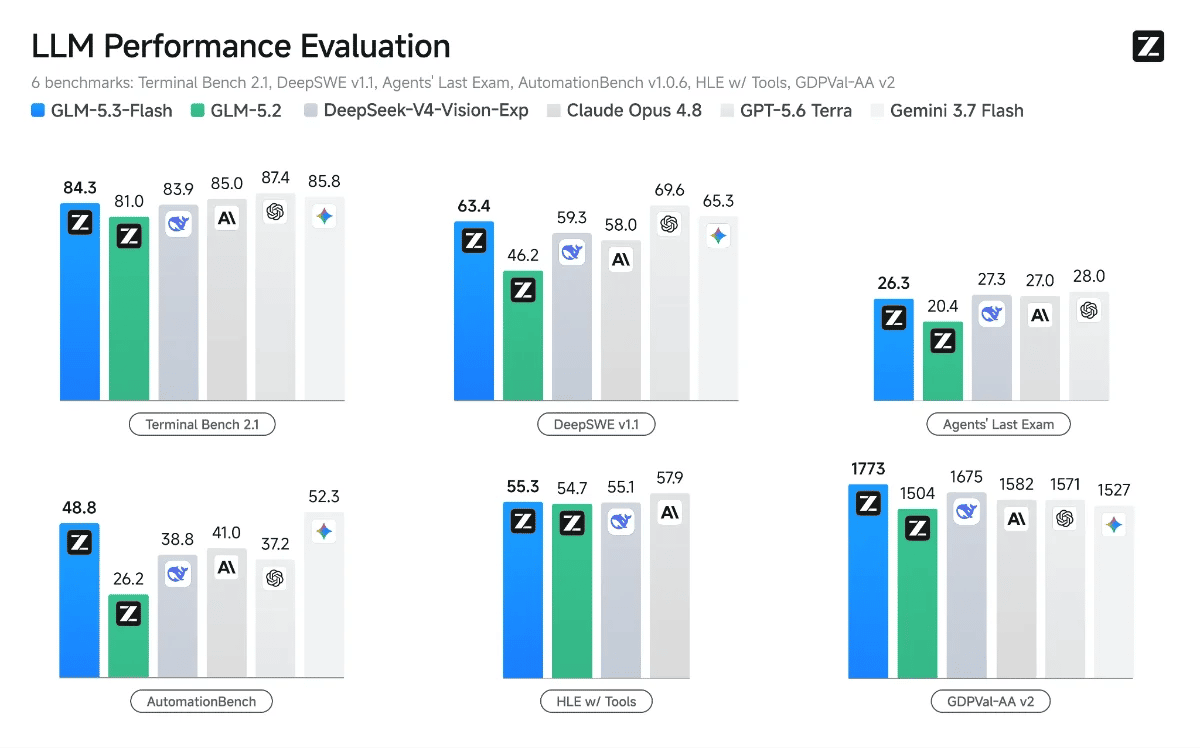
The company says it outperforms GLM-5.2 across coding and agentic benchmarks while approaching Claude Opus 4.8 on some tests.
The model was released anonymously as Ox Alpha on OpenCode and OpenRouter before Z.ai’s announcement.
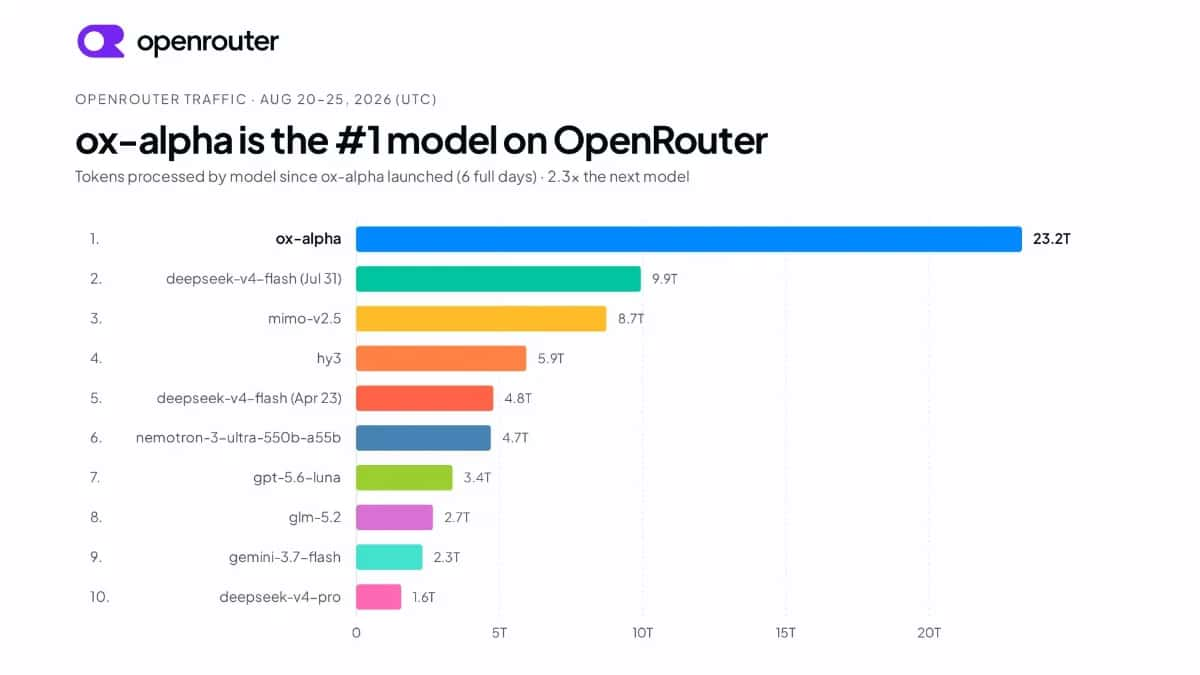
Z.ai said the company used the anonymous deployment to gather real-world user feedback ahead of launch, and that Ox Alpha quickly became the most popular model of the week
OpenRouter said Ox Alpha processed more than 20 trillion tokens in six days, making it the largest model launch on the platform by token volume.
The model was offered free of charge during the preview, with OpenRouter listing a 1.05-million-token context window.
The price-to-performance ratio was a major part of Ox Alpha’s appeal during its anonymous preview: developers were getting frontier-level coding and agentic performance for free.
Z.ai’s disclosure now puts a concrete number behind that proposition.
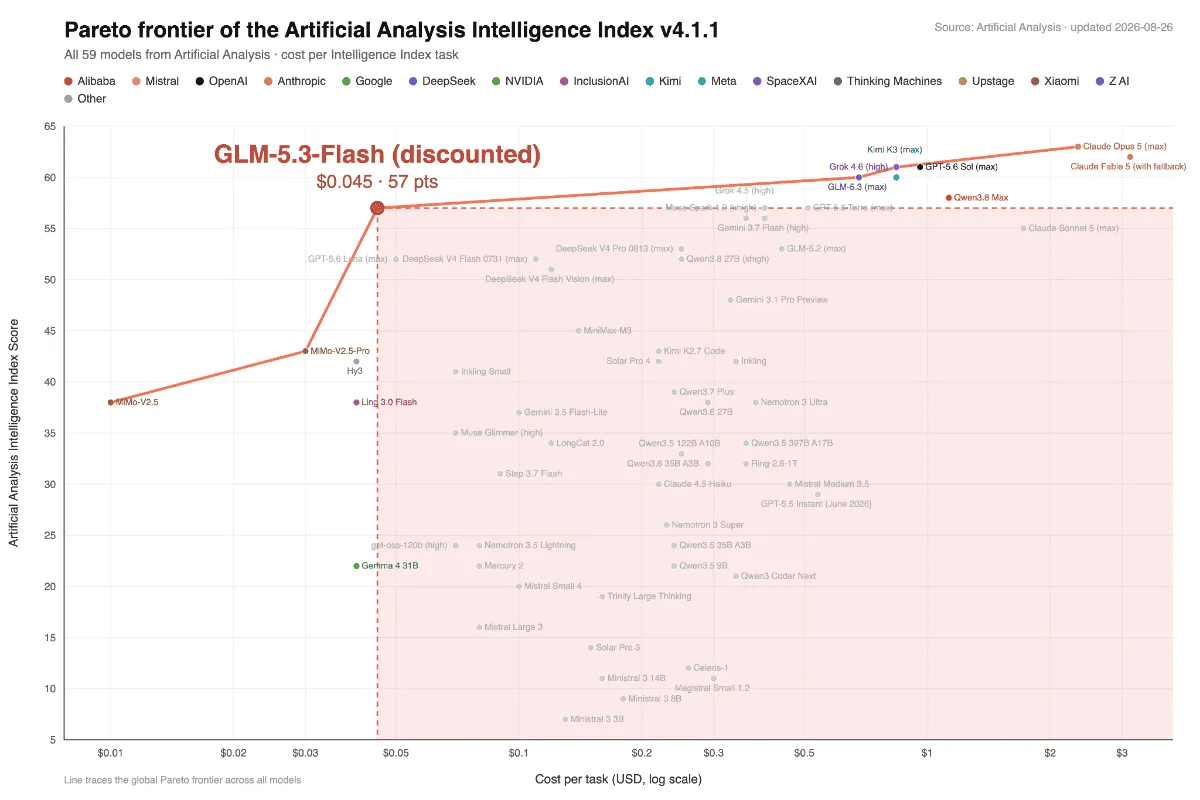
The company says GLM-5.3-Flash scores 57 on Artificial Analysis’ Intelligence Index, at a discounted cost of just $0.045 per task, putting it in a markedly different price-performance bracket from models such as Claude Opus 4.8 and GPT-5.6.
Z.ai also said it has served GLM-5.3-Flash over the past week on a large cluster of domestically developed Chinese AI accelerators, with the deployment spanning tens of thousands of chips.
The company built a dedicated inference engine on top of SGLang and reported a threefold improvement in end-to-end serving performance compared with its initial baseline on the same hardware.
Z.ai said the resulting system achieved hardware efficiency and per-token costs comparable with mainstream NVIDIA GPUs. “This demonstrates that Chinese chips can support frontier-model inference efficiently and economically at scale,” said the company. Z.ai did not identify the specific Chinese accelerators used to serve the model.
However, this claim arrives against a backdrop of US restrictions designed to limit China’s access to advanced AI computing hardware.
US export controls have imposed licensing requirements on high-performance AI chips and related technologies for China.
Washington currently allows exports of certain lower-performance or otherwise restricted Nvidia AI accelerators, including the H200, to approved Chinese customers on a case-by-case licensing basis, subject to security and supply conditions.
NVIDIA’s more advanced Blackwell and upcoming Vera Rubin systems remain restricted from the Chinese market under US export controls
Z.ai lists the model at $0.15 per million input tokens and $0.50 per million output tokens, with OpenRouter currently applying a promotional 50% discount to the input rate.
The model is also available as open weights under an MIT licence on Hugging Face, allowing developers to download and run it themselves rather than accessing it only through an API.
Z.ai, formerly known as Zhipu AI, is a Beijing-based Chinese AI company that became the world’s first publicly listed large-language-model developer when it went public on the Hong Kong Stock Exchange in January.
Its current flagship is GLM-5.3, a 744-billion-parameter model designed for coding, agentic tasks and long-context workloads.
- AI Productivity to Add $28 Billion to $84 Billion to India's GDP: Cognizant Study
- OpenAI's Codex Helps in Aerodynamic Engineering for Mazda
- Bengaluru Accounts for 34% of India's FDE Talent: Report
- 84% See AI Productivity Gains, but Only 10% Allow Agent Autonomy: TCS Study
- Snowflake Introduces Business Ontology, Cortex AI Gateway to Bring AI Agents Into Enterprise Workflows
- Three Members Behind Claude Code Leave Anthropic Within 10 Days