

OpenAI has launched GPT-6 Sol and GPT-6 Luna, two lower-cost models built on the same technical advances as its GPT-6 Astra flagship.
The AI giant has also cut the API prices for the new models by 50% compared with the promotional pricing of their predecessors, the GPT-5.6 Sol and Luna.
GPT-6 Sol is priced at $2 per million input tokens and $10 per million output tokens, while GPT-6 Luna costs $0.10 per million input tokens and $0.50 per million output tokens.
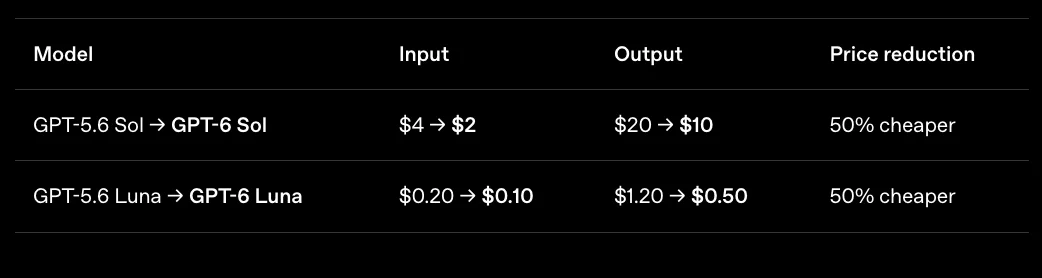
The company said improvements to inference and prompt caching let it reduce serving costs while maintaining stronger performance across professional workflows, coding, computer use, and factuality.
GPT-6 Sol is positioned for complex coding and agentic workloads, while Luna is designed for higher-volume tasks where cost is a larger constraint. Both models support a 1.05-million-token context window and up to 128,000 output tokens through the API.
On AutomationBench, which tests AI agents on end-to-end business workflows across sales, marketing, finance, support, and HR, OpenAI said GPT-6 Sol outperformed Claude Opus 5 and Claude Fable 5.1 while costing substantially less per task.
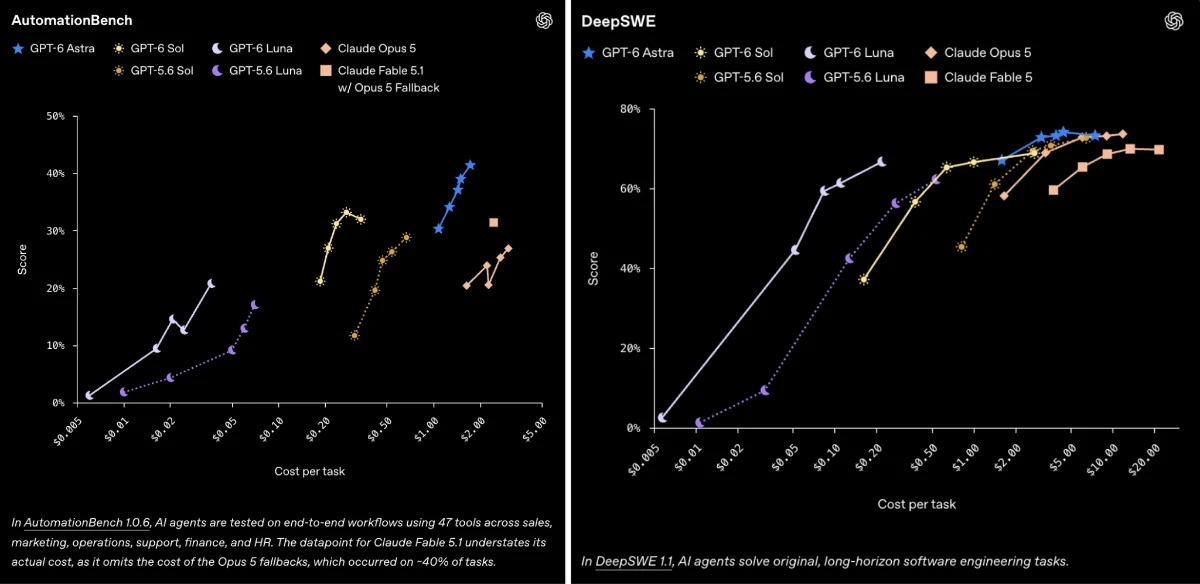
On DeepSWE, a benchmark for long-horizon software-engineering tasks in real codebases, Sol performed close to Claude Fable 5 while costing about 80% less per task.
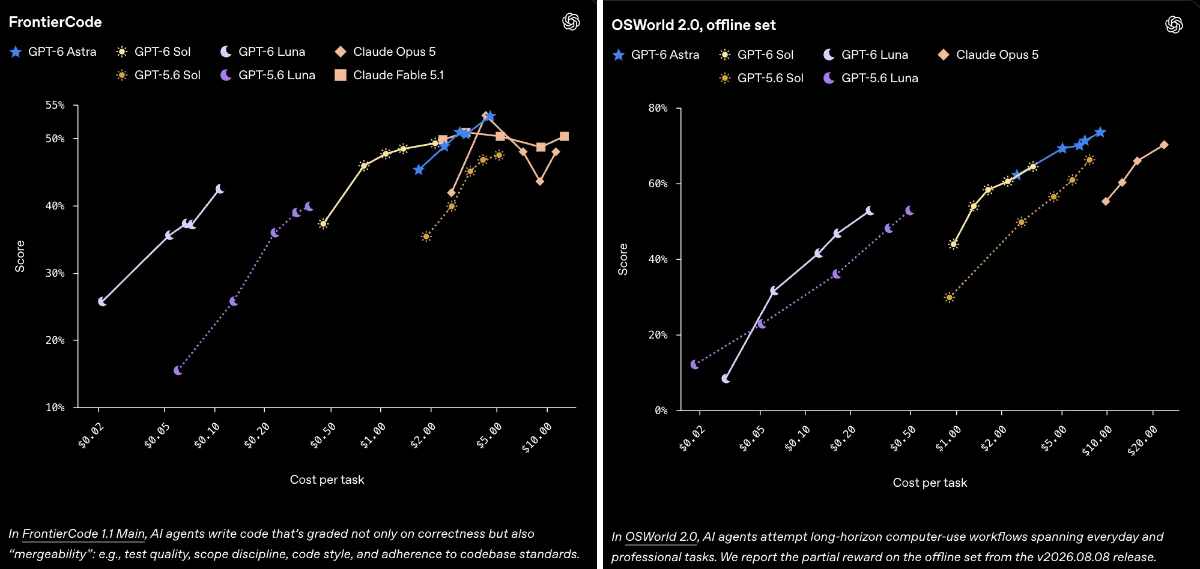
OpenAI also reported similar cost efficiencies on other benchmarks, including the OSWorld 2.0 computer use tests, FrontierCode, Agents’ Last Exam, and more.
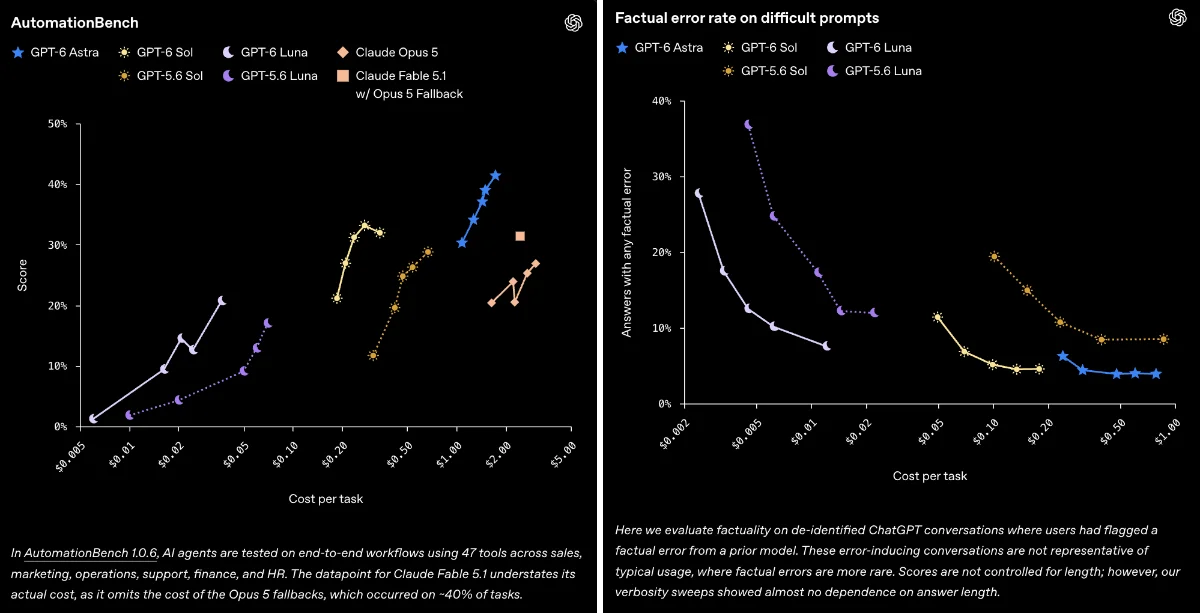
OpenAI is also increasing the economics of long-running agents through improved prompt caching.
“We’ve improved prompt caching for GPT‑6 to deliver higher cache hit rates by default, helping agents reuse more context, respond faster, and benefit from discounts of 90% on cached input-token reads,” said the company.
GPT-6 Sol and Luna are available through the API as gpt-6-sol and gpt-6-luna, and are being rolled out in ChatGPT Work and Codex for Plus, Pro, Business, Enterprise, and Edu users. Free and Go users can access Luna through the desktop app. OpenAI is rolling out the models gradually in ChatGPT.
The launch comes shortly after OpenAI introduced GPT-6 Astra, leaving the company with a three-model GPT-6 family spanning its highest-capability model and lower-cost models intended for broader agentic and high-volume workloads.
However, these models are also being released at the same time as Anthropic's Claude 5.5 Opus. Opus 5.5 offers slightly higher benchmark performance than GPT-6 Sol, albeit at a significantly higher price.
On FrontierCode, Opus 5.5 scored 51.4% at $2.25/task, versus Sol’s 48.4% at $1.37. On AutomationBench, Opus 5.5 scored 34.4% at $0.86, versus Sol’s 33.2% at $0.27.

Your reaction
Discussion
What's your take on this story?
No comments yet — be the first to share your view.