

Anthropic has launched Claude Opus 5.5, which delivers performance comparable to Claude Fable 5.1 on most work while costing 40% less to run than Opus 5.
The model is available immediately across Anthropic’s platforms, as well as Amazon Web Services, Google Cloud, and Microsoft Azure.
Anthropic is also increasing five-hour usage limits for Pro, Max, Team, and seat-based Enterprise subscribers, and introducing a rate-limit reset that users can save and use when needed. It did not disclose the new limits.
“Opus 5.5 is particularly good at long and sprawling jobs like codebase-wide migrations and audits,” Anthropic said in a blog post.
In one example the company cited, an early tester used Opus 5.5 to complete a migration involving a 680,000-line codebase in less than a day. Another tester used it to audit and fix a 200,000-line codebase in under three hours, while Opus 5 took more than 20 hours and used 2.5 times as many tokens.
The company also reported improvements on software optimisation tasks. When asked to reduce load times across every page of a web application, Opus 5.5 succeeded in 39 of 40 attempts, while Opus 5 generally produced smaller improvements and, in some cases, changed application behaviour, the company revealed.
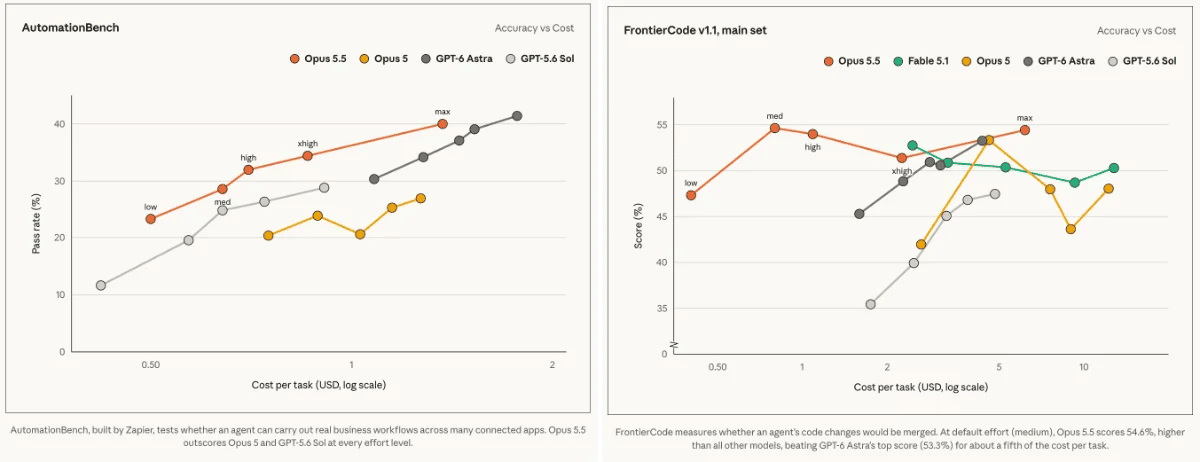
On Anthropic’s benchmark suite, Opus 5.5 leads its comparison set on agentic coding, knowledge work, and computer-use evaluations.
It scores ahead of Fable 5.1 and Opus 5 on Terminal-Bench for sandbox state verification, code quality-focused FrontierCode, and CursorBench evaluating IDE efficiency, and leads the GDPval-AA knowledge work evaluation. OpenAI’s GPT-6 Astra remains ahead on Anthropic’s scientific-research benchmark and narrowly leads its business-workflow evaluation.
The company said Opus 5.5 can match GPT-6 Astra on Terminal-Bench at roughly two-fifths of the cost per task, while exceeding Astra on FrontierCode at around one-fifth of the cost. On CursorBench, it said Opus 5.5 outperforms GPT-5.6 Sol at about a third of the cost.
However, Anthropic acknowledged limitations in its evaluation methods. “Building evaluations that reliably catch every failure prior to deployment remains an unsolved problem,” the company said.
Opus 5.5 costs $4 per million input tokens and $20 per million output tokens, down from $5 and $25 for Opus 5. Cache reads have fallen from $0.50 to $0.20 per million tokens. Anthropic also said the model generates output more than 30% faster than Opus 5.
The model includes an action-screening classifier, an auditable open-source sandbox, and code review designed to catch vulnerabilities before changes are merged.
Anthropic said Opus 5.5 is more resistant to prompt injection than Opus 5 across coding, tool use, computer use, and web browsing. Its automated behavioural audit, covering nearly 2,000 scenarios, found improvements across most measures of misaligned behaviour.
Anthropic said there was an 85% reduction in Opus 5.5 attempting to circumvent containment compared with Opus 5 and Claude Mythos 5.1, while noting that models can sometimes recognise when they are being evaluated.
Because of its capabilities in cybersecurity and biology, Opus 5.5 launches with safeguards similar to Fable 5.1. Most cybersecurity tasks will be routed to Opus 4.8, while vetted organisations can apply for access to biology research. Anthropic also plans to expand its Cyber Verification Program to Opus 5.5.
Opus 5.5 also includes Anthropic’s preserved-thinking safeguard, which prevents API users from modifying Claude’s previous context to extract its reasoning at scale. Claude Sonnet 5.5 and Haiku 5.5 are scheduled to follow in the coming weeks.
The model is also being released at the same time as OpenAI's GPT-6 Sol and Luna.
Opus 5.5 offers slightly higher benchmark performance than GPT-6 Sol, albeit at a significantly higher price.
On FrontierCode, Opus 5.5 scored 51.4% at $2.25/task, versus Sol’s 48.4% at $1.37. On AutomationBench, Opus 5.5 scored 34.4% at $0.86, versus Sol’s 33.2% at $0.27.
- Mphasis Raises FY27 Growth Outlook After 9.2% Dollar Revenue Growth in Q2
- Adobe’s CX Enterprise Coworker Gets Embedded Within Leading AI Platforms
- Sarvam AI Appoints Ex-Google Cloud India MD Sashikumar Sreedharan as President and CBO
- EXL Acquires Aimpoint Digital, Adds 250 AI and Data Experts
- Coforge Joins SpaceX Network to Develop Industry-Specific Grok Applications
- India’s Office Workforce to Reach 48 Mn by 2030 as AI Reshapes Demand: Report