Key takeaways
- Anticipate the emergence of quantum internet infrastructure in India within three years.
- Prioritize early applications of quantum technologies in secure communications and sensing.
- Recognize quantum sensing as a transformative opportunity for healthcare and energy sectors.
- Focus on building a skilled talent base in quantum technologies through university and industry collaborations.
- Emphasize the environmental benefits of quantum sensing technologies for sustainable energy consumption.
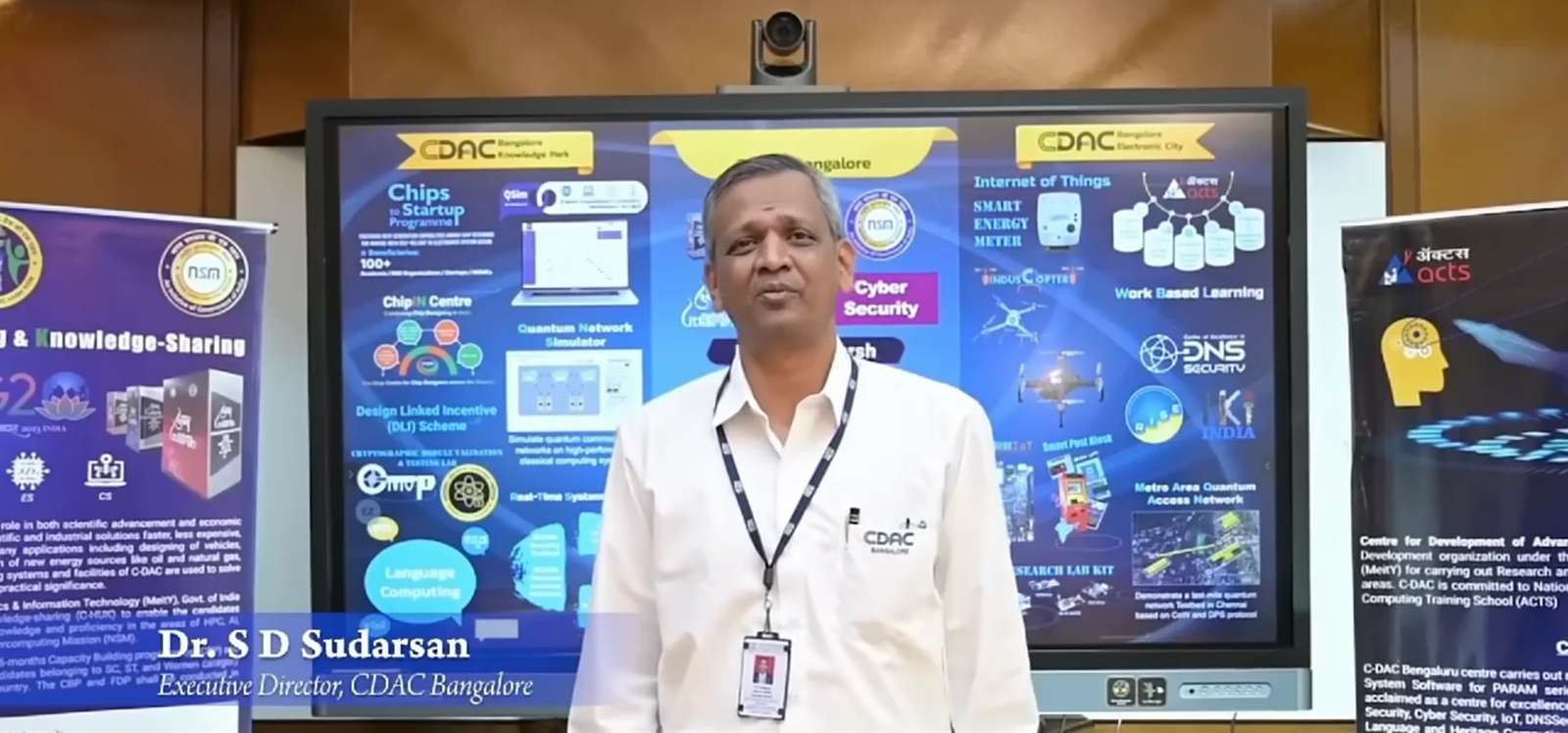
India could see early applications of quantum technologies in secure communications, sensing, and cryptography, while a quantum internet may emerge within the next three years, according to SD Sudarsan, Executive Director at the Centre for Development of Advanced Computing (C-DAC).
Speaking at the launch of a quantum hub at the Manipal Academy of Higher Education (MAHE) on March 5, Sudarsan said that while quantum computing receives the most attention, communication technologies are likely to be the first to see real-world deployment.
“While computing seems to be the most talked about, the initial applications are likely to be on the communication side. Quantum key distribution networks are already being developed so that a secure quantum internet can become possible in a short period,” he said.
He added that India could witness the emergence of quantum internet infrastructure within a few years. “Three years down the line, we are sure of having the way fibre came to the floor, we may have a quantum internet coming up,” Sudarsan said.
Sudarsan also highlighted the growing importance of quantum sensing as another major opportunity area. According to him, the technology could impact sectors ranging from healthcare to energy and materials science.
“Quantum sensing is going to be a game changer because it will be green energy and clean in terms of energy consumption. It will require expertise from medical science, material science, physics, chemistry and several engineering disciplines,” he said.
Beyond applications, Sudarsan emphasised the need to build a large talent base in quantum technologies in India. He said C-DAC has been focusing on capacity building through collaborations with universities and industry.
“India requires a large number of people in this area. Capacity building is extremely important, and events like this are part of that effort,” he said.
C-DAC has been working with MAHE through faculty development programmes and research collaborations. Sudarsan noted that the organisation began developing a quantum simulator even before the launch of the National Quantum Mission.
“Even before COVID-19, we started developing a quantum simulator so that researchers could experiment even if hardware was not readily available,” he said.
The platform has since evolved into Qniverse, which supports large-scale qubit simulations and multiple quantum algorithms. Sudarshan said that more than 15,000 researchers and students are using it today.
The platform, he added, also provides access to a six-qubit physical quantum system at the backend.
Talent Building
Sudarsan said the newly launched quantum hub at MAHE will complement C-DAC’s upcoming quantum infrastructure in Bengaluru.
“The 25-qubit system here can serve as an R&D facility, while the 108-qubit facility coming up in Bengaluru will function as an open national facility,” he said.
Notably, earlier this year, Rigetti Computing India, a wholly owned subsidiary of Rigetti Computing, received an $8.4 million purchase order to supply a 108-qubit quantum computer to C-DAC.
The system will be installed on-premises at C-DAC’s Bengaluru centre and is expected to be deployed in the second half of 2026, according to the company.
Sudarsan said that quantum technology development in India will require collaboration across disciplines.
“Quantum is not just computer science or electronics. It involves physics, chemistry, mathematics, biology, material science, mechanical engineering, civil engineering and energy systems,” he added.
Initiatives under the National Quantum Mission, along with efforts by the Ministry of Electronics and Information Technology and academic institutions, he further said, are strengthening India’s quantum research ecosystem.