
Just a day after BharatGen launched its multilingual model, Sarvam AI introduced two large language models—Sarvam 30B and Sarvam 105B—showcasing tools specifically designed for Indian languages and offering real-world affordability at the India AI Impact Summit 2026.
During the launch, Co-Founder Pratyush Kumar emphasised that the focus is on serving local users rather than building tools solely for global benchmarks.
The key differentiator for both models is their strong support for Indian languages, including Hindi, Punjabi and Marathi, among others–an area where many global systems still struggle.
Kumar took to the stage to demonstrate how the models are trained and optimised to serve India’s diverse population at a reasonable cost. “The 105B is better than DeepSeek R1. We only want to work towards making it better,” he said, adding that both the models would be open source so that everyone can be free to use them.
The models currently support 11 languages, which will be increased to 22 in the future.
The announcement came on Day 3 of the six-day India AI Impact summit, being held from February 16 to 21 under the government’s IndiaAI Mission. Policymakers, technologists and global companies have assembled in the capital to debate how AI can drive growth, governance and inclusion. Sarvam’s launch added tangible momentum to those conversations.
Sarvam 30B & 105B
The Sarvam 30B model, as the name suggests, consists of 30 billion parameters. It is designed to balance performance with efficiency. It supports multilingual text generation, conversational AI, translation and content creation, and is aimed at deployments where quick responses and affordability matter.
During the live demonstration, Kumar presented benchmark results suggesting that Sarvam 30B has already outperformed several well-known international models on key evaluation metrics.
In one demonstration, the company showed how the model could power conversational AI even on a basic feature phone with a keypad, an indication of its lightweight architecture and optimisation for low-resource environments. The implication is significant: AI access may no longer be restricted to high-end smartphones or expensive hardware.
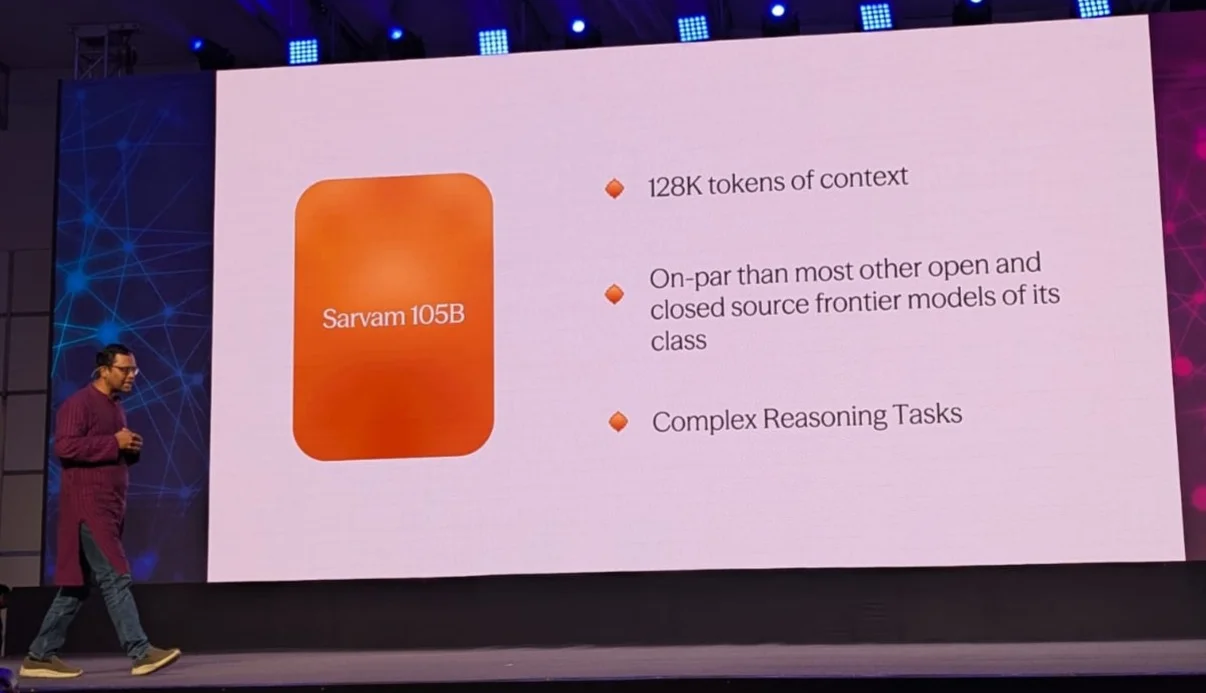
The more powerful of the two, Sarvam 105B, targets depth. It is engineered for complex reasoning and advanced language tasks. With a context window of 1,28,000 tokens, the model can process and retain large volumes of information, making it suitable for long-form summarisation, detailed analysis and nuanced dialogue.
Sarvam claims the 105B model rivals and, in certain benchmarks, outperforms global peers, including DeepSeek R1.
To demonstrate its enterprise potential, the team uploaded a company balance sheet during the session. Within seconds, the model analysed the data and began answering layered financial and contextual questions.

Your reaction
Discussion
What's your take on this story?
No comments yet — be the first to share your view.