
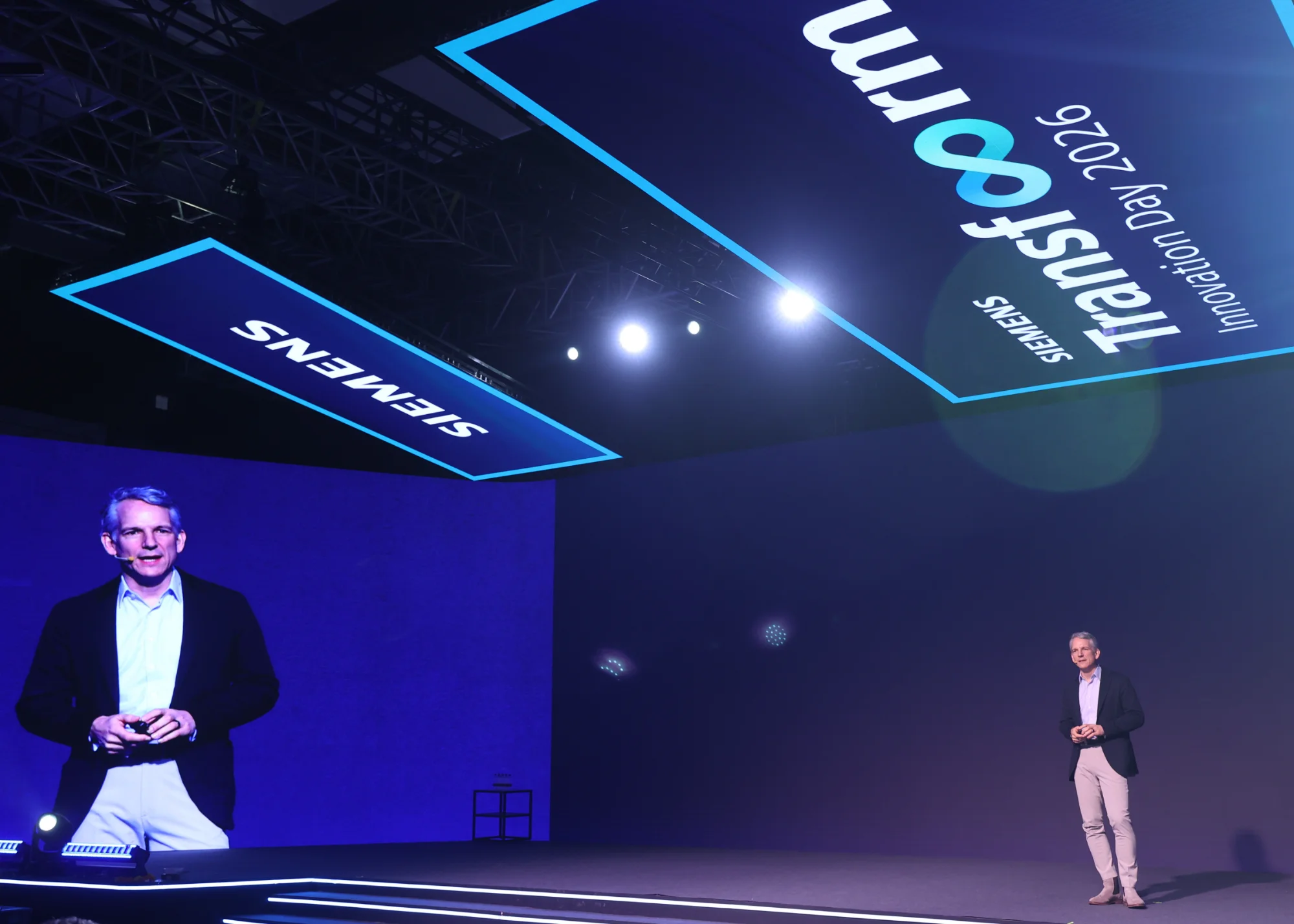
While agentic AI is emerging as the next big shift in artificial intelligence, Siemens believes the technology is still in its early stages and not yet ready for scaled deployment. This comes even as the company rapidly expands AI across its industrial software and automation stack.
Speaking to AIM on the sidelines of Siemens Innovation Day 2026, Peter Koerte, Chief Technology and Strategy Officer at Siemens AG, says the company is actively experimenting with agentic AI but remains cautious about its deployment.
“Agentic AI is still in its infancy,” Koerte says, adding that the technology requires careful governance before it can be widely adopted.
Siemens is already testing such systems internally through what it calls an ‘AI factory’, a platform that allows teams to build applications using large language models and develop task-specific AI agents.
Koerte states that now people can build their own agents or an agent factory.
However, he emphasises that autonomy remains limited. Human oversight continues to play a critical role, particularly in security and reliability.
“The question is how we govern it, especially with all the security concerns that come with it,” Koerte says, adding that most systems still require human verification.
While experimentation is underway, Siemens is simultaneously embedding AI across its product stack. Koerte says the company currently has around 130 products that are either AI-augmented or AI-native, a number expected to grow as AI becomes more deeply integrated into its software and automation offerings.
This integration, however, makes it difficult to isolate AI as a standalone revenue stream.
“It’s really hard. It’s almost embedded in everything we do,” Koerte says.
To support this expansion, Siemens is scaling its AI workforce. It currently employs around 1,500 AI specialists, including roughly 300 researchers working on next-generation technologies and about 1,200 engineers embedded within product teams.
The company is also expanding geographically, with a new AI team in Seattle expected to grow to 200-300 employees.
At the same time, Siemens is strengthening partnerships with major technology providers for compute infrastructure and software capabilities, rather than building everything in-house.
On the inorganic front, Koerte says Siemens is taking a measured approach despite the surge in AI startups. Instead of outright acquisitions, it is prioritising strategic investments.
“For the most part, many of them are very small. Many only have an idea on a sheet of paper,” Koerte says.
One such investment is in PhysicsX, a company focused on AI-driven simulation technologies.
He says that it’s too early to tell, as everybody's racing and they have to see who makes it to the finish line.
Alongside product and talent expansion, Siemens continues to build its intellectual property base. The company files around 4,700 patent applications annually and holds a total portfolio of approximately 44,000 patents.
Of these, more than 1,000 patents are in data science and AI, reflecting its long-standing focus on industrial analytics and automation.
As Siemens balances experimentation with caution, its strategy around agentic AI remains clear: build internally, embed widely, and scale only when the technology matures.

Your reaction
Discussion
What's your take on this story?
No comments yet — be the first to share your view.