
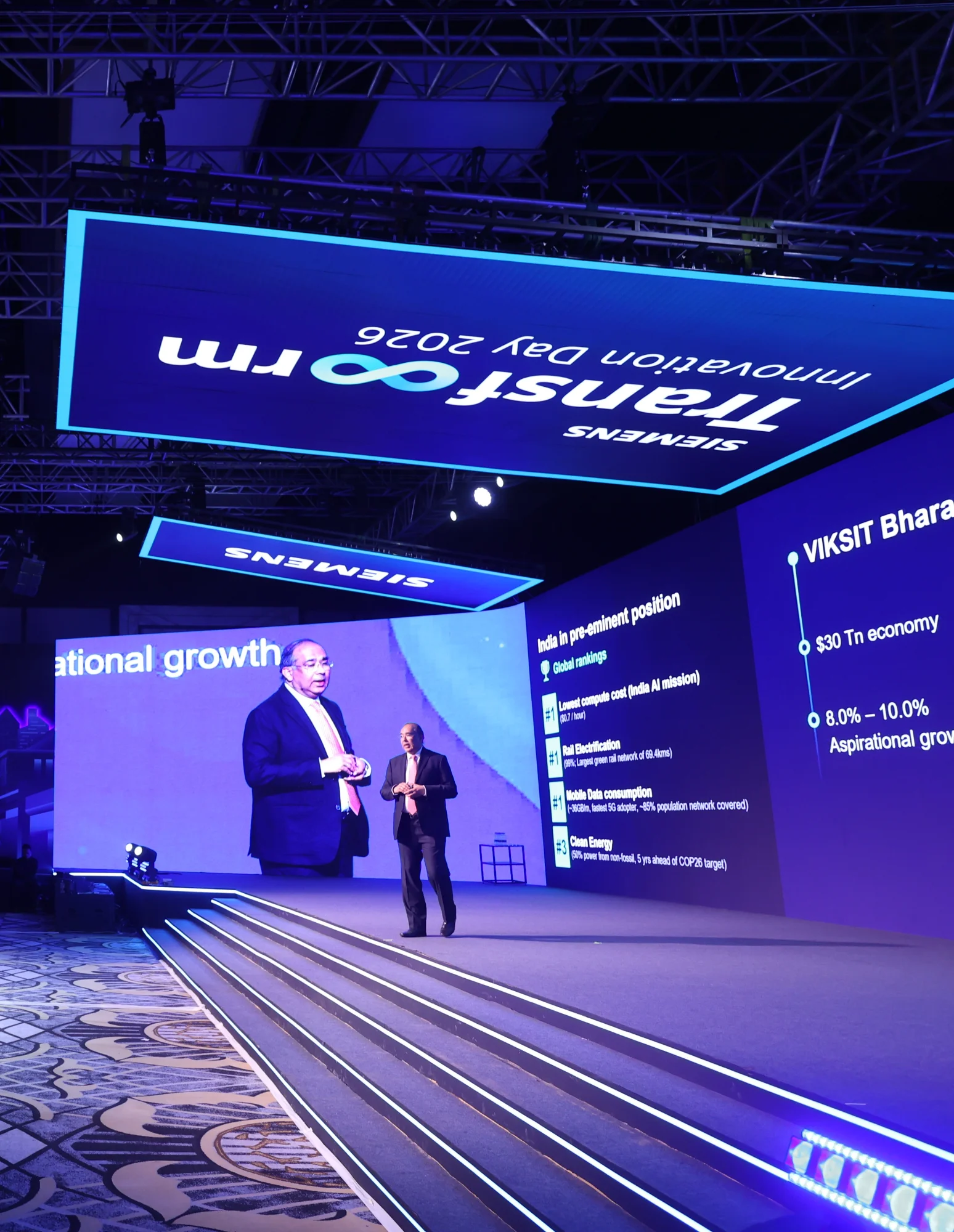
As India expands manufacturing and digital infrastructure, tech conglomerate Siemens says it is well-positioned to participate in the country’s next phase of industrial growth.
Sunil Mathur, Managing Director and CEO of Siemens India, tells AIM that the company is already deeply localised in the country and continues to invest in its manufacturing footprint. “We have 25 factories right now in the country already,” Mathur says.
While the company has not disclosed a specific investment figure, Mathur indicated that Siemens is continuing to expand its capabilities. “Suffice to say, we are investing significantly after all into our factories to operate them,” he remarks.
He adds that AI and software will play an increasingly important role as manufacturing scales. “We already have close to 10,000 software specialists in the country who can support that activity,” Mathur notes.
In the Union Budget 2026–27, the government announced plans to scale up domestic manufacturing across seven strategic and frontier sectors, including biopharma, semiconductors, electronics components, rare earths and critical minerals, chemicals, capital goods and containers, and textiles and sports goods. The move aims to strengthen India’s manufacturing base, reduce import dependence, and build global competitiveness in high-technology and supply-chain-critical industries.
Siemens now wants to tap into the domestic advanced manufacturing momentum with solutions such as Industrial AI, digital twins, industrial simulation, next-generation automation, digital grids, autonomous buildings, and advanced energy systems. The company says it has deployed over 700 digital references in India with 25 ecosystem partners.
Data Centre Growth
Beyond manufacturing, Siemens sees strong growth potential in India’s data centre market, which is expanding rapidly due to demand for cloud infrastructure and artificial intelligence.
CBRE projects the market value of data centres to grow to over $10 billion by 2027. The government also seeks to expand India’s role in this arena, with a 21-year tax holiday for foreign cloud service providers utilising data centres in India.
According to Deloitte, India’s current data centre capacity is 1.5 GW and is projected to surge to 8–10 GW by 2030, but Mathur says the long-term potential could be much higher. He compares India’s capacity with Europe to highlight the growth opportunity.
“In Europe, 350 million people have got 55 gigawatts of data centres,” he illustrates, suggesting that India’s infrastructure will need to scale significantly to meet future digital demand.
Siemens provides the underlying infrastructure and technologies used in data centre facilities, including electrification, automation, and energy management systems.
Semiconductor Mission Gaining Momentum
Mathur also expressed confidence in the early progress of India’s semiconductor manufacturing ambitions.
“I think the semiconductor mission is off to a good start,” he remarks, noting that multiple global players have already begun setting up fabrication plants in the country.
Siemens is already engaged with several companies involved in the initiative. “There are five or six major semiconductor players who have already started manufacturing fabs, and we are working with all of them,” he says, while declining to name specific customers.
AI Adoption Among MSMEs Still Uneven
Artificial intelligence could also help improve productivity among India’s small and medium enterprises, although adoption levels remain uneven.
“AI is going to be a great support for SMEs overall… it will enable them to be more flexible, and it will enable them to be quicker,” Mathur notes.
However, he cautions that smaller companies may not yet be ready to adopt advanced digital technologies. “You’ve got to have electrification, automation before you go into digitalisation,” he states, adding that many smaller businesses still need to build foundational capabilities before deploying AI.
To support smaller manufacturers, Siemens has introduced digital platforms designed to make industrial software easier to adopt. The company’s Accelerator platform, a marketplace launched three years ago, allows businesses to access applications in a self-service format.
“It’s like an Amazon marketplace. You go there, you buy them, and then you download and deploy yourself,” adds Peter Koerte, Member of the Managing Board, Chief Technology Officer, and Chief Strategy Officer at Siemens AG.
Such platforms are designed to help small and medium-sized companies adopt industrial software without requiring complex implementation processes.
Government Projects Remain Central
Public sector projects continue to represent a significant share of Siemens’ operations in India. Mathur says government-related projects account for 40–60% of the company’s business in the country, depending on the size and timing of orders.
The company works across a wide range of sectors, including aerospace, defence, pharmaceuticals, railways, cement, steel, and consumer packaged goods.
Siemens is also involved in discussions with state governments on the infrastructure needed for new industrial parks and digital hubs. Mathur says the company is supporting multiple states as they design infrastructure for industrial parks, data centres, and technology clusters.
“We are talking to multiple states… more in terms of supporting them in creating these industrial parks with the infrastructure know-how that we have,” he adds.
Rather than building facilities directly for governments, Siemens typically works with private developers and infrastructure providers supplying the underlying technologies.
A key starting point for such projects, Mathur noted, is ensuring a reliable power supply. “The first thing is how do you get electricity into an industrial park?” he remarks.
From electrification and grid connectivity to automation systems and digital infrastructure, Siemens provides technologies that support the development of these industrial ecosystems.

Your reaction
Discussion
What's your take on this story?
No comments yet — be the first to share your view.