
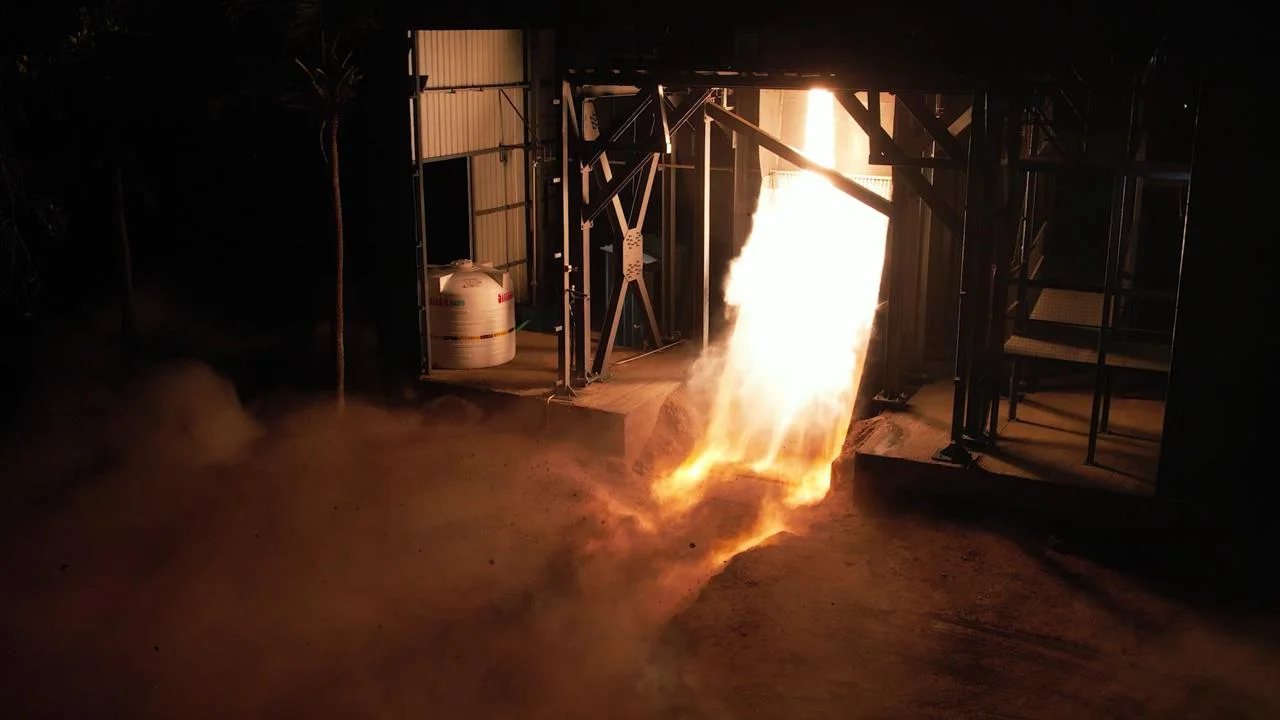
Chennai-based space tech startup Agnikul Cosmos has completed the booster-engine test of its 3D-printed Agnite engine at its Chennai testing facility. The company said the test demonstrated large-scale 3D printing of rocket engines and confirmed it can build engines in seven days.
The IIT Madras-incubated startup claims the single-piece engine reduces production time by up to 97% compared to traditional methods. This enables faster launch response and allows customers to secure firm schedules and custom orbital trajectories.
Srinath Ravichandran, CEO and Co-founder of Agnikul Cosmos, said the design focuses on solving schedule delays. “Traditional engines take months to build because you’re machining, welding, and assembling dozens of parts. Ours prints in a few days, which means we can respond to launch demand faster than the industry standard,” he said in a statement.
He added that electric pump architecture reduces the number of parts and supports reuse. “These aren’t just technical choices but are the reasons why we can commit to low turnaround and actually deliver on it,” he said.
The company reiterated that the tested engine, which is 1 metre long, is the largest single-piece Inconel (nickel-chromium-based superalloy) rocket engine built to date. It also used electric-motor-driven pumps, marking a step forward in propulsion development.
Agnikul said its platform integrates launch vehicle production, mission control, and ground stations into a single system. This reduces coordination risks seen in traditional launch models.
The system also allows payload changes up to 30 days before flight and supports sectors such as defence and disaster response.
Moin SPM, COO and Co-founder, said the test confirms readiness for higher launch frequency. “Our manufacturing capabilities are enabling us to produce engines in line with customer demand, rather than limiting them,” he said.
He added that the company will now focus on execution and maintaining a steady launch cadence.
The test follows a previous milestone where the company fired three semicryogenic engines together. It said the latest test builds on that work and supports scalable launch vehicle design.
Agnikul last secured fundingof approximately $17 million in November 2025, valuing the company at $500 million from a consortium of investors. It also recently received equity support from the Tamil Nadu government. The startup also recently partnered with NeevCloud to help launch data centres in space. It is now developing its upcoming Agnibaan launch vehicle to carry small satellites on demand, following its previous launch of Agnibaan SOrTeD.

Your reaction