
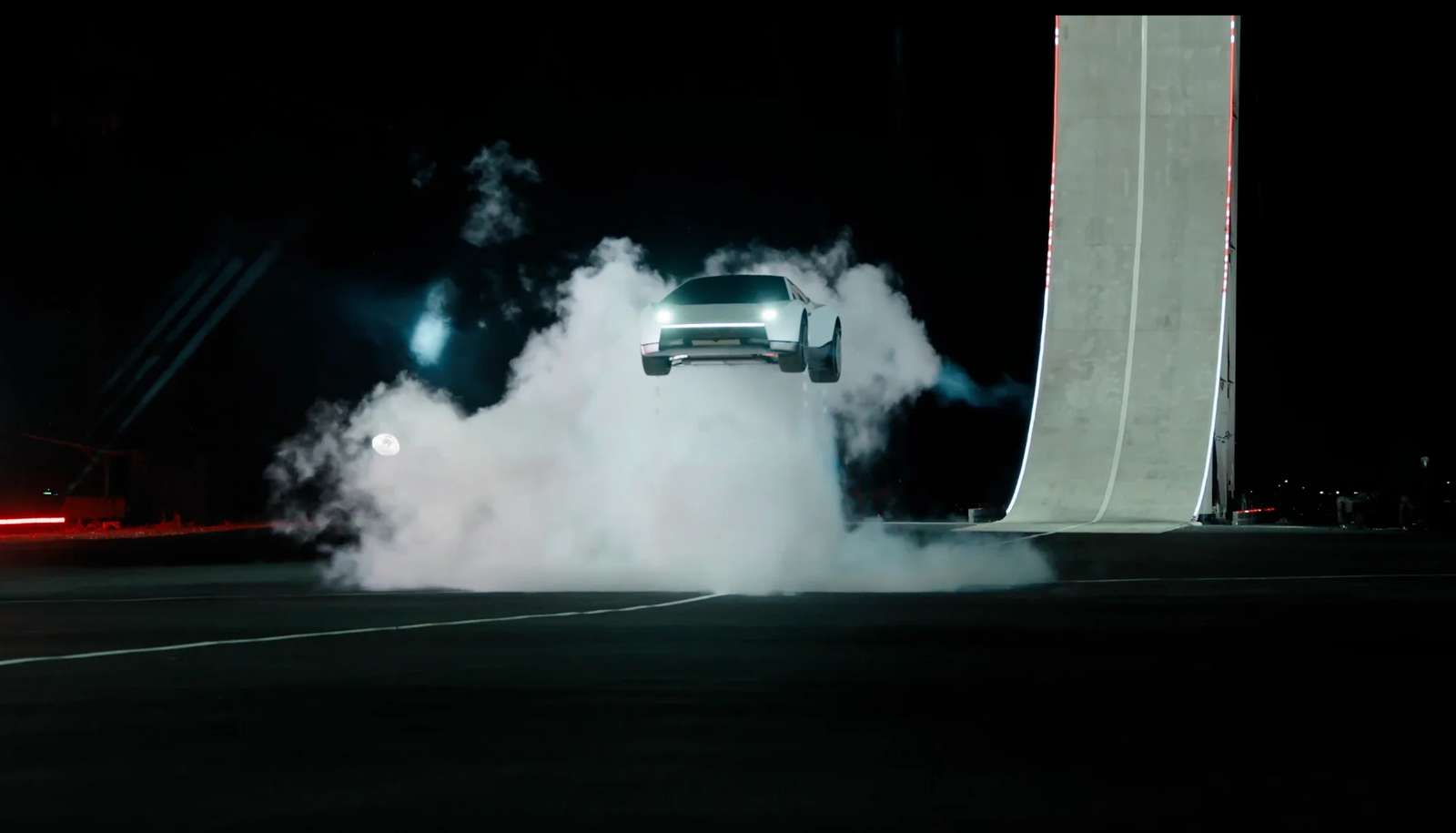
Tesla has unveiled its long-delayed next-generation Roadster, showcasing an electric sports car that can perform mid-air manoeuvres using rocket-style thrusters developed in collaboration with SpaceX.
Chief Executive Elon Musk said production is expected to begin in 2028, nearly a decade after the company first announced the vehicle.
The demonstration took place on October 16 at a SpaceX facility in Texas, where the Roadster drove up a steep ramp, turned in mid-air and jumped over other vehicles. Tesla also demonstrated a version of the car driving upside down using a suction system beneath the vehicle.
Real life, baby https://t.co/3QEqn18wig
— Tesla (@Tesla) October 16, 2026
The unveiling marks a new milestone for a vehicle whose launch has been postponed repeatedly since 2017. Tesla has yet to provide a confirmed retail price or a detailed delivery schedule, leaving questions about when customers who reserved the car will receive it.
The Roadster is a two-seat electric sports car developed by Tesla in collaboration with SpaceX. Tesla demonstrated the vehicle’s ability to accelerate, perform aerial manoeuvres and use a suction system to remain attached to a ramp while inverted.
“This is the culmination of incredible work by Tesla and SpaceX engineers working closely together to make something that you haven't seen in any movie,” Musk told the audience at the unveiling.
Tesla vehicle engineering Chief Lars Moravy said the Roadster could accelerate from zero to 60 miles per hour (97 kmph) in less than a second and reach a top speed exceeding 230 mph (370 kmph). The company claimed the vehicle achieved the acceleration milestone in 0.81 seconds during the demonstration.
“Definitely much faster than that,” Musk said when discussing the car’s speed. “I think you've got to crack halfway to the speed of sound.”
Tesla also claims the vehicle can travel more than 300 miles (480 km) on a single charge. This is substantially below the 620-mile (998 km) range promised when the second-generation Roadster was first announced in 2017.
The company has outlined three configurations for the vehicle, with different performance capabilities and intended uses.
The Performance version is intended for road use and has a claimed zero-to-60 mph acceleration time of less than 1.6 seconds. The Thrust version adds rear-mounted cold-gas thrusters and is claimed to reach 60 mph in less than 0.9 seconds. Tesla describes this configuration as a limited release.
The Rocket version has a full system of thrusters around the vehicle, allowing it to perform rotational movements and lift off the ground. Tesla claims it can accelerate from zero to 60 mph in less than 0.59 seconds. The single-seat model is available by invitation and is not approved for public-road use.
The thrusters use compressed gas rather than conventional chemical rocket propellant. The demonstration also featured a fan-based suction system beneath the car, which Tesla used to keep it attached to an inverted ramp. The company has not provided a full breakdown of the production vehicle's engineering specifications or the conditions under which all its performance claims can be achieved.
Tesla has not disclosed the final retail prices of the three configurations. Its reservation page lists a $50,000 deposit for the Performance version and a $250,000 deposit for the Thrust version. The Rocket variant is available by invitation. These deposits are not the same as confirmed final vehicle prices.
The Roadster’s unveiling comes as Tesla increasingly positions itself around autonomous driving, artificial intelligence and robotics, in addition to manufacturing electric vehicles.
The company has introduced its Cybercab robotaxi and is developing its Optimus humanoid robots.
- AI Productivity to Add $28 Billion to $84 Billion to India's GDP: Cognizant Study
- OpenAI's Codex Helps in Aerodynamic Engineering for Mazda
- Bengaluru Accounts for 34% of India's FDE Talent: Report
- 84% See AI Productivity Gains, but Only 10% Allow Agent Autonomy: TCS Study
- Snowflake Introduces Business Ontology, Cortex AI Gateway to Bring AI Agents Into Enterprise Workflows
- Three Members Behind Claude Code Leave Anthropic Within 10 Days