
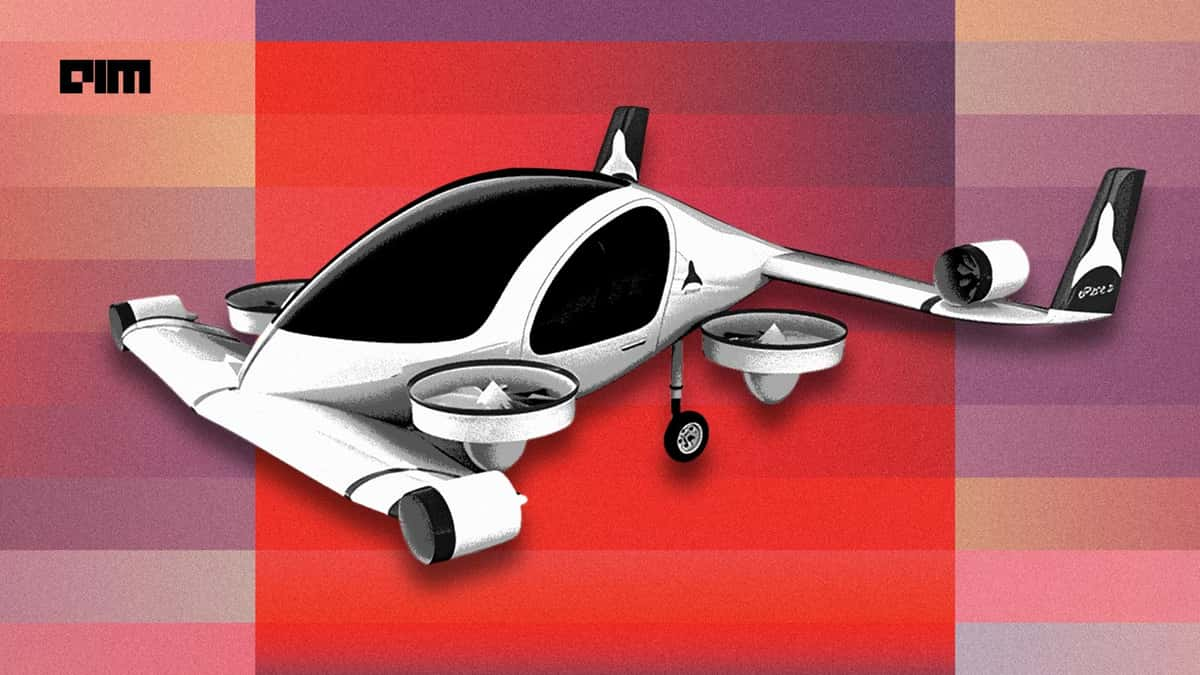

The ePlane Company recently unveiled its integrated eVTOL prototyping and testing facility at IIT Madras Discovery Campus, marking its shift from lab-scale work to industrial manufacturing.
Spread across 60,000 sq ft, the facility is a step towards commercialising its electric vertical take-off and landing (eVTOL) aircraft.
Its flagship model, the e200X, is designed for dense urban environments. With a globally compact 8m x 10m footprint, it is built for rooftop-to-rooftop operations in congested cities.
Yet, the question remains about the viability of such an innovation in India.
“India's urban air mobility sector is ready to take off, just not yet,” says Dr Sunil Shekhawat, Co-Founder and CEO of SanchiConnect. “The concepts are compelling, the interest is growing, and the startups are emerging, but translating this momentum into real-world operations will take more than enthusiasm.”
Regulation is Evolving, but Slow
Certification remains the biggest hurdle.
Shekhawat says aircraft must meet stringent safety and operational standards, which require a lengthy certification process.
“Air ambulances in India have historically operated in a fragmented regulatory environment, but that is changing fast,” Vishnu Ramakrishnan, SVP for advanced air mobility strategy at The ePlane Company, tells AIM. “We are at an inflexion point.”
The Directorate General of Civil Aviation (DGCA) has introduced frameworks covering aircraft certification, vertiports, and pilot licensing, with air traffic management rules expected next.
“What gives us added confidence is our ecosystem,” he adds. “Our anchor customer from day one is India's only Helicopter Emergency Medical Service (HEMS) certified operator, running close to 300 operations annually.”
Infrastructure Gap
Even if regulations evolve, infrastructure is largely missing.
“Air taxis need vertiports, charging systems, and low-altitude air traffic management. None exists at a meaningful scale in India today,” Shekhawat says.
Closing this gap will require coordinated investments, including from governments and private stakeholders. “Until that happens, even the most advanced aircraft has nowhere to go,” he says.
Globally, eVTOL development is progressing faster. Companies such as Joby Aviation, Archer Aviation, and Germany’s Volocopter are among the leaders preparing for commercial launches later this decade, while China’s EHang has already begun autonomous passenger flight operations in controlled settings.
Large aerospace giants, including Airbus, Embraer, and Hyundai, are also investing in urban air mobility platforms alongside operators like Blade Air Mobility.
India’s ecosystem, though nascent, is expanding. InterGlobe Enterprises has partnered with Archer Aviation for planned deployments, while startups such as Sarla Aviation and Aexo Aerospace are building indigenous platforms.
From Prototype to Certification
Founded in 2019 by IIT Madras professor Satyajit Prakravarti, The ePlane Company has spent the past six years building indigenous aerospace capabilities.
It began with small experimental aircraft. Ramakrishnan says their first prototype in 2019 carried a two kg payload and demonstrated vertical take-off with fixed-wing transition. He added that a larger subscale aircraft, the E-50, was developed in 2023.
The e200X, built using carbon-fibre composites, is now entering testing. The company collaborates with NVIDIA, AWS, Dassault and CADFEM-Ansys to power its advanced simulation, cloud infrastructure, avionics, and edge computing capabilities focused on life-saving utility.
“We have completed the prototype and are moving into ground testing, followed by tethered and full flight trials,” he says.
Industry reports suggest that India’s air taxi market is expected to capture a substantial share by 2033, expanding at a CAGR of 18.4% from 2023 to 2033.
The company received Design Organisation Approval (DOA) in 2023, becoming the first private Indian firm to begin type certification for a commercial electric aircraft. Commercial deployment is targeted between late 2027 and early 2028.
Why Air Ambulances Come First
Instead of launching air taxis directly, the company is prioritising air ambulances.
The model is focused on speed rather than in-flight treatment. “Patients are typically stabilised on the ground before transport. We are not performing complex procedures mid-air,” Ramakrishnan says.
Urban missions are expected to last 10–15 minutes to reduce delays caused by traffic. Unlike conventional retrofit operators, the e200X is designed specifically for medical use. “The stretcher position, equipment bays, and access points are integrated from the start,” he says. “That is a significant advantage over retrofitted systems.”
The company estimates strong demand potential. “India could see up to 198 million trips per month by 2030 at viable price points,” Ramakrishnan says.
Traditional air ambulances cost ₹1.5–2 lakh per hour. The ePlane Company aims to significantly reduce this. “If a ground ambulance costs ₹12,000–13,000, this would not be more than twice that,” he says. Early adoption, however, will be limited. “ePlane will be expensive initially. The first users will be corporates, hospitals, and time-sensitive travellers,” Shekhawat says.
He adds that adoption will depend on visible impact. “When people see an aerial ambulance cut through two hours of traffic to save a life, trust will build quickly.”
“Ask anyone stuck in Bengaluru traffic for two hours if they'd pay a premium to fly over it,” Shekhawat says.
Funding Gaps and Supply Challenge
Financing remains another structural challenge.
“Investors want traction before funding. Startups need funding before they can show traction. In deep-tech aviation, that deadlock is costing India its edge,” Shekhawat says.
The company raised $5 million in a pre-Series A round in 2022 and $14 million in a Series B round in November 2024, co-led by Speciale Invest and Antares Ventures. The capital is being used for certification, testing infrastructure, and commercialisation.
Building an aircraft has required developing supply chains from scratch. The company initially relied on European vendors for composite materials but is increasingly sourcing locally. Battery cells are still imported, while assembly and testing are done in-house.
Despite being a digitally enabled aircraft, autonomy remains restricted. “Passenger flights cannot be autonomous under current regulations,” Ramakrishnan says.
AI is instead used for design optimisation, simulations, and flight modelling. Control systems are developed in-house by teams with experience from HAL, NAL, and DRDO.
India’s eVTOL ecosystem is progressing, but remains fragmented across regulation, infrastructure, and funding. The ePlane Company positions itself as an OEM rather than an operator. “The opportunity is real. The startups are ready. But execution will depend on how quickly the ecosystem comes together,” Shekhawat says.
- The Bengaluru Founder Building a Bridge to San Francisco
- This Bengaluru Startup Is Building AI Agents for Hardware Design
- Drizz Is Taking on the Reliability Challenge in AI App Testing
- How This Indian AI Unicorn is Disrupting Hollywood With Digital Humans
- The AI Underwriting Engine Behind Recur Club’s ₹500 Cr Festive D2C Capital Push
- Loan Collection in India is Still Largely Manual. This AI Startup is Changing That