
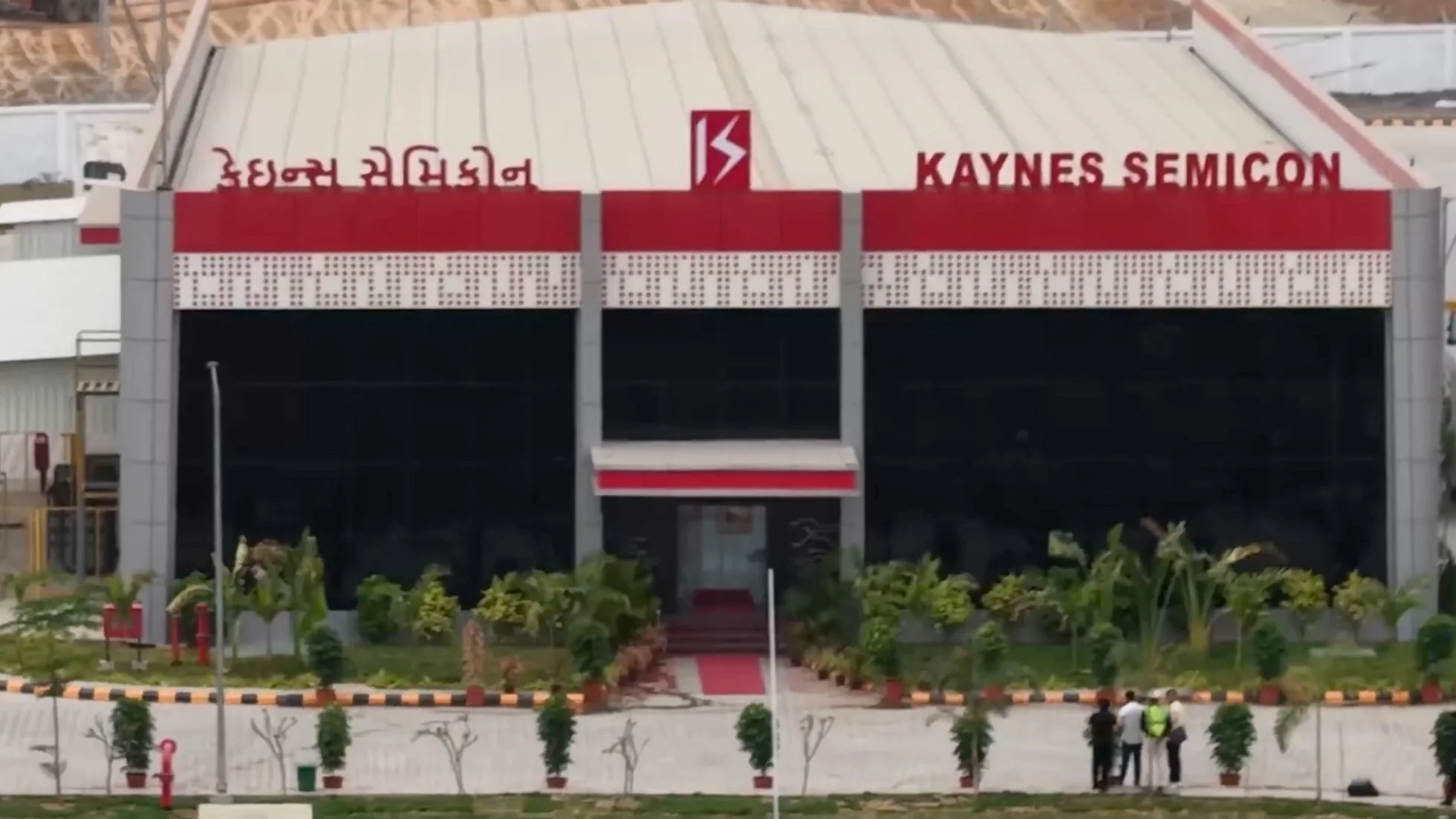
Kaynes Semicon has started commercial production at its OSAT (Outsourced Semiconductor Assembly and Test) plant in Sanand, Gujarat, following its inauguration by Prime Minister Narendra Modi on March 31. The facility will manufacture advanced intelligent power modules for automotive and industrial use.
The plant operates as an OSAT/ATMP unit, focusing on assembly, testing, marking, and packaging. It aims to address a gap in India’s semiconductor ecosystem, particularly in backend manufacturing capabilities.
The plant will produce modules comprising 17 chips, which it will supply to Alpha and Omega Semiconductor, a global supplier of power semiconductors. Once all phases are complete, the facility will have a production capacity of 6.33 million units per day.
The Sanand is the second such semiconductor unit in India to begin commercial production under the India Semiconductor Mission, following Micron Technology’s OSAT unit last month.
The plant also supports applications that require compact, efficient power systems, especially in the automotive and industrial sectors. Officials said it will help build local capabilities in high-technology manufacturing and reduce reliance on imports. It also positions Kaynes as a key domestic player in India’s semiconductor value chain.
Ashok Chandak, President of India Electronics and Semiconductor Association (IESA), said in a statement that the inauguration signals a shift “from intent to successful execution in the semiconductor sector”.
He added that the launch of the facility and its multi-chip module reflects “growing strength in advanced packaging, system integration, and scalable semiconductor manufacturing”.
Chandak said the Sanand plant, with an investment of about ₹3,300 crore and an expected capacity of nearly 60 lakh chips per day, will “significantly boost domestic manufacturing capability” and support local economic development.
Meanwhile, Kaynes has also signed a memorandum of understanding with IndiesemiC, an Ahmedabad-based, fabless semiconductor startup, to strengthen domestic semiconductor packaging and manufacturing.
The collaboration will initially focus on QFN40 and QFN64 packages for applications in IoT, wearables, and display systems. IndiesemiC plans to build 10 million units over three years for a global customer, along with an additional 5 million units annually for others.
Kaynes also recently partnered with SiMa.ai for physical AI manufacturing and with Emerson (previously, National Instruments) for its semiconductor testing facilities across India.

Your reaction
Discussion
What's your take on this story?
No comments yet — be the first to share your view.