Investors Map India’s Next AI Opportunity at Happy Llama 2026
By Smruthi Nadig ·
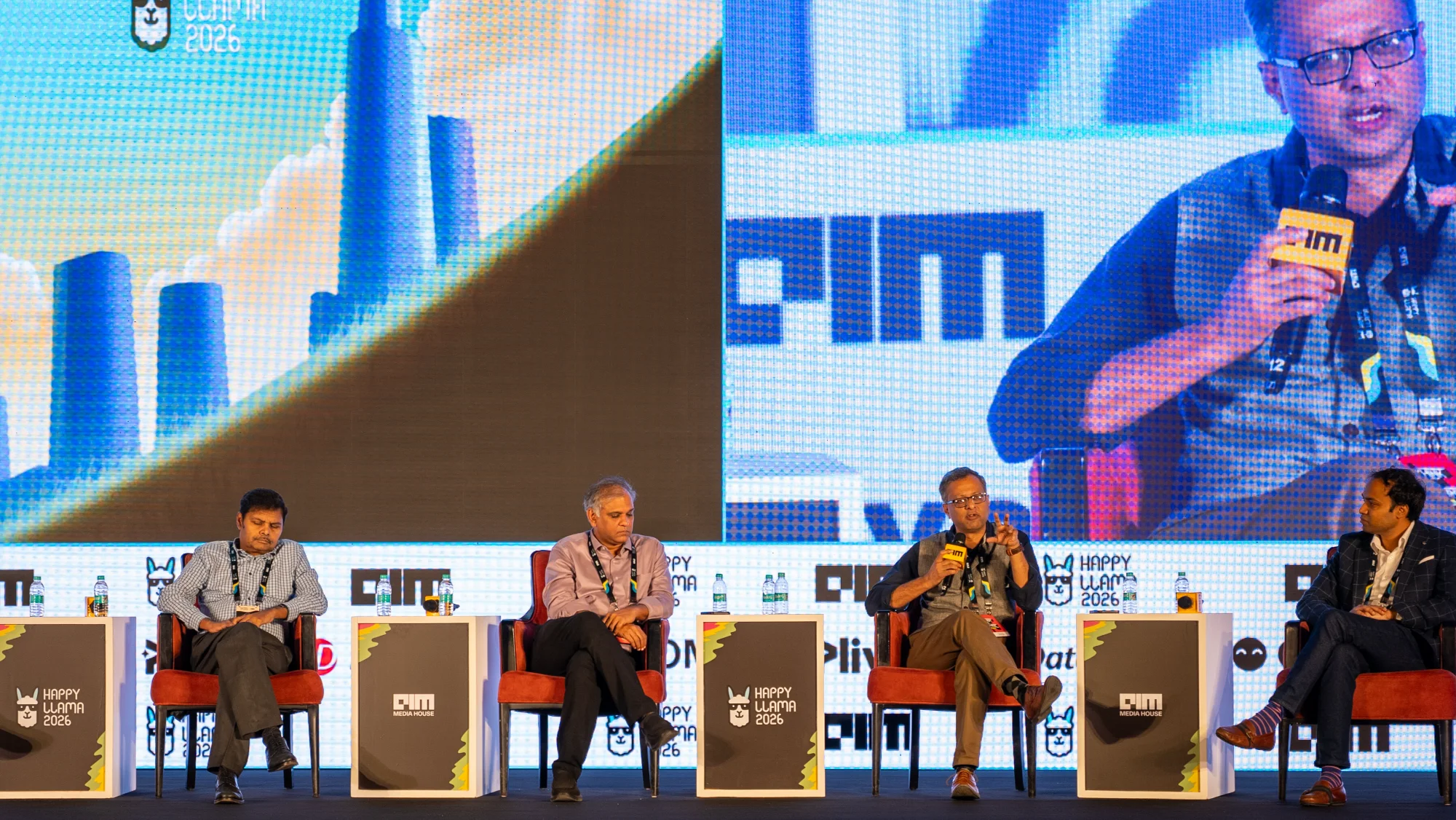
As AI reshapes the global technology landscape, investors backing Indian startups say the country’s biggest opportunity lies not in building foundational models but in creating AI infrastructure, domain-led applications, and efficient developer ecosystems.
That was the consensus among venture capital leaders speaking at a panel discussion titled ‘The Capital Behind India’s AI Rise’ at Happy Llama 2026, a premier AI startup summit organised by AIM.
While the global AI race is currently dominated by companies in the US and China building large-scale foundational models, investors said India’s strengths lie in building higher up the stack, particularly in AI infrastructure, developer tooling, and vertical applications.
India’s Strengths Lie Beyond Foundational Models
For Chinnu Senthilkumar, Managing Partner at Exfinity Venture Partners, the foundational model race is already heavily concentrated in a few global technology hubs.
“Foundational models were effectively locked in many years ago,” Senthilkumar says. “India may not have a strong chance there today, but there are significant opportunities if you combine AI with strong vertical domain expertise.”
According to him, Indian startups can build powerful solutions by applying AI to deep technical problems in specialised industries.
One example he highlighted was the application of AI in analogue chip design, a domain where automation has barely progressed over the past few decades. By combining decades of engineering knowledge with AI systems, startups can address long-standing technical bottlenecks.
He also pointed to opportunities in physical AI, semiconductor architecture, and specialised AI systems, particularly in industries that require deep technical expertise.
“In many of these areas, applying AI to existing domain knowledge can create meaningful innovation,” Senthilkumar adds.
AI Infrastructure and Middleware Gaining Momentum
Another key opportunity identified by investors lies in AI infrastructure and middleware layers, which support the development and deployment of AI applications.
Somshubhro Pal Choudhury, Co-Founder and Partner at Bharat Innovation Fund, reveals that India is increasingly emerging as a hub for developer-driven AI innovation.
“India is currently number two globally in terms of AI repositories on GitHub,” Choudhury adds. “The developer ecosystem here is extremely strong.”
According to him, this strength is translating into a growing number of startups building tools around the AI stack.
These include platforms focused on AI model optimisation, security and red-teaming for large language models, agent orchestration systems and developer tools that enable companies to integrate multiple AI models.
Because Indian startups often lack access to large GPU clusters and substantial capital, they are focusing on efficient AI systems and optimisation techniques.
“We are seeing startups orchestrate open-source models and smaller language models in very creative ways,” Choudhury further says. “Often they can build solutions at a fraction of the cost compared to companies in the West.”
The Scale of India’s AI Startup Ecosystem
The number of startups experimenting with AI is expanding rapidly. According to Choudhury, there are currently around 7,000 AI startups in India, though only about 600 could be considered deep tech or highly differentiated.
Investors say this sheer volume of experimentation is one of India’s biggest strengths. “The advantage India has today is simply the number of founders building,” Choudhury explains.
However, the pace of innovation also means competition is intense. “As investors, every time we meet a company, within a month we see five or 10 others building something similar,” he says. “The challenge is identifying which ones will truly stick.”
From SaaS to Deeper Tech
Historically, India’s startup ecosystem has been known for building SaaS and application-layer companies, particularly in enterprise software.
But investors say the ecosystem is gradually moving towards deeper technology. Shubham Gupta, Partner at Together Fund, notes that infrastructure startups are beginning to take a larger share of AI investments.
“In the last two years alone, we have seen close to 3,000 deals in the AI ecosystem, and around 26% of them were infrastructure companies,” he says.
“Traditionally, that number was below 10%.” This shift indicates that Indian founders are increasingly tackling technically challenging problems, rather than focusing only on application-layer products.
However, Gupta cautions that global competition in AI is extremely intense. “There is really no India advantage in AI today,” he says. “You have to build world-class products from day one.”
Capital Remains a Critical Bottleneck
Despite the growing startup ecosystem, investors agree that access to capital remains one of India’s biggest challenges.
Deep-tech startups require significant and sustained investment, particularly when building infrastructure products.
“Access to capital is fundamental if you want to build world-class technology,” Gupta says.
India’s early-stage funding environment has improved significantly, but later-stage funding, especially large growth rounds, remains limited compared to ecosystems such as Silicon Valley.
“What the Bay Area offers is the ability to raise $20 million, $50 million, or even $100 million rounds,” Choudhury points out. “That level of capital is still difficult to access from India.”
Another challenge is global distribution.
Many Indian startups targeting enterprise markets must hire sales teams in the United States to scale internationally, which increases operational costs.
The Importance of Enterprise Adoption
Panellists also highlighted the need for stronger enterprise adoption within India.
Indian startups often rely on US or global markets for early customers, but domestic adoption could help companies iterate faster.
“If Indian enterprises became early design partners and customers, startups could test products locally and shorten feedback cycles,” Gupta says.
This would allow startups to refine their products before scaling internationally.
Execution Speed is the New Moat
Perhaps the most striking insight from the discussion was that traditional startup moats are rapidly disappearing in the AI era.
New research papers, open-source models, and developer tools are emerging at an unprecedented pace.
As a result, investors say the real differentiator is execution speed and team quality. “We meet nearly 6,000 startups every year but invest in only a handful,” Gupta clarifies.
At the earliest stages, investors are increasingly evaluating founders based on their technical depth, learning speed, and understanding of where AI technology is heading.
“In the AI world, execution becomes the moat,” he points out. Strong founding teams often combine deep domain expertise with AI engineering capabilities, enabling them to understand the problem and build the technology to solve it.
Where Durable Advantages May Emerge
Even in a rapidly evolving industry, panellists believe certain types of moats may still emerge.
According to Sampath P, Partner at Kalaari Capital, enterprise workflows remain complex and difficult to automate, creating opportunities for startups that can deliver reliable AI systems.
“Enterprises care deeply about accuracy, privacy, and security,” he says. “If startups can deliver transparent and reliable AI solutions that integrate into enterprise workflows, that becomes a strong advantage.”
In particular, startups that combine AI capabilities with deep industry expertise may build more defensible businesses.
India’s Role in the Global AI Race
Despite the challenges, investors remain optimistic about India’s long-term role in the global AI ecosystem.
The country has a large pool of technical talent, a growing base of AI developers, and a rapidly expanding startup ecosystem.
But to compete globally, the panellists suggest India will need deeper pools of capital, stronger enterprise adoption and more founders tackling technically complex problems. And as AI continues to evolve at breakneck speed, investors agreed that the winners will ultimately be the founders who move fastest.