
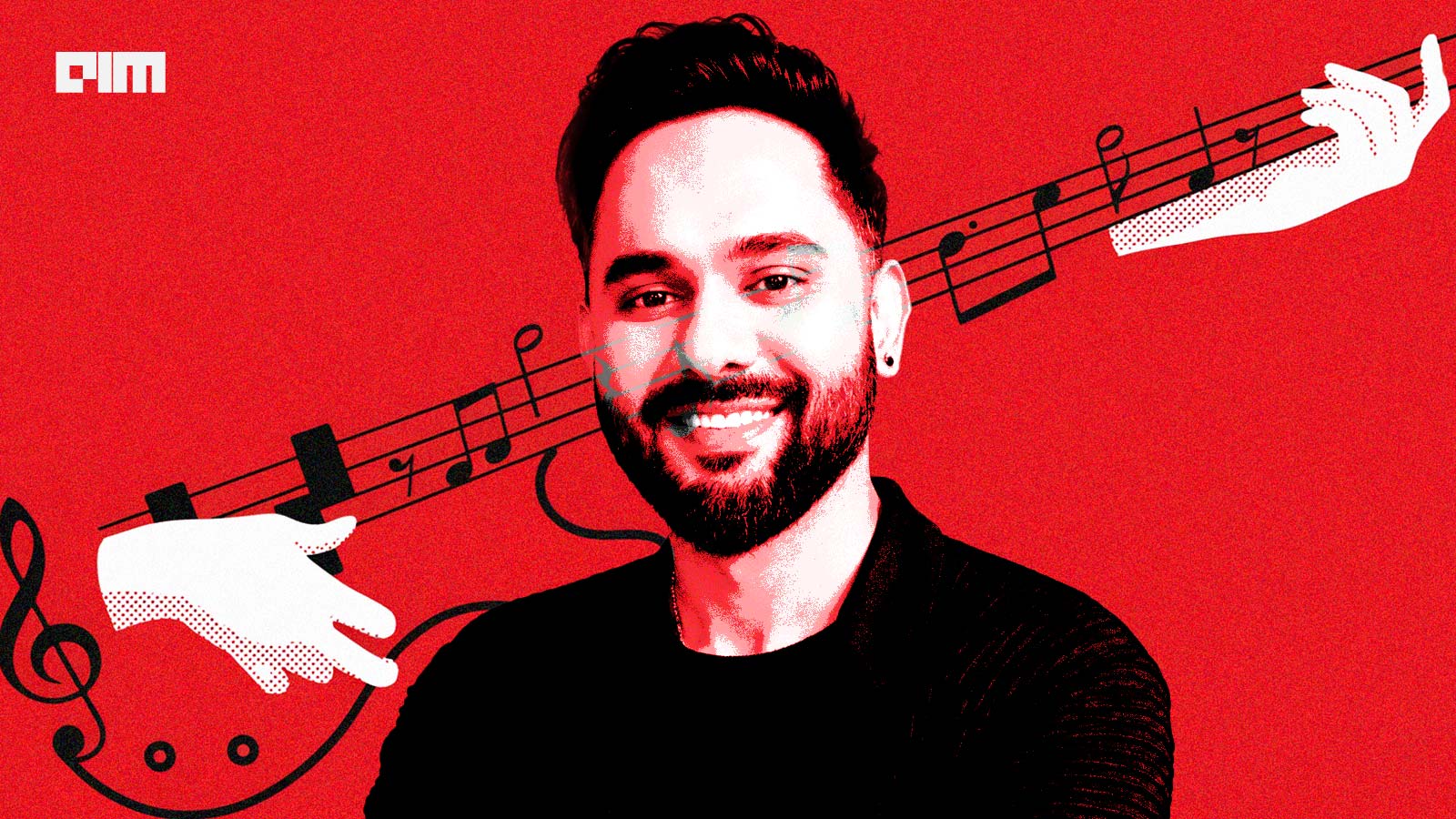
Millions heard the viral song ‘Chai Ki Tapri’ on India’s Got Latent, but few knew the AI startup behind it. For Soundverse Founder Sourabh Pateriya, the viral hit is only a glimpse of what the company is trying to build.
When Pateriya left Spotify in 2023, he wasn’t trying to build another AI music generator. He wanted to solve the problems he had experienced firsthand as both a musician and a product designer.
Today, the startup is repositioning itself from an AI song generator to what Pateriya calls an idea-to-audience platform, using AI agents to handle everything from music creation and editing to distribution, promotion and royalty collection.
“We are not just a song generator platform anymore,” Pateriya tells AIM in an exclusive interview. “If anything, we are building a 100x musician.”
Soundverse is also part of the 2026 Google for Startups Accelerator: India cohort, one of 20 AI-first startups selected from nearly 2,500 applications.
From Metal Bands to Spotify
Pateriya’s journey into AI music began long before generative AI became mainstream.
Growing up in Jabalpur, he was surrounded by music through his father’s extensive cassette collection while also pursuing storytelling and comics. Alongside an engineering degree in information technology, he developed an interest in user experience before completing a Master’s degree in interaction design from IIT Bombay to better understand how people interact with technology.
His professional career took him through Samsung, where he worked on foldable smartphones, voice interfaces and robotics, followed by Tobii, an eye-tracking company where he filed multiple patents.
At the same time, he remained active as a musician, first leading a metal band that performed across IIT festivals before starting an electronic music project.
The two worlds converged in 2020 when he joined Spotify’s music creation team.
“I genuinely felt the dissonance in my mind where the music journey and the tech journey were becoming very separate,” he recalls. “In 2020, that convergence finally happened.”
After spending three-and-a-half years at Spotify, he left to launch Soundverse.
Why Soundverse is Moving Away From Foundation Models
Unlike many AI music startups racing to build increasingly larger foundation models, Soundverse is deliberately stepping away from that battle.
The company initially trained its own music generation models from scratch. Its V5 and V6 models were developed in-house after years of investment in research and infrastructure. However, Pateriya believes competing directly with companies building large foundation models is becoming increasingly difficult.
“We did spend a lot of money, and we saw that the ROI was not getting there,” he says. “The compute and the money required to remain competitive with all the global giants are going to be very high.”
Instead, Soundverse is focusing on the application layer, orchestrating multiple AI systems rather than competing to build the largest music model.
The company operates in a crowded AI music market alongside startups such as Suno, Udio and ElevenLabs Music, all of which offer AI tools for creating songs, vocals and music from text prompts.
Agent One is the Company’s New Centrepiece
That strategy has culminated in Agent One, Soundverse’s flagship AI agent.
Unlike conventional AI music generators that create a complete song from a prompt, Agent One allows creators to edit, refine and control the generation process.
Users can begin with a hummed melody, a MIDI sequence, a guitar riff or even an existing song before asking the AI to create variations.
Pateriya says the system orchestrates between 80 and 100 tools to fulfil complex creative requests. He says songs typically range between two and five minutes.
Soundverse follows a freemium model, with its Creator plan in India starting at ₹399 per month, alongside usage-based pricing for more complex AI agent workflows.
AI as a Creative Partner, Not a Replacement
Pateriya sees AI music evolving through multiple phases.
The first wave focused on one-shot song generation from prompts. The second, which he believes has already begun, is centred around editing and hybrid workflows where AI augments human creativity instead of replacing it.
“The second wave of AI will be very controllable and editing-based,” he says “AI acts as your augmentation instead of your replacement.”
Eventually, he expects AI to become as invisible as synthesisers or cloud computing. “Nobody says anymore that you made this in a synthesiser,” he says. “Similarly, AI will become part of everything we do.”
For musicians, he argues, AI should automate engineering tasks while leaving storytelling and composition in human hands.
Building an Ethical AI Music Platform
Music copyright remains one of the industry’s biggest challenges, but Soundverse says it has deliberately taken a different path from several competitors.
The company’s models were trained using artist partnerships, licensed music libraries containing 3,00,000 to 4,00,000 songs, synthetic datasets and copyright-free public data.
“We never took the direction that Suno, Udio and other companies took, which scraped it off the internet,” he says.
The company has also published white papers outlining its ethical framework, covering artist consent, royalty calculations and AI model training. Royalties are paid to artists whose content contributes through these partnerships.
From Casual Users to Professional Creators
Soundverse initially targeted casual creators with short 15-second music generations. However, improvements in audio quality, editing capabilities and voice generation have pushed the company towards semi-professional musicians, professionals and production houses.
Agent One now supports AI-generated music videos alongside song creation. Users can upload an image and generate accompanying visuals before distributing finished songs directly to platforms such as Spotify, Apple Music and YouTube.
The company is also developing AI agents that can help artists promote music, pursue sync licensing opportunities and even secure live performances.
“We have actually compressed the entire ecosystem, where all the way from creation to audience and the royalty collection is going to happen in the same agent,” Pateriya says.
Growth, Revenue and Fundraising
Although Soundverse’s largest user base remains in the US, its visibility in India increased dramatically after it appeared on Shark Tank India.
The platform currently has around 5,00,000 monthly active users, while more than 3.5 million people have used the platform overall. Users have created over 15 million songs so far, and Pateriya expects that figure to exceed one billion within the next three years.
Soundverse operates with a team of just 31 people. The company is heavily engineering-led, with only four to five musicians working alongside the technical team.
The startup recently crossed $1.3 million in monthly recurring revenue.
Despite raising only about $325,000 to date, the company has already become profitable. The company does plan to raise additional funding, but Pateriya says strategic investors matter more than capital alone.
“If you’re just getting money without any strategic involvement, I would rather not take it,” he says.
Moving ahead, Soundverse is betting that creators need more than another text-to-song generator. The company wants to build AI agents that support artists throughout the entire creative lifecycle.

Your reaction
Discussion
What's your take on this story?
No comments yet — be the first to share your view.