


India wants to build an AI ecosystem that does not need China’s or the US’s permission to function.
The ambition goes beyond homegrown models. India wants its own compute, data infrastructure and, eventually, enough control over the underlying technology to ensure that a foreign government or technology company cannot dictate terms or decide how much access the country gets to AI.
The thinking is not new. From the 1950s through the 1970s, India’s biggest technological bets, from nuclear technology to space, were shaped by the same instinct: build critical capabilities at home rather than remain dependent on other countries.
But AI is different.
Technology has moved too fast. In 2026, India is not simply trying to catch up with something that has already been built. It is trying to build while the frontier itself keeps moving, competing with companies that can spend billions of dollars on a single generation of models.
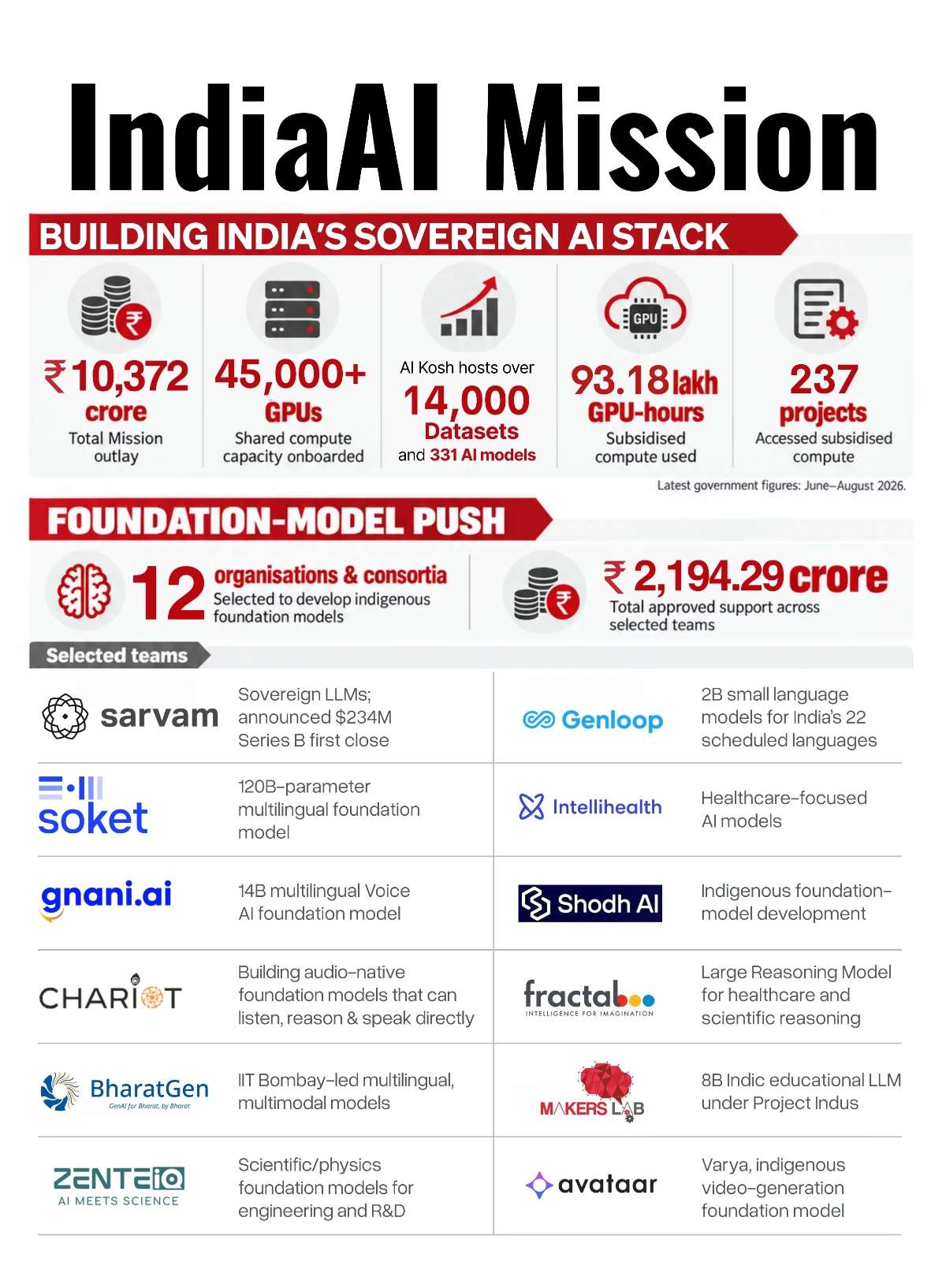
That is the bet behind the ₹10,372 crore IndiaAI Mission. The question is whether ₹10,372 crore, and everything that follows, will be enough.
The First Signs of Success
In July, Sarvam unveiled Bulbul V4, its latest text-to-speech model, with richer emotion, more natural expression and greater control over vocal delivery.
Sarvam says the model beat US platforms ElevenLabs and Cartesia Sonic-3 in a 20,000-vote blind listening study across 11 Indian languages.
It also released Saaras V4, its speech-recognition model, which supports 22 Indian languages and five output modes, including transcription, translation, transliteration and code-mixed speech.
Sarvam says Saaras V4 recorded the lowest average word-error rate across seven English speech-recognition benchmarks, including tests of Indian-accented English, while also adding single-pass multi-speaker transcription.
However, these models are in no way comparable to GPT, Claude or Gemini, nor is that necessarily the point.
Those are the product of decades of investment in talent and hundreds of billions of dollars in capital.
Yet, Indian AI startups face another critical area where they must leapfrog the competition.
Building Models Won’t Automatically Lead to Commercialisation
The first question is whether the ₹10,372 crore of public money allocated to the IndiaAI Mission is producing a credible path to commercial adoption.
That is less clear when Indian consumer companies are increasingly choosing foreign AI infrastructure for precisely the use cases that startups such as Sarvam claim to be building for and excelling at.
ElevenLabs, for instance, powers multilingual voice applications at Meesho, Cars24, ShareChat and 99acres, including Hindi and other Indian-language use cases. Sarvam, meanwhile, claims Bulbul V3 outperformed ElevenLabs in an independent blind listening study across 11 languages.
Karnataka’s government is also exploring ElevenLabs for voice-AI pilots spanning skilling, healthcare, investment promotion and citizen services.
Similarly, while the IndiaAI Summit event was meant to showcase India’s AI ambitions, OpenAI announced partnerships with Tata, JioHotstar, Eternal, Pine Labs, Cars24, HCLTech, PhonePe, CRED and MakeMyTrip.
So even if startups in India’s AI mission aren’t competing with global AI firms on models, they’re competing against the distribution advantage and market hold that these companies already have on the Indian market.
But Sarvam’s adoption path is taking shape, with partnerships including Swiggy and Razorpay for voice-led commerce, and IDFC FIRST Bank for a joint R&D lab focused on banking AI.
Its broader partnerships with companies such as IBM, HCLTech, HP, Mahindra Finance and IndiGo suggest an expanding enterprise distribution strategy.
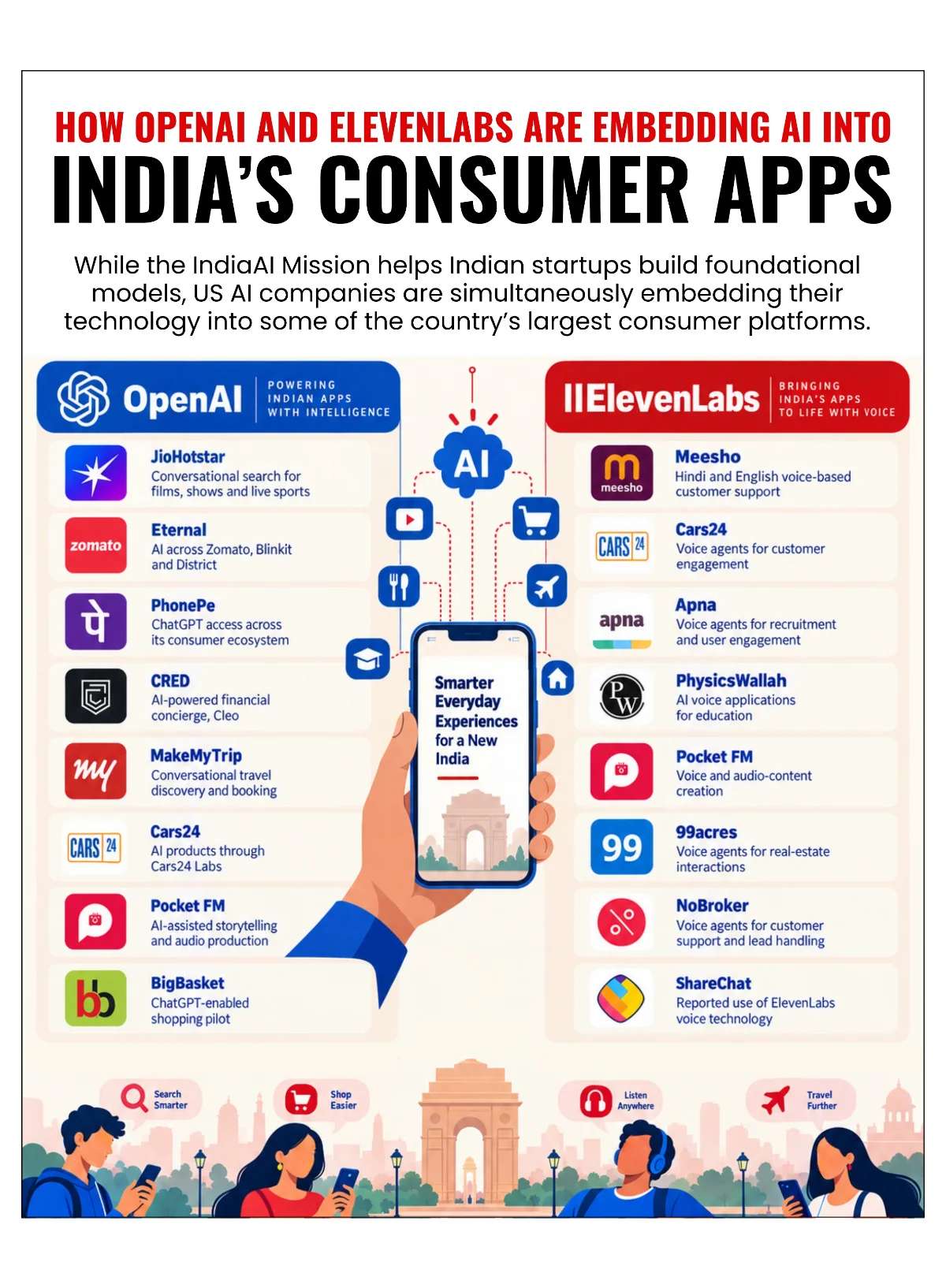
ChatGPT and foreign voice-AI providers such as ElevenLabs remain deeply embedded in India’s consumer and AI landscape.
OpenAI says India now has more than 100 million weekly ChatGPT users. Little evidence yet shows that India’s homegrown models are taking a meaningful share of the consumer AI market from the American labs.
This boils down to a major factor that puts a ceiling on India’s sovereign AI ambitions—and, to an extent, every other country’s: compute.
The Inevitable Dependency
Almost every major AI system today ultimately depends on hardware from US companies such as NVIDIA and AMD, or on cloud infrastructure controlled by US hyperscalers.
India is now attracting some of the world’s largest AI infrastructure investments from Microsoft, Amazon and Google.
Google has committed $15 billion to an AI hub in Visakhapatnam, including gigawatt-scale compute.
Amazon has committed another $13 billion to expand AI and cloud infrastructure in India by 2030, taking its total planned investment to $48 billion, and Microsoft is bringing its largest Indian data centre online in Hyderabad.
But compute is precisely where India’s sovereign-AI ambitions encounter their hardest constraint.
Would companies currently choosing ElevenLabs adopt Sarvam’s models if Sarvam could offer comparable performance while also providing the compute capacity to serve those models reliably at scale?
Capacity remains constrained. Even the IndiaAI Mission’s subsidised compute has faced utilisation and deployment problems, while access to high-end GPUs remains expensive.
And this creates the uncomfortable contradiction at the heart of sovereign AI. India can build its own models, but if the infrastructure required to train and serve them at scale remains dependent on globally controlled GPU supply and US cloud companies, the sovereignty exists only at the model layer.
Today, compute is in visible short supply.
Even six-year-old NVIDIA A100 GPUs are appreciating in value as demand for inference and other workloads keeps them in use.
GPU providers in the US, like CoreWeave, recently signed an A100 contract extending into 2029, while saying pricing for older-generation GPUs remains at or above levels seen years ago.
These neoclouds, the companies which enable access to GPUs via the cloud, have admitted to hoarding GPUs. One such company, Nebius, says it could sell its entire 2027 capacity today but is deliberately holding some back for future demand.
“Global demand, tight memory supply and large technology companies securing capacity are putting pressure on both hardware availability and cloud economics,” Karan Jaju, Co-Founder of CloudPe, tells AIM. “We anticipate GPU cloud pricing in India could rise by 15–20% over the next 12–18 months unless memory supply eases or alternative architectures gain traction.”
Currently, the IndiaAI Mission has onboarded more than 38,000 GPUs through its shared compute portal and plans to add another 20,000, with the government targeting over 1,00,000 GPUs by the end of 2026.
Given the high cost of GPUs, government-led procurement has been one of the easier ways leading Indian AI startups can access compute. “Without that, chasing these dreams would be very difficult,” says Ganesh Gopalan, CEO and co-founder of Gnani AI, a startup selected for the IndiaAI Mission.
“The rest is our hard work, a lot of luck, research, and talent….But without compute, you’re nowhere. I’m fairly thankful to the government for making that possible,” he adds.
Private providers such as Yotta, Sarvam and Neysa are also expanding their own GPU infrastructure, with announced capacities ranging from thousands to tens of thousands of GPUs.
Yet, even these figures, put together, remain modest relative to the compute required to train and deploy sovereign AI systems at a national scale, particularly when much of the capacity is allocated in phases or is still under development.
While global hyperscalers are expanding their AI infrastructure in India, Jaju explains that their pricing models may not work well for startups that need predictable, long-term compute costs.
Hyperscalers typically offer enterprise and on-demand pricing, but rising GPU infrastructure costs make it difficult for startups to secure stable pricing. “When a startup wants a stable or fixed pricing model and wants predictability over pricing, a hyperscaler like AWS cannot assure that,” he says.
However, Sarvam has since raised $234 million, while Neysa has secured a $1.2 billion capital raise, including planned debt financing, to scale its AI infrastructure and deploy more than 20,000 GPUs in India.
It remains to be seen how much this funding will translate into access to additional compute, and whether that access will be sufficient to ease the constraints facing Indian AI companies.
Nobody is 100% Sovereign
India’s AI sovereignty ultimately depends on foreign compute and how easily and at what scale it can procure it. That makes it important to treat sovereignty as a spectrum, rather than an absolute state of independence.
Even the US depends on the Netherlands for ASML’s EUV machines, which are essential to manufacturing the most advanced chips, and remains exposed to China for critical minerals and rare-earth processing.
China has its own frontier models, domestic AI infrastructure, and chipmakers such as Alibaba and Huawei for AI workloads, yet Chinese AI labs still use NVIDIA GPUs for leading models because of their performance.
“Dependence on NVIDIA and other global hardware suppliers does not necessarily undermine sovereign AI,” Jaju says. “India will continue to participate in the global hardware ecosystem, but sovereignty should be defined by control over where data, workloads and intellectual property reside.”
So what definition of sovereignty must India pursue? Puneet Chandok, President of Microsoft India, tells AIM, “I think sovereignty today is less about geography and more about trust.”
“Sovereignty is about which stack that you trust to build on.”
Chandok ties the argument to the company’s push to expand cloud and AI infrastructure in India, and to the collaboration essential between US big tech companies and the Indian AI ecosystem.
The challenge is to build an ecosystem in which Indian AI companies can trust the infrastructure, software and talent they depend on, whether those resources are domestic or foreign.
That interpretation of sovereignty also changes how India should procure AI. If the goal is reliable infrastructure, competitive capability and control over critical workloads—not simply geographic ownership—then local-content requirements may be the wrong test.
Venkatesh Krishnamoorthy, Country Manager of India at the Business Software Alliance, tells AIM, “Procurement rules should allow departments to choose the best available AI products based on outcomes, security, and performance.”
He adds that removing unnecessary barriers to cloud use and cross-border data transfers would help Indian developers access the data and technologies needed to build and deploy competitive AI systems.
Along these lines, some strongly believe sovereignty is essentially synonymous with access: it matters less where the model is built than whether the country has unrestricted access to it. This is where open-weight models come in.
Tech and policy researcher Pranesh Prakash argues that sovereignty is not about where a model is built, but about whether a country has unrestricted access to use, modify, and deploy it.
Prakash, a strong advocate for building atop open-weight models, tells AIM, “At a minimum, what is required for digital sovereignty when it comes to AI is access to open models.”
“Whether a model is Indian-made or not does make a difference in that regard,” he says.
In contrast to proprietary reasoning models, open-source and open-weight models let users freely download, modify, fine-tune, and deploy them without permission from the original developer.
The Need to Build Models From Scratch
While Indian AI startups do not completely dismiss this argument, they prioritise building models from scratch, arguing that the experience builds a long-term foundation.
“Doing so creates an ecosystem that will allow you to pursue new trajectories and areas of thought,” says Sajo Mathews, Machine Learning Lead at Deccan AI.
He argues that without investing in foundational AI capabilities, countries risk losing the ability to identify and pursue the next wave of technological breakthroughs.
“Trying to short-circuit does not create the ecosystem and the capabilities that you actually need underneath to be able to create something which is valuable,” Mathews says.
Vivek Raghavan, Co-Founder of Sarvam, also goes so far as to agree that post-training open-weight models will be sufficient in ‘99% of use cases’, but they may not be feasible for national security use cases.
“My definition of a sovereign model is a model where the sovereign can actually audit the data that was used to train the model,” he notes.
He explains that linguistic factors mean some of the model’s lowest levels, like the tokeniser when built from scratch and tailored to Indic languages, can yield better results.
Similarly, Dheemanth Reddy, Co-Founder and CEO of Maya Research, which builds voice models for India, says voice models need to be carefully built to account for nuances in tone, pacing, and emotion across the many languages spoken in India.
“A model speaking Telugu or Kannada should not simply translate information into those languages, but understand the cultural context in which they are spoken,” he adds.
The Reverse Brain Drain Dream
Even if an Indian AI startup has the compute to train a model from scratch, post-train an open-weight model, or scale an application, another bottleneck remains: talent.
India’s premier research institutions produce strong researchers, but the ecosystem still faces two structural constraints: insufficient research funding and talent leaving the country.
Sarvam appears to be experimenting with a different approach to the latter.
Its San Francisco office, including the hiring of former SpaceX AI researcher Devendra Chaplot, suggests that building India’s AI ecosystem may not always require bringing every researcher back.
Whether this model can help Indian companies access top talent while retaining their connection to the domestic ecosystem remains to be seen.
The IndiaAI Mission has faced legitimate questions over whether tens of thousands of crores in public spending is justified given the country’s other development priorities, and whether sovereign AI risks becoming an exercise in national pride.
But it would be premature to conclude that the mission has made no progress. Sarvam’s recent announcements, in particular, suggest that India is beginning to build capabilities that were previously difficult to imagine.
But AI models, sovereign or otherwise, have little value if they go unused.
For India’s AI ambitions to translate into something more than technological self-sufficiency, these models must win adoption in the real world, across both consumer and enterprise applications.
Perhaps the clearest measure of success would be seeing Indian users and businesses choose Indian AI services over established foreign alternatives, and in many cases switching their deployments, not because they are Indian, but because they better suit their needs.
- This Bengaluru Startup Is Building AI Agents for Hardware Design
- Drizz Is Taking on the Reliability Challenge in AI App Testing
- How This Indian AI Unicorn is Disrupting Hollywood With Digital Humans
- The AI Underwriting Engine Behind Recur Club’s ₹500 Cr Festive D2C Capital Push
- Loan Collection in India is Still Largely Manual. This AI Startup is Changing That
- The Antithesis Approach to Breaking AI-Generated Code