

As organisations move AI workloads into production, there are more urgent questions around data residency, cloud dependence, and where sensitive workloads should run that need to be addressed.
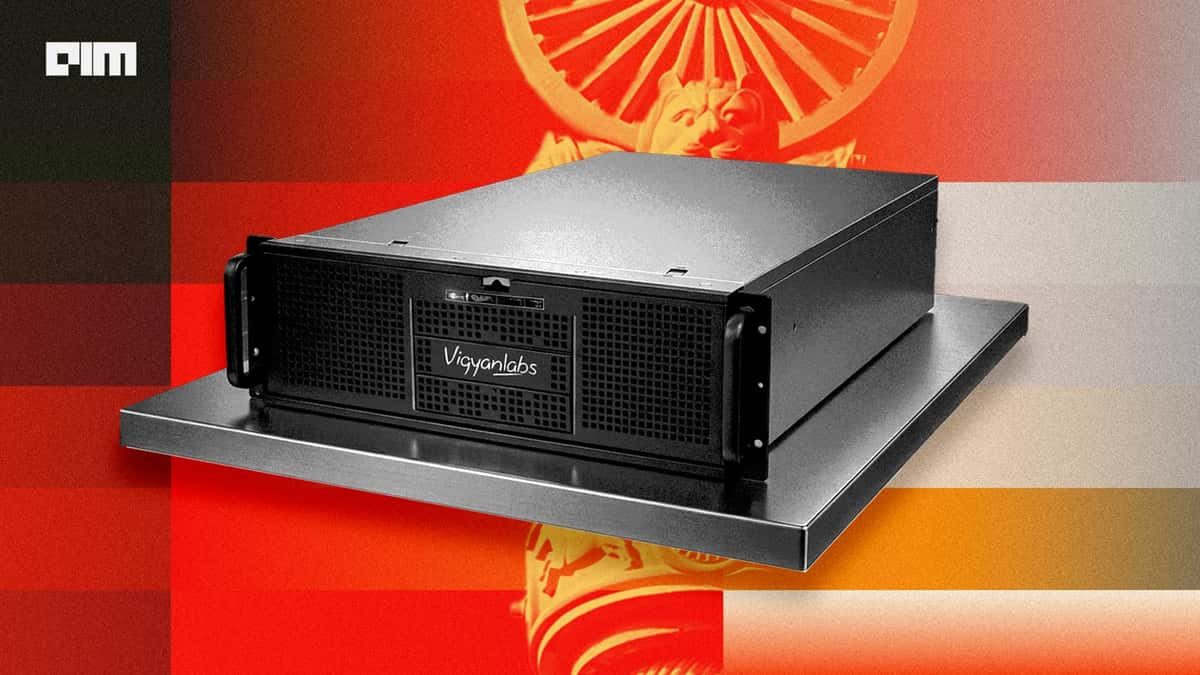
Krishnaa Advance Systems (KAS) and Mysuru-based AI startup Vigyanlabs are betting that some of this compute will need to sit much closer to the organisations using it. The companies recently launched FEMTO as an integrated AI infrastructure appliance that brings compute, storage, networking, virtualisation, orchestration, and power management into a single system.
According to former ISRO chairman S Somanath, the top-end FEMTO-4 configuration is rated for up to 32 PFLOPS of AI compute alongside its integrated GPU cloud, virtualisation, orchestration, and model-serving stack.
AI Data Centre-in-a-Box
FEMTO is the result of a partnership between KAS, a subsidiary of Krishna Buildestates, and Vigyanlabs, which has developed the underlying technology stack.
KBE is a third-generation contracting company with experience across industrial plants, townships, and commercial developments. According to Rahul Bahl, Managing Director of KAS, the subsidiary was established to apply KBE's construction and engineering expertise to sovereign AI infrastructure, while Vigyanlabs contributes its patented technology stack.
For Vigyanlabs CEO Srinivas Varadarajan, the idea emerged from a gap between growing AI adoption and the infrastructure available to run it.
"The idea for FEMTO emerged from a simple observation: AI adoption was accelerating rapidly, but the infrastructure required to run AI remained largely dependent on conventional data-centre architectures, high power consumption and external cloud platforms," Varadarajan tells AIM.
Bahl adds that KAS had encountered a similar problem through conversations with potential customers. Organisations looking to deploy AI infrastructure independently often faced a choice between building complex data centre infrastructure or using foreign-hosted infrastructure where they had less control over workloads and data.
FEMTO aims to simplify that deployment by consolidating infrastructure that organisations would otherwise procure and integrate separately.
The system arrives as a configured 4U appliance with its infrastructure and AI software installed. An organisation can rack it, connect power and network, establish access controls, and begin running workloads. For completely air-gapped deployments, no internet connection is required.
Running AI Where Data Sits
FEMTO is primarily designed for AI inference rather than training foundation models from scratch. Its intended workloads include real-time AI applications, multi-user and multi-model serving, retrieval-augmented generation, and lightweight fine-tuning.
It supports open models including Llama, Mistral, Gemma, Qwen, Phi, and GPT-OSS, along with multimodal and embedding models. The company also says its highest-performance configuration can support models containing up to 1 trillion parameters.
According to Varadarajan, FEMTO-4 has been tested with DeepSeek-V4-Flash, Gemma-4-31B, Qwen3.8-27B, and Nemotron-3-Super-120B. However, the company has not disclosed detailed benchmark results from those tests.
The FEMTO family has four configurations for different demand levels. Lower configurations are intended for departmental deployments and lighter inference workloads, while higher configurations target enterprise, government, defence, and institutional workloads requiring greater compute density and multi-model serving.
Vigyanlabs describes FEMTO as more than a conventional GPU server because the appliance integrates compute with storage, networking, virtualisation, orchestration, and power management.
Smaller AI Infrastructure
Power efficiency is another part of the pitch.
Vigyanlabs claims FEMTO consumes 50% less power than a conventional server-based setup delivering similar AI compute. Varadarajan attributes this to the combined system architecture, including purpose-built hardware, thermal design, and intelligent power-management software.
The company says the highest-performance FEMTO configuration consumes less than 6 kW and can operate using air cooling. According to Vigyanlabs, this removes the need for additional liquid-cooling infrastructure and requires no cooling water.
KAS separately claims that FEMTO can reduce data centre capital expenditure by 30% compared with a conventional deployment. That comes partly from consolidating compute, networking, security and cooling, as well as eliminating water infrastructure and allowing customers to size electrical capacity around a smaller footprint.
The companies point to the Vigyanlabs AI Data Centre in Mysuru as an operational reference. The facility runs on the FEMTO architecture at a power usage effectiveness, or PUE, below 1.3 and operates with air cooling only.
KAS said broader case-study data from early customer deployments, covering cost outcomes and performance under real workloads, is still being finalised.
Sovereignty Beyond Hardware
FEMTO's other central proposition is sovereign AI. FEMTO can be deployed on-premises and can operate in a completely air-gapped environment without an external cloud connection.
"For a bank, hospital, or government body, this is the difference between using AI and being able to demonstrate, on demand, exactly where data resides and who can access it," Bahl says.
Vigyanlabs says more than 50% of FEMTO's content is indigenous and that its complete software stack is developed in India. Some semiconductors and specialised components are sourced from the global supply chain, while the company says the architecture, system integration, software stack,m and power-management technology are developed in India.
Bahl says the strongest interest so far has come from government and regulated enterprises, including banking, insurance, and public infrastructure. He said defence organisations have also shown interest, although procurement cycles in the sector tend to be longer.
Pilots have been completed with India Post, IBM, and IIT Bombay. The company has not disclosed detailed performance results from these pilots or additional customer names.
A ₹100 Cr Bet
KAS and Vigyanlabs plan to invest ₹100 crore over the coming year.
The investment will go towards manufacturing capacity, R&D for future generations beyond FEMTO-4, and expanding deployment in sectors including government and regulated enterprise. The spending will also cover sales, support, installation, certifications, and compliance work required for regulated customers.
FEMTO is currently being offered through an outright purchase model for organisations seeking ownership of the infrastructure. KAS plans to add leasing and infrastructure-as-a-service options for customers that want access to AI infrastructure without the same upfront capital expenditure.
The longer-term plan extends beyond selling individual appliances.
Bahl expects India's AI infrastructure to become more distributed, with sovereign computing nodes deployed across cities and sectors. Varadarajan similarly expects more AI compute to move closer to where data is generated, including enterprises, factories, government departments, defence environments, hospitals, campuses, and other specialised environments.
That would place systems such as FEMTO alongside, rather than necessarily in place of, large cloud and data centre infrastructure. Centralised facilities can continue serving workloads that benefit from shared large-scale compute, while on-premise systems can target organisations that want greater control over infrastructure, data residency, or disconnected operations.
For KAS and Vigyanlabs, the immediate question is whether the appliance can move beyond pilots and early deployments into broader commercial adoption.
- The Bengaluru Founder Building a Bridge to San Francisco
- This Bengaluru Startup Is Building AI Agents for Hardware Design
- Drizz Is Taking on the Reliability Challenge in AI App Testing
- How This Indian AI Unicorn is Disrupting Hollywood With Digital Humans
- The AI Underwriting Engine Behind Recur Club’s ₹500 Cr Festive D2C Capital Push
- Loan Collection in India is Still Largely Manual. This AI Startup is Changing That