
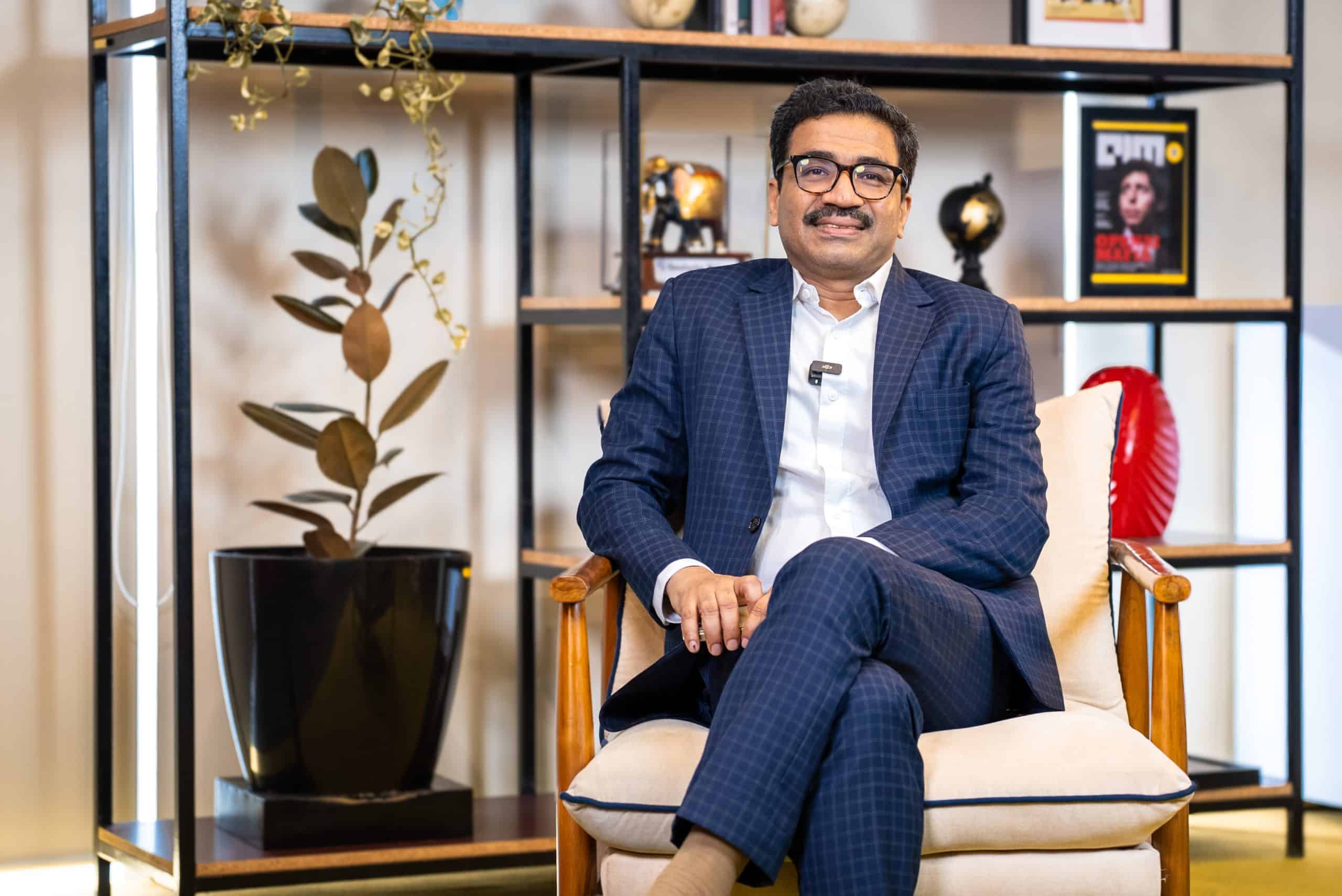
Yotta Infrastructure is targeting to raise $1.25-1.5 billion through a combination of a pre-IPO round and its upcoming initial public offering (IPO) to fund its AI infrastructure expansion, CEO Sunil Gupta tells AIM in an exclusive interaction.
Gupta also dismisses news reports that the company plans to raise about $1 billion by selling a 25% stake, calling them ‘completely inaccurate’ and clarifying that no promoter is selling shares. “No promoter is exiting; no promoter is selling shares. The entire funding will go into the company for further capex investments,” he says.
Gupta adds that Yotta has already completed the first leg of its pre-IPO fundraising by securing around $150 million from 150 high-net-worth individuals (HNIs) and family offices over the past three to four months. He shares that the company’s latest funding round values Yotta at approximately ₹37,000 crore ($3.9 billion).
The company is now in discussions with large global institutional investors and expects to file its Draft Red Herring Prospectus (DRHP) within the next few weeks.
$7 Billion Capex
Gupta says the company’s AI infrastructure capex of around $7 billion represents cumulative investments across multiple GPU deployments rather than a single project.
He further shares that Yotta has already invested around $1.8 billion since its inception in 2019. The investments span its Mumbai and Greater Noida data centre campuses, sovereign cloud infrastructure, managed cloud services, and its initial deployment of around 10,000 NVIDIA GPUs.
Gupta adds that those were GPUs used by Indian AI startups, including Sarvam AI and BharatGen, to train their models.
Beyond its GPU infrastructure, Yotta also operates sovereign cloud infrastructure for the National Informatics Centre (NIC) and the Software Technology Parks of India (STPI), powering the NIC Cloud and STPI Ananth Cloud, Gupta says.
85,000 GPUs
At the IndiaAI Impact Summit held in February, Yotta announced plans to deploy 20,736 liquid-cooled NVIDIA Blackwell Ultra GPUs, backed by an investment of over $2 billion. The company also said NVIDIA would establish one of the Asia-Pacific region’s largest DGX Cloud clusters within Yotta’s Blackwell Ultra supercluster under a four-year engagement worth more than $1 billion.
Gupta revealed that the company had already ordered 8,192 NVIDIA Blackwell B200 GPUs before announcing its 20,000 Blackwell B300 deployment during the AI Impact Summit.
According to Gupta, all 8,192 B200 GPUs have already been delivered and are being deployed for two global customers, each of which has contracted 4,096 GPUs under long-term agreements lasting four to five years.
However, Gupta said surging global demand has prompted Yotta to further increase that deployment.
“Because of this rush, I have increased my GPU cluster capacity by an additional 10,000 units,” he says.
The GPUs will be installed at Yotta’s Delhi campus, called D2. “It’s a 60-megawatt building. Earlier, I was planning to use 40 megawatts of that building for 20,000 GPUs. But I’m using the remaining 20 megawatts to put in an additional 10,000,” he says.
Beyond that, Gupta says the company plans to deploy another 36,000 GB300 GPUs at a second facility on its Mumbai campus, a 75-megawatt data centre called NM2.
Taken together, the company’s existing 10,000 GPUs, the 8,192 B200 GPUs, the planned 30,000 B300 GPUs, and the additional 36,000 GB300 GPUs will bring Yotta’s total GPU capacity to around 85,000.
“I would say almost like 85-90% of this capacity is going to global offtakers who are giving long-term contracts. Our realisation is also that this GPU market is a completely global market. People are just looking for good-quality, NVIDIA-certified reference architecture clusters,” he says.
Rise of Overseas Customers
Gupta says more than 75% of Yotta’s existing 10,000 GPU capacity is already contracted by overseas customers, primarily from the US and Europe and have nothing to do with India. He shares that demand accelerated after NVIDIA introduced Yotta to global customers during NVIDIA GTC earlier this year.
Gupta says nearly 85-90% of the company’s upcoming GPU capacity has already been contracted by global customers through long-term agreements, with many customers paying advances months before deployment due to the worldwide GPU shortage.
“The model builders and the inference providers were looking for high-quality GPU clusters, and NVIDIA did the matchmaking for us. Within five days, I ended up contracting almost 6,000 of our GPUs,” he says. He adds that many of those GPUs became available after completing training workloads for Sarvam AI and the Indian Institute of Technology (IIT) Bombay following the IndiaAI Impact Summit.
“Out of my existing set of around 10,000 GPUs, more than 75% are dollar-denominated, which means they are with global customers. The US customers are using this GPU cluster to serve their respective US and European markets—nothing to do with India,” he says.
Changes Required in IndiaAI Mission
Gupta also criticises the current IndiaAI Mission procurement model, saying that the short duration of government contracts weakens the business case for large GPU investments.
He complains that GPU providers are expected to invest billions of dollars before receiving any contract award. “We have been giving constant feedback to the IndiaAI Mission. There’s something fundamentally and structurally wrong with the way it is structured,” Gupta says.
Moreover, he says the current framework allows new players to participate by offering lower prices, even if they have not yet deployed GPU infrastructure or are offering lower-performance GPUs.
He adds that these players can participate by meeting the minimum benchmark and providing a bank guarantee.
Gupta argues that while lower prices may appear beneficial at first glance, the approach allows ‘a lot of non-serious players’ into the market.
“If they give you only one-year contracts, then you have to figure out how you will recover your balance investment. You will amortise your cost over four or five years,” Gupta says.
He adds that Yotta has been consistently sharing this feedback with the government and expects changes in the next version of the IndiaAI Mission. “I think they are coming with IndiaAI Mission Version 2.0,” he says.
Types of Customers
Gupta says Yotta currently serves two distinct categories of AI customers. The first consists of enterprises and AI companies that rent dedicated GPU clusters for training, fine-tuning and inference
“I give them GPU clusters, and then it’s up to them what they want to do on that, whether they’re building their own models or doing inferencing,” Gupta says. He adds that customers in this category include Sarvam AI, Zoho, and IIT Bombay.
The second category comprises users of Yotta’s Shakti Studio, the company’s inference platform that hosts around 77 AI models and charges customers on a token basis.
Gupta says Yotta is seeing strong adoption of open-source models on its AI Factory platform, with DeepSeek and Llama among the most popular choices.
However, Gupta says inference remains a relatively small business today as most enterprises are still evaluating AI. The largest source of demand for Yotta’s GPU infrastructure currently comes from global model builders and AI marketplaces, which use thousands of GPUs for both model training and inference. He concludes that these customers typically run inference workloads during peak usage and switch idle GPUs to training during off-peak hours.

Your reaction
Discussion
What's your take on this story?
No comments yet — be the first to share your view.