
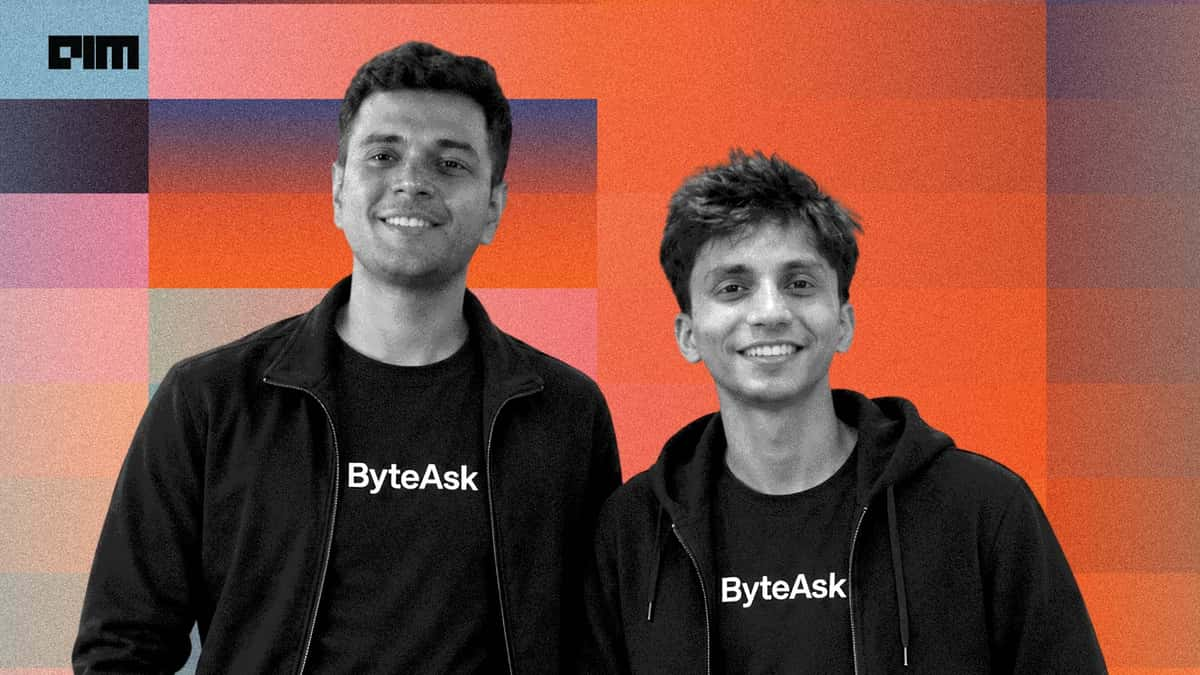

Two IIT Delhi computer science graduates built an AI legal research startup, attracted more than 5,000 lawyers and sold the company to Manupatra within four months of founding it. Now, less than a year later, Anirudha Kulkarni and Pratyush Saini are back with a second startup, this time targeting one of the areas where they believe generic AI coding tools still fall short: C and C++.
Their new company, ByteAsk, has raised $1 million in pre-seed funding from Y Combinator and Entrepreneur First, alongside angel investors from global quantitative trading firms. Founded in June and headquartered in San Francisco, the startup is building AI coding agents for developers working in mission-critical environments including automotive, robotics, high-frequency trading, embedded systems, aerospace and semiconductors.
The shift from legal research to systems programming may appear unusual, but the founders see a common thread between the two ventures: generic AI models are not enough when the cost of an error is high.
“Building LawSutra taught us that models are only as useful as the context, verification and workflows around them. At ByteAsk, we are applying that same philosophy to code,” says Co-Founder and CEO Kulkarni.
Why C and C++?
AI coding assistants have rapidly changed how developers write software, particularly in languages such as Python and Java. But the founders argue that those gains have not translated equally to C and C++, where developers often work with large legacy codebases and spend considerable time debugging, testing, profiling and verifying changes.
“If you look at the way the average Python developer is programming now, it’s vastly different from how C is behaving because he is getting all these AI coding tools,” Kulkarni adds.
The problem becomes more consequential in systems where software controls physical or financially critical infrastructure. According to Kulkarni, C developers are often dealing less with generating lines of new code and more with understanding and modifying existing systems.
“Any C developer, they are usually paid for removing stuff and debugging existing info and not generating lines and lines of code,” he says, adding that in environments such as aircraft, an AI-generated error can become a much more serious problem because the software operates in a safety-critical setting.
ByteAsk is therefore not positioning itself as another general-purpose coding assistant. Its product combines an agentic coding environment with tools used by C and C++ developers and references technical documentation, standards and specifications relevant to the systems being developed.
The company says this grounding is intended to reduce hallucinations, particularly around specialised technical details. “Every decision that is taken by the coding agent has some reference to all the documentation that is out there in the market for C like their standards, their guidelines,” says Co-Founder and CTO Saini.
A Crowded Coding-Agent Market
ByteAsk is entering an increasingly crowded AI coding market dominated by companies such as GitHub, Anthropic, OpenAI and Cursor. Investment banking and financial services company William Blair estimates that AI coding generated more than $5 billion in sales in 2025, while CB Insights put the broader coding AI agents and copilots market at $4 billion, with the top three players accounting for more than 70% of the market.
While general-purpose tools focus on generating and modifying software across languages, the founders argue that C and C++ require greater emphasis on existing codebases, debugging, verification, performance profiling and technical specifications.
Cursor is one of the company’s direct competitors, according to the founders, while Microsoft is also entering the space. Rather than compete purely on code generation, ByteAsk is building around C/C++-specific tools and technical documentation.
The founders estimate that C++ represents around $400 billion in annual salary spend and see agentic coding as a roughly $10 billion opportunity. The figures are ByteAsk’s own estimates, but they underline the size of the developer workforce the startup is targeting.
From LawSutra to ByteAsk
The founders’ first company, LawSutra AI, was also built around the limitations of generic AI. The startup focused on semantic legal search, allowing users to search by the meaning and context of a query rather than relying only on keywords. It attracted more than 5,000 lawyers before Manupatra acquired it four months after its founding.
That experience appears to have shaped ByteAsk’s approach. Rather than assuming a more capable general-purpose model will automatically solve a specialised problem, the founders are building infrastructure around the model to provide domain-specific context and verification.
The two founders also bring direct experience in systems and AI infrastructure. Kulkarni holds B.Tech and M.Tech degrees in computer science from IIT Delhi and previously worked on low-latency C++ systems at Optiver and Quantbox Research. Saini, who holds a B.Tech in Computer Science and Engineering from IIT Delhi, previously worked on AI infrastructure at ThirdAI and AI security systems at SimbianAI.
That background helped them identify the problem from both sides: as AI engineers watching coding agents improve rapidly, and as systems programmers familiar with the constraints of C and C++.
A Specialised Market for AI Coding
Its immediate customers are expected to come from high-frequency trading, automotive and embedded systems, with expansion into other industries planned later. The company says its agents are already being used more intensively than a comparable open-source coding agent and that its weekly active users are doubling week-on-week. On an internal benchmark involving real firmware engineering tickets, ByteAsk said its grounding environment enabled a smaller model to resolve 89% of tickets, compared with 61% for the best frontier model tested without the environment.
The fresh capital will go towards research and engineering, GPU compute, training data and enterprise infrastructure, including security, privacy and on-premises deployment. ByteAsk is also developing its own post-training approach for C++, with plans to release a specialised model within the next six to eight months.
For the founders, the longer-term goal is not simply to make an AI assistant that writes C++ faster. They want to reach a point where developers can delegate increasingly complex engineering work to specialised agents while retaining control over accuracy, latency and cost.
“The way I see the future for C developers would be very similar, even better than Python developers, where cost is not a bottleneck at all,” Kulkarni says.
- The Bengaluru Founder Building a Bridge to San Francisco
- This Bengaluru Startup Is Building AI Agents for Hardware Design
- Drizz Is Taking on the Reliability Challenge in AI App Testing
- How This Indian AI Unicorn is Disrupting Hollywood With Digital Humans
- The AI Underwriting Engine Behind Recur Club’s ₹500 Cr Festive D2C Capital Push
- Loan Collection in India is Still Largely Manual. This AI Startup is Changing That