
Teaching machines to understand human context can be a daunting task. With the current evolving landscape, Natural Language Processing (NLP) has turned out to be an extraordinary breakthrough with its advancements in semantic and linguistic knowledge. NLP is vastly leveraged by businesses to build customised chatbots and voice assistants using its optical character and speed recognition techniques along with text simplification.
To address the current requirements of NLP, there are many open-source NLP tools, which are free and flexible enough for developers to customise it according to their needs. Not only these tools will help businesses analyse the required information from the unstructured text but also help in dealing with text analysis problems like classification, word ambiguity, sentiment analysis etc.
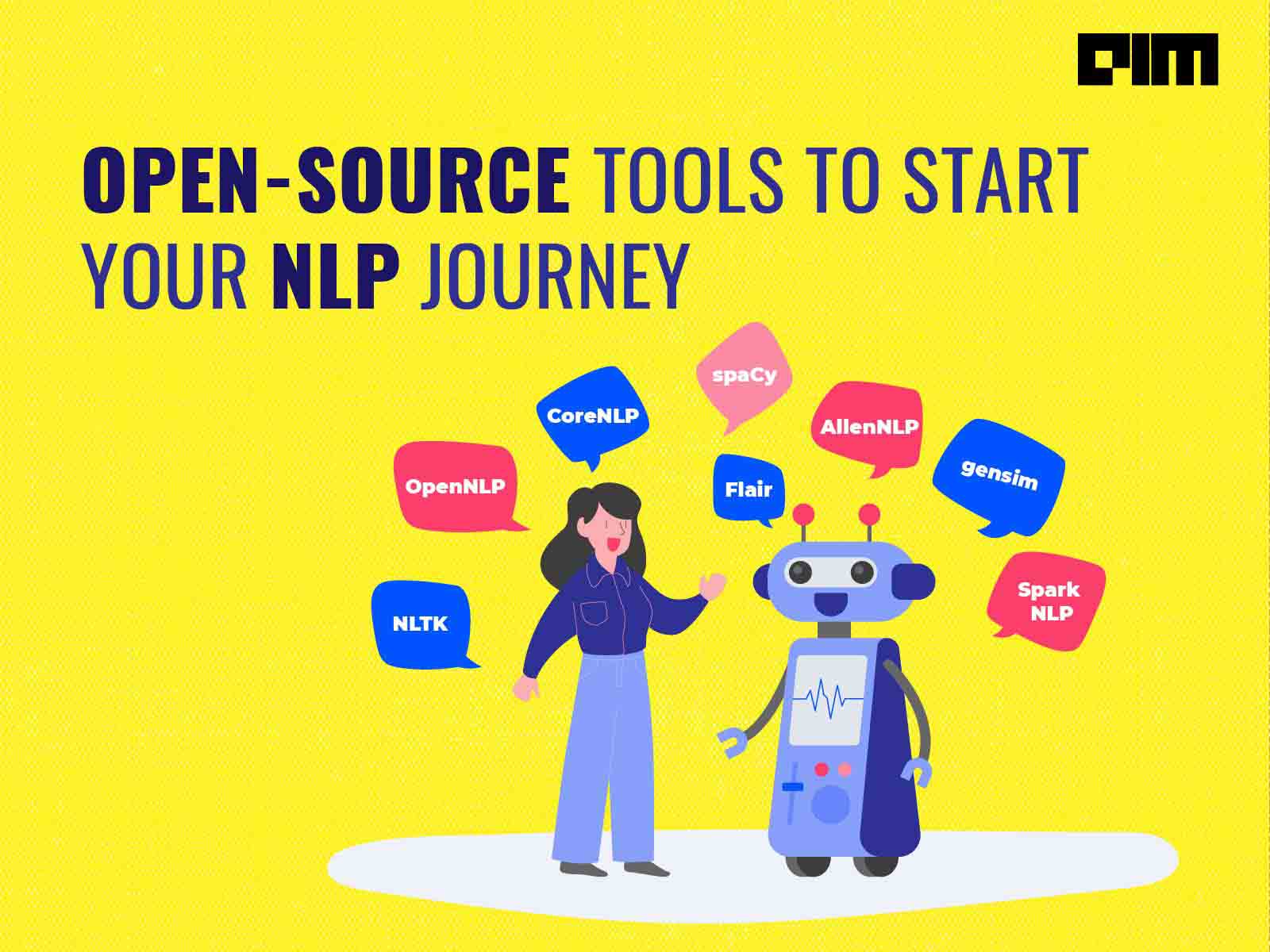
Here are eight NLP toolkits, in no particular order, that can help any enthusiast start their journey with Natural language Processing.
Also Read: Deep Learning-Based Text Analysis Tools NLP Enthusiasts Can Use To Parse Text
1| Natural Language Toolkit (NLTK)
About: Natural Language Toolkit aka NLTK is an open-source platform primarily used for Python programming which analyses human language. The platform has been trained on more than 50 corpora and lexical resources, including multilingual WordNet. Along with that, NLTK also includes many text processing libraries which can be used for text classification tokenisation, parsing, and semantic reasoning, to name a few. The platform is vastly used by students, linguists, educators as well as researchers to analyse text and make meaning out of it.
USP: Tokenisation; Identifying named entities; Sentiment analysis.
Click here to try it out.
Also Read: Despite The Breakthroughs, Why NLP Has Underrepresented Languages
2| OpenNLP
About: Apache OpenNLP library is also an open-source ML-toolkit that helps in processing natural language text. Along with supporting the most common NLP tasks, such as tokenisation, segmenting sentences and tagging part of speech part-of-speech, OpenNLP can also be leveraged to build more advanced text processing services. It also includes maximum entropy and perceptron based machine learning.
USP: Extracting named entity; Chunking; Parsing; Detecting language; Coreference resolution.
Click here to try it out.
Also Read: Is Common Sense Common In NLP Models?
3| CoreNLP
About: CoreNLP is an open-source platform developed by Stanford NLP Group as a comprehensive solution for natural language processing in Java. By supporting side languages, CoreNLP allows in deriving linguistic annotations in text. CoreNLP takes the raw text by humans and analyses its parts of speech, names, people, dates, times, numeric quantities, etc. to indicate the relevant noun phrases.
USP: Works with six languages including Arabic, Chinese, English, French, German, and Spanish; Parsing; and Tokenisation.
Click here to try it out.
Also Read: How This NLP-Driven Literature Search Engine Helping In COVID
4| spaCy
About: spaCy is an open-source library in Python and Python for Natural language Processing. Built on the latest research, spaCy is designed for deploying in real-world products. It comes with pre-trained statistical models and word vectors supporting more than 60 languages. spaCy is licensed under MIT and is commercial for anyone to use.
USP: Linguistic annotations; Tokenisation; Named Entities; Word Vectors; Dependency Parsing, Lemmatisation.
Click here to try it out.
Also Read: How Domain-Specific Pre-Training Can Outstrip General Language Models
5| AllenNLP
About: AllenNLP is again a free, open-source natural language processing platform built on PyTorch, can be used for the building ML model. AllenNLP encompasses reference implementations of high-quality models for both core natural language processing tasks like semantic role labelling and other NLP applications like textual entailment.
USP: Answering questions; Semantic role labelling, Textual Entailment; Text to SQL
Click here to try it out.
Also Read: Top 8 Pre-Trained NLP Models Developers Must Know
6| Flair
About: Flair is an open-source and a simple framework built by the Humboldt University of Berlin. Built on PyTorch, Flair is one of the renowned deep learning frameworks available. It comprises advanced word embeddings like GloVe, BERT, ElMo etc. and has been designed to support several languages and an easy to use API.
USP: Named entity recognition; Part-of-speech tagging; Sense disambiguation; Classification.
Click here to try it out.
Also Read: How To Establish Reasoning In NLP Models
7| gensim
About: gensim is an open-source Python library, which can be used for topic modelling, document indexing as well as retiring similarity with large corpora. gensim’s algorithms are memory independent with respect to the corpus size. It has also been designed to extend with other vector space algorithms.
USP: Latent semantic analysis; Latent Dirichlet Allocation; Random projections; Hierarchical Dirichlet Process; word2vec deep learning
Click here to try it out.
Also Read: How Mercedes-Benz Is Using AI & NLP To Give Driving A Tech Makeover
8| Spark NLP
About: Spark NLP is an open-source Natural Language Processing library which has been built on Apache Spark ML. Spark NLP is equipped with more than 200 pre-trained pipelines and models supporting more around 40 languages. Supporting transformers like BERT, XLNet, ELMO, Spark NLP provides accurate and straightforward annotations for NLP.
USP: Tokenisation; Part-of-speech tagging; Named entity recognition; Spell Checking; Multi-class text classification, Multi-class sentiment analysis.
Click here to try it out.

Your reaction
Discussion
What's your take on this story?
No comments yet — be the first to share your view.