
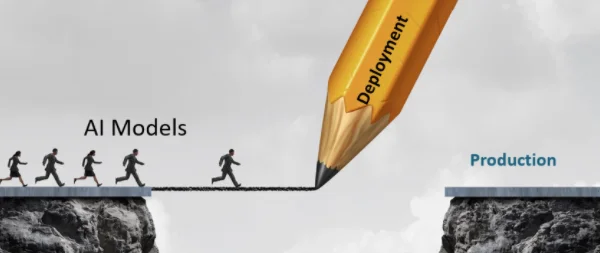
With surmounting interest in data science and the fast-growing Data Scientist community, AI as a technology has come a long way crossing the chasm from Innovators and early adopters to the Early Majority. Along with all the hype that’s there today around AI, there is still the unaddressed issue of less than 12% models reaching the production stage
Data Scientists are creating models day in and day out but there are millions of models that are still waiting to see the light of the day in production.

Gartner identified time to value as one of their biggest challenges, reporting that it takes an average of 52 business days for the team to build a predictive model, and longer to deploy into production
While the usual belief is that the deployment should need fewer days than building a model but it is becoming the most challenging issue of the industry today. Building the model is one thing, what’s more, challenging is operationalizing AI.
There are significant challenges in Operationalizing AI
1. Analytics challenged leadership:
This one serves as the major hurdle in operationalizing AI. The senior leaders in the Organizations are not that conversant in AI and hence lose out to the AI Integrated Organizations. Leadership support is the most important factor in operationalizing AI.
In the words of a senior leader of one of the large Private Sector Bank
“Our Organization started losing to the new start-ups in this space, that’s when our CEO decided to adopt AI. It took us 3 years to regain the market share which we lost due to new entrants. Our CEO made it mandatory for the entire leadership to pursue courses in Data Science, that was just the beginning, we started having weekly knowledge sharing sessions, Innovation lab workshops etc.”
2. Data Quality
Gartner predicted that through 2022, 85 percent of AI projects will deliver erroneous outcomes due to bias in data, algorithms or the teams responsible for managing them.
Testing and Validation is practiced in the controlled environment and hence the data used is of good quality while when it comes to deploying the model in production, it has to work on real-world data which in most of the cases lacks quality which results in low Model accuracy
3. Legacy Infrastructure
Another big challenge in operationalizing AI is the issue of legacy infra of the large organizations which makes it impossible to operationalize AI.
4. Managing the Compute power
Compute power requirement depends a lot on the kind of model being worked upon. In the case of deep learning, computer vision models the compute power for the training data set is high while we can use 1/nth compute power in production. But for the KNN models, the compute power in production needs to be high. So optimizing the compute power in each stage of analytical modelling is key to the success of Operationalizing AI in organizations.
5. Interpretability
Interpretability is essential for operationalizing anything today. People need to understand what’s going on in the black box. This goes back to the first point we discussed around Senior Management understanding of AI. The first step to start any data science initiative in the Organization is to present the business case or get the budget.
The moment you decide doing something using Neural Network to achieve High Accuracy it becomes a black box for the management as the high accuracy comes at the cost of low interpretability. Though as a concept you can explain the management on what’s happening within the solution but mostly the solution is a black box for the organizations. For example risk scoring using the Neural Networks can be highly accurate but difficult to explain.
Adoption of AI is a major point of discussion across the boardrooms today but to move beyond discussion we need to overcome the above-mentioned challenges. Space of data and analytics is changing rapidly, to remain significant in these times, Organizations will have to make sure that they take every step required for operationalizing AI.
References:

Your reaction
Discussion
What's your take on this story?
No comments yet — be the first to share your view.