


Whenever a new open-source AI framework is released that claims to outperform existing AI models in efficiency or speed, developers are hailed as heroes on X, Hacker News, and Reddit.
And soon, the big AI labs release their own projects based on the framework and its idea.
A year ago, MCP sparked a similar wave of industry-wide adoption; more recently, OpenClaw did the same.
Now, Jev, an AI model developed by TypseSafe AI, is in the spotlight. Led by Diogo Almeida, a former OpenAI engineer instrumental in building ChatGPT, the company is now valued at $7.5 billion weeks after launch.
Such cycles bring a lot of hype. Almost as if the pitfalls and shortcomings of LLMs and AI models vanished overnight, developers seem free of their challenges.
And thus, Jev also needs close examination of what its capabilities truly amount to and what it takes for developers and engineering teams to integrate it into production.
What is Jev?
Jev is not a departure from the transformer architecture that ChatGPTs and the Claudes of the world are based on—it uses the same architecture. But it does not generate language.
It provides specific decision options, or in TypeSafe AI’s words, ‘calibrated decisions’ for a user query, each backed by a confidence score.
It essentially behaves like a machine-learning classifier that evaluates a query against predefined options and assigns each a probability.
“Decision models are specialised AI models that pick a single, pre-defined answer based on a confidence score rather than generating a free-form response,” Sathya AG, a Principal Architect at Google, tells AIM. “Deploying an LLM for simple deterministic workflows and tasks such as sorting support tickets or financial transactions is equivalent to using a smartphone exclusively for its flashlight capability.”
This has been the highlight of Jev's launch. TypeSafe claims its model is up to 193.6 times faster and 444.6 times cheaper than conventional LLMs for structured decision-making workflows.
Take customer support tickets, for example. Each ticket needs to be assigned to the right department, assessed for urgency, and evaluated for the need for human intervention. LLMs can perform these tasks, but Jev can return those decisions directly—language processing is overkill.
It can assign a department category, an urgency score, and a probability indicating whether human review is needed.
“LLMs introduce unnecessary costs for deep reasoning and linguistic fluency, when the task demands nothing more than a fast, reliable, binary signal,” says Sathya.
Moreover, Jev is attractive when teams need a general-purpose model that can handle changing classification tasks without training and maintaining a separate classifier for each one.
TypeSafe AI reports that hiring marketplace Jack & Jill replaced Gemini 3.1 Flash Lite with Jev for candidate scoring, reporting 88% lower costs and roughly half the median processing time, with no statistically significant change in measured quality.
Developers have already put Jev to work on everything from Claude Code skill selection to agents playing soccer and Super Mario.
And it didn’t take long for everyone to hop into the benchmark fight and claim they’re better than the others.
The Shipping Wars Have Begun
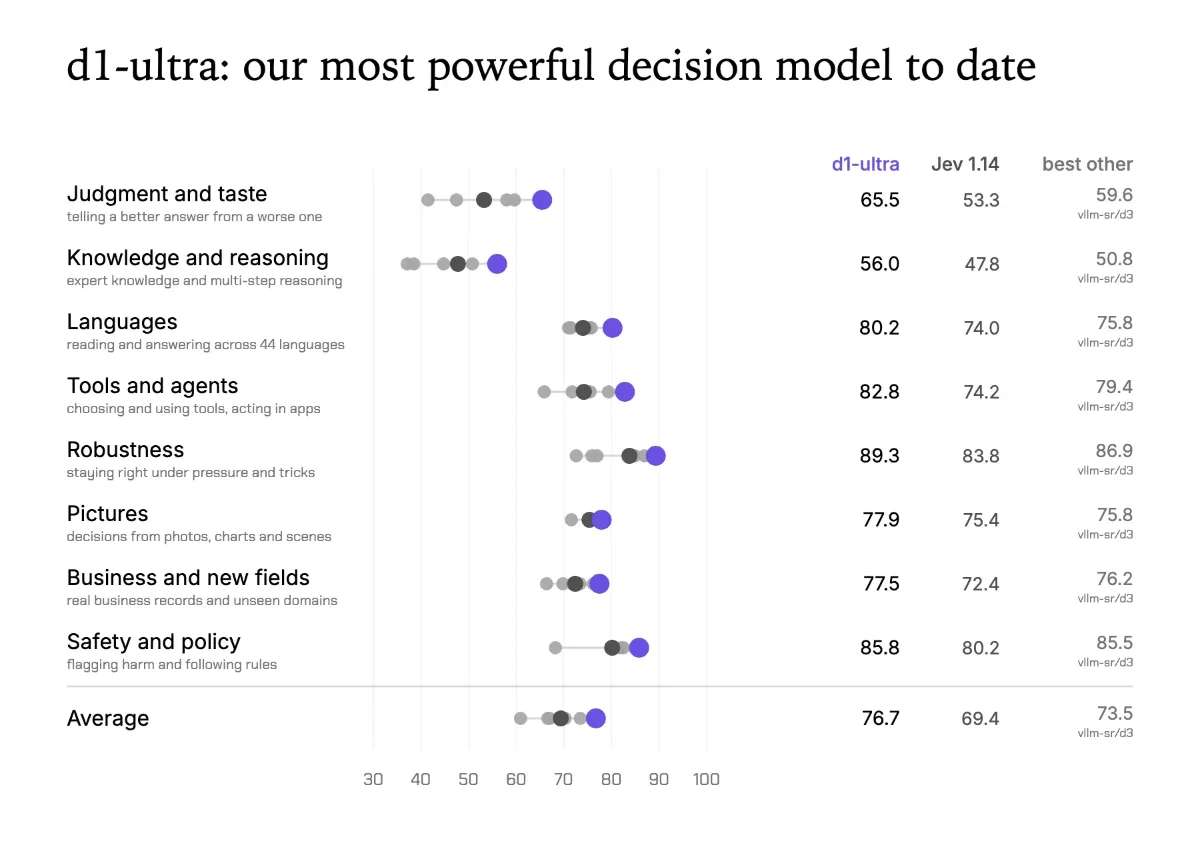
Liquid AI made one of the month's more specific competitive claims when it introduced d1, saying the model was the first to rival Jev on text-based decisions while extending the approach to images.
In its own tests across six applications, d1 matched or beat GPT-6.1 Sol on four, at 19 to 200 times lower cost and with significantly lower latency across all six.
The applications ranged from filtering customer-support tickets to inspecting circuit boards for defects and managing the context retained by coding agents.
Two days later, Liquid released open-weight versions of the model, including a 3-billion-parameter variant designed to run on hardware ranging from data-centre GPUs to edge devices.
At its DevDay in late September, OpenAI announced a Decisions API, bringing its Luna model's capabilities to structured decision-making tasks such as classifying inputs, routing requests, and selecting an AI agent's next action.
Cloudflare released Clef and Clef-flash as open-source decision models.
AWS released Strands Decider 2B through its Strands Labs initiative, with the company’s distinguished engineer Marc Brooker beginning to develop the model after encountering Jev
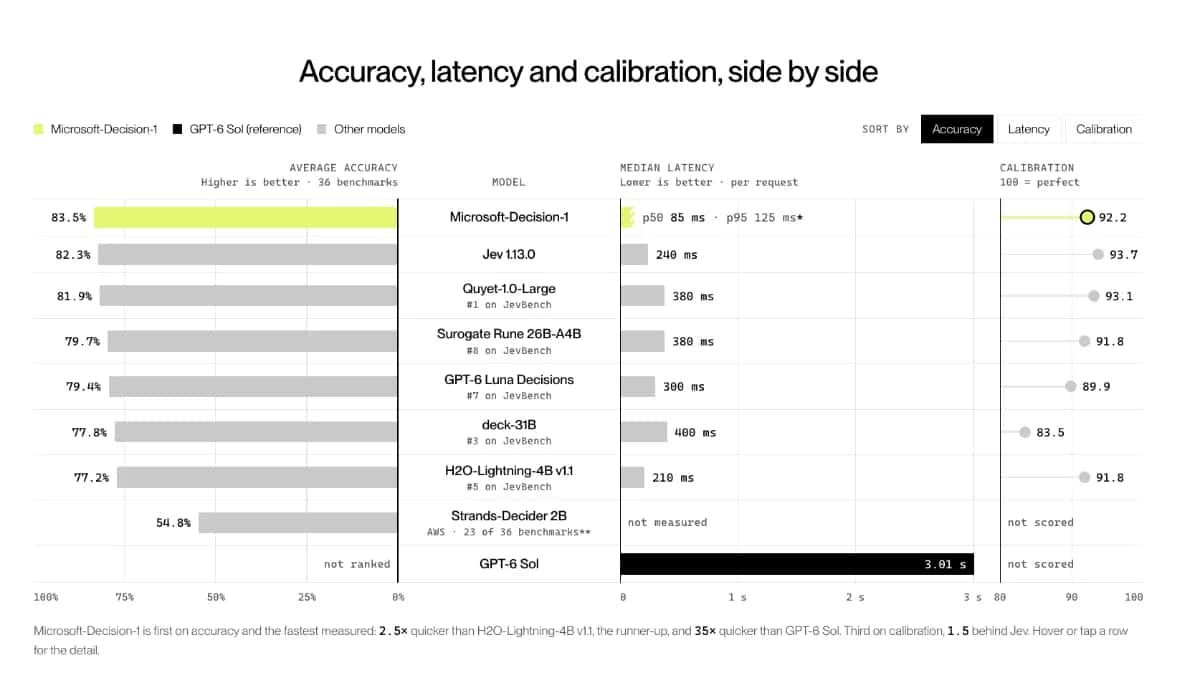
Microsoft joined the party most recently, with Microsoft-Decision-1, a model post-trained from Qwen3.5-9B.
The company claims the model scores higher on average accuracy and has lower median latency than Jev in tests, and also outperforms OpenAI’s GPT-6 Luna Decisions and AWS Strands-Decider 2B.
So options for developers and engineering teams are plenty.
But what does it take to deploy them in the real world so developers, enterprises, and engineering teams can start experiencing the advantages?
The Bottlenecks to Deployment
“In my opinion, the adoption of decision models today will not look like a one-to-one replacement of generative models,” says Sathya.
“Instead, it will mirror a smart factory assembly line where specialised machines route complex work to human experts. We are moving toward a strict division of labour between two distinct tiers.”
With this ‘factory assembly line’ analogy, he explains that decision models will behave like a high-speed sorting machine that intercepts incoming traffic, instantly analyses every request, and handles routine sorting.
“Generative models sit at the end of the line, and are activated when the sorting machine flags a highly complex, custom piece of cargo that requires deep reasoning,” he says.
Adoption is picking up beyond hobby projects and developer experiments. For instance, Vercel reported that Jev reached nearly 13% of paid teams on its AI Gateway within 24 hours of launch, making it the fastest-adopted model in the platform's history. Vercel's own agent framework, eve, has also made Jev its default evaluation model.
“But it is still too early to call this established enterprise adoption,” Pratik Ambhore, Head of Data Engineering at RSI, tells AIM.
“The real bottleneck is evaluation, as organisations need labelled historical data, meaningful thresholds, and a clear understanding of the cost of a false positive versus a false negative.”
Like Sathya, Ambhore also points ot a cascade model where the decision model handles the high-confidence majority and ambiguous cases go to a more capable model or a human.
“But those thresholds have to be validated on the organization’s own data rather than taken at face value from a model’s confidence score.”
Thus, telemetry data and trust deficit are the other two challenges to large-scale deployment of decision models.
A common challenge engineering teams and enterprises continue to grapple with is the lack of granular, factual, structured data these models rely on.
“While generative models can pull answers out of the general internet or unstructured data, a decision model requires highly specific, historical logs of past enterprise choices and exact outcomes to function accurately,” tells Sathya.
“Because companies lack this underlying factual data, they cannot confidently predict how a model will behave. Without proper telemetry to audit and prove a model's logic, enterprises are wary of downstream system failures.”
But Jev’s constrained outputs do not eliminate the need to validate its decisions.
TypeSafe AI has touted a “0% hallucination rate”, but the figure concerns whether Jev's outputs conform to predefined schemas, not whether its decisions are correct.
The model may not invent a new option, but it can still choose the wrong one.
An independent evaluation by developer Will Kelly illustrates this problem. Kelly ran nine experiments, specified 28 predictions before collecting data, and made 123,805 API requests.
In one experiment, he tested whether misleading text embedded in support tickets could influence Jev's routing decisions. A direct instruction to ignore the question changed the decision in just one of 200 tickets. But a subtler claim that a support lead had already made the decision changed the result in 147 of 200 tickets.
Confidence scores offered some warning, but not a reliable safeguard. When the subtler attacks succeeded, Jev's average confidence score was 0.680, compared with 0.983 on clean tickets. But confidence also fell when the attacks failed, meaning a low score could flag a suspicious case without reliably indicating whether Jev had been misled.
The findings come from one evaluation of a single model version, not a measure of Jev's general failure rate. But they illustrate a fundamental limitation: a decision can be perfectly valid in format and still be wrong.
“The model can still choose the wrong answer, and a confidence score is not automatically a calibrated probability,” says Ambhore.
“So I see decision models reducing the cost and complexity of making decisions, not eliminating the need to validate those decisions.”
- Internet on Alert as AI Uncovers Critical Flaws in PHP Used by 70% of Websites
- From Claude Code Mods to Super Mario: What People Are Building on Jev
- 8 Reasons Why Anthropic’s New Report is an AI Doomer’s Worst Nightmare
- How VECV Built a Real-Time Data Backbone for 2,50,000 Connected Vehicles
- Anthropic Stands Alone Against Open Models
- The $205 Bn AI Bet Google Can’t Afford to Lose