


Artificial intelligence and data analytics have long been embedded in military systems—from drone surveillance and signals intelligence to logistics optimisation and target recognition.
Machine learning itself is not new to warfare. What is new is the rapid rise of large language models (LLMs).
Unlike earlier narrow AI tools built for specific tasks, LLMs can synthesise vast volumes of text datasets, answer complex queries, generate operational summaries and connect disparate intelligence streams in real time.
Militaries are now experimenting with, and in some cases deploying, these systems for intelligence analysis, battlefield management and target support during live conflicts.
United States of America
In early January 2026, during Operation Absolute Resolve—the US raid that captured Venezuelan President Nicolás Maduro and his wife Cilia Flores—Anthropic’s Claude LLM was deployed by Pentagon analysts for tasks such as intelligence processing, document analysis, and operational planning through integration with Palantir’s software platform, widely used across defence and intelligence agencies.
During the subsequent Iran strikes, the US Central Command reportedly employed Claude for intelligence assessment, target identification, and combat scenario simulation. Notably, this took place just hours after President Donald Trump ordered federal agencies to cease using Anthropic’s AI products.
These deployments formed part of the broader US defence AI adoption initiatives, including Project Maven, which integrates LLMs into intelligence and sensor-fusion pipelines, and enterprise platforms such as GenAI.mil, where multiple LLMs are available for mission support.
However, the Pentagon’s use of AI in military deployments triggered a major controversy between Anthropic and the US government.
Anthropic resisted the Pentagon’s demands to remove contractual safeguards prohibiting use in autonomous weapons or mass surveillance. In response, the administration designated Anthropic a ‘supply chain risk’ and ordered a phased removal of Claude from federal use.
Anthropic vowed to challenge the designation legally, while OpenAI secured a new defence agreement to deploy its models on classified networks, positioning itself as the alternative provider.
China
A detailed investigation by Recorded Future, a US threat intelligence firm, assessed last year that the People’s Liberation Army (PLA) and affiliated defence contractors are likely using generative AI systems to process open-source intelligence, automate report drafting, conduct event extraction, and support early-warning analysis workflows.
As of June 2025, Reuters reported that a senior US Department of State official stated DeepSeek had “willingly provided and will likely continue to provide support to China’s military and intelligence operations”, adding that the company was referenced over 150 times in procurement records for China’s People’s Liberation Army (PLA) and affiliated entities, including services provided to PLA research institutions.
Separately, in November 2024, Reuters reported that Chinese researchers linked to the PLA had adapted Meta’s Llama model to develop a military-focused chatbot known as ChatBIT, designed for dialogue-based analysis and research purposes, underscoring the use of open-source model derivatives in defence contexts
India
During Operation Sindoor, the Indian Army integrated advanced AI into its combat and decision-making processes.
Lieutenant General Rajiv Kumar Sahni, then Director General of Electronics and Mechanical Engineers and DG Information Systems, described in a briefing last October that the operation was India’s first conflict where AI was used heavily to shorten the “kill chain” and sharpen targeting accuracy.
He said the Army fed 26 years of historical data into AI models, enabling them to pinpoint enemy assets such as gun and missile units with about 94 % accuracy, supporting “human-in-the-loop” precision strikes during the May 2025 conflict with Pakistan.
AI tools were part of a suite of about 23 integrated applications that enhanced surveillance, intelligence fusion and battlefield picture generation by ingesting and correlating vast real-time and historical data to reduce uncertainty and speed decisions.
These applications included the Electronic Intelligence Collation and Analysis System, which scanned and matched electronic emissions against decades-old databases to prioritise critical threats, and Trinetra integrated with the Project SANJAY Battlefield Surveillance System, which consolidated feeds from radars, UAVs, satellites, and other sensors into a unified common operational picture for commanders.
In addition, predictive modelling and AI-enhanced weather forecasting tools—integrating data from the India Meteorological Department—helped planners calculate environmental effects on extended-range artillery fire up to 48 to 72 hours in advance, improving timing and precision under dynamic conditions.
Sahni confirmed that these capabilities are now being upgraded with a military-specific LLM expected to become operational in about six months after his briefing.
Last month, the Indian Army’s Department of Military Affairs selected CoRover to set up a sovereign AI-ML lab powered by BharatGPT, which will enable Army personnel to learn, build and deploy secure AI agents within a sovereign infrastructure framework
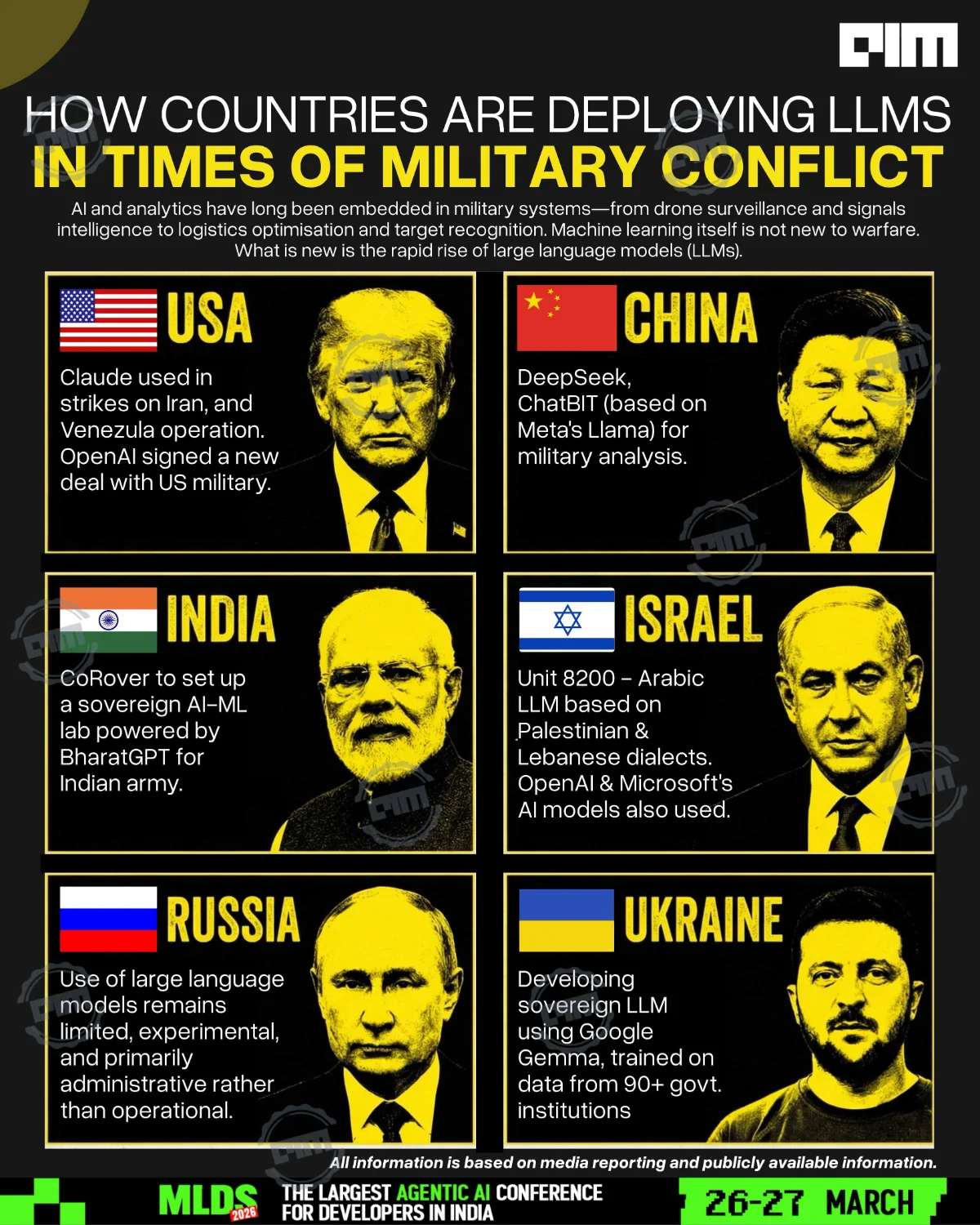
Israel
Investigations by The Guardian and The Associated Press in early 2025 revealed that Israel’s military intelligence directorate, particularly Unit 8200, has built and deployed advanced AI systems—including a large language model trained on extensive collections of intercepted Palestinian communications.
According to the Guardian’s joint investigation with +972 Magazine and Local Call, the unit developed a ChatGPT-like Arabic-language foundation model trained on roughly 100 billion words of primarily spoken Palestinian and Lebanese dialect data gathered through signals intelligence operations. The system functions as an analytical assistant, capable of answering queries about monitored individuals and extracting patterns from large surveillance archives.
Separately, the AP reported that commercial US AI systems supplied by Microsoft and OpenAI were integrated into Israeli military workflows via Azure cloud infrastructure, with internal documents showing a sharp increase in usage after the October 7, 2023, attacks. These systems reportedly supported intelligence analysis and AI-assisted target selection during operations in Gaza and Lebanon.
Human rights groups and AI experts cited in both investigations warned that probabilistic models can amplify bias, generate false associations, and obscure decision logic in lethal contexts. Israeli officials declined to disclose operational safeguards but stated that such technological tools operate alongside professional oversight to maximise precision.
Russia
While Russia employs advanced AI tools and technologies across its warfighting architecture, its use of large language models remains limited, experimental, and primarily administrative rather than operational.
A February report from the Center for Strategic and International Studies (CSIS) assesses visual AI systems at high technological readiness levels, already embedded in drone reconnaissance and strike workflows. Meanwhile, text-based AI, including LLM-type capabilities, remains at an early research stage.
Russian doctrine envisions LLMs not as autonomous battlefield decision-makers but as support tools within command-and-control systems, intended to assist with document preparation, semantic search across operational data, scenario generation, and predictive decision support.
As per the report, more than half of commanders’ planning time is reportedly spent on paperwork and document management, creating demand for automated text-processing systems.
Rather than developing frontier-scale sovereign models, Russia is expected to adapt open-weight and commercially available LLM architectures into secure, on-premise systems integrated with retrieval-augmented databases. However, no certified, military-grade LLM system is currently fielded at scale.
Ukraine
In December 2025, Reuters reported that Ukraine is developing a sovereign large language model using Google’s open-weight Gemma framework. The project is being undertaken in partnership with national telecom operator Kyivstar and overseen by the Ministry of Digital Transformation.
The system will initially train on Google’s external computing infrastructure before being transferred entirely to domestic data centres, reflecting Kyiv’s objective of retaining full operational control over AI systems used by both civilian agencies and the military.
Deputy Minister Oleksandr Bornyakov told Reuters that the decision to build an independent model—rather than rely on proprietary platforms such as ChatGPT or Chinese systems like DeepSeek and Qwen—was deliberate.
Ukraine’s armed forces intend to integrate the LLM into battlefield management systems to support troop coordination, intelligence synthesis, and enemy monitoring. Minister Mykhailo Fedorov has confirmed that AI tools are already embedded in aerial and satellite reconnaissance workflows and drone piloting. Meanwhile, US-based Palantir Technologies software assists with strike analysis, disinformation tracking, and demining prioritisation.
The Ukrainian LLM will be trained on datasets drawn from more than 90 government institutions, including court records, regional archives and documentation of Russian military actions. Officials have emphasised linguistic adaptation, including support for Ukrainian dialect blends and minority languages such as Crimean Tatar, to address limitations in existing models.
Overall, while AI has long played a role in modern warfare, the integration of large language models marks a structural shift. They now sit closer to the decision-making layer itself and actively reshape how militaries process information, coordinate operations and manage the accelerating tempo of conflict.
- When Sam Became Ram Ahead of Diwali
- Jev Isn’t An Overnight Fix For Your Lack of AI Fundamentals
- Internet on Alert as AI Uncovers Critical Flaws in PHP Used by 70% of Websites
- From Claude Code Mods to Super Mario: What People Are Building on Jev
- 8 Reasons Why Anthropic’s New Report is an AI Doomer’s Worst Nightmare
- How VECV Built a Real-Time Data Backbone for 2,50,000 Connected Vehicles