Key takeaways
- Kubernetes automates the deployment and management of containerised applications, gaining popularity with cloud technology.
- Top competitors in container management include Microsoft Azure, Google Cloud, and Amazon AWS.
- Azure Kubernetes Service (AKS) replaced Azure Container Service in 2018, offering serverless capabilities and enterprise-grade security.
- AKS is known for its cost-effectiveness and quick updates to support newer Kubernetes versions.
- Despite its strengths, AKS currently lacks a hardened OS image optimised for containers.
Kubernetes is an open-source system that automates the deployment, scaling, and management of containerised applications. Kubernetes comes from the garage of Google after nearly 15 years in the making. Essentially a container management system, Kubernetes’ popularity soared with businesses operating on cloud infrastructure and technology.
The container software package includes an application code, runtime, system libraries, and other settings needed to run an application. The top competitors include cloud providers like Microsoft Azure, Google Cloud, and Amazon AWS.
- Azure Kubernetes Service (AKS)
In 2018, Azure replaced its Azure Container Service with Azure Kubernetes Service. Microsoft has described AKS as “offering serverless Kubernetes, an integrated continuous integration and continuous delivery (CI/CD) experience and enterprise-grade security and governance.”
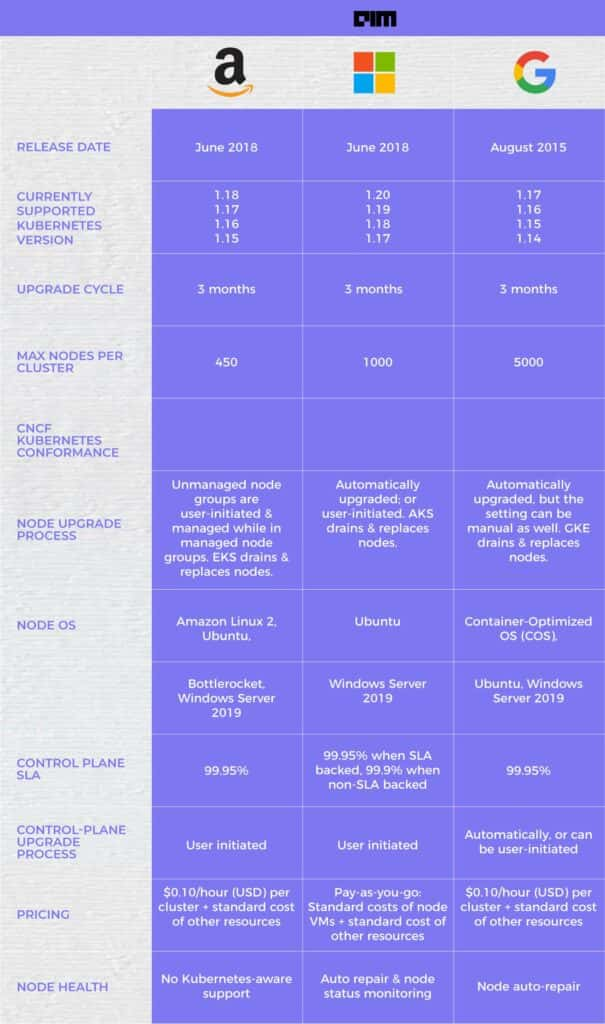
AKS is known for quick updates to support newer versions of Kubernetes and its cost-effective nature since it continues to push customers off of old versions to take advantage of newer Kubernetes. AKS easily integrates with the other Microsoft Azure features, such as Azure Active Directory, making it a good resource for Microsoft users. The system has a very structured approach to its supported versions; it supports up to the 1.18 version. AKS is, to date, the only cloud vendor to provide a free managed control plane service with charges only per node. This being said, AKS lacks a hardened OS image optimised for running containers; it currently only supports Ubuntu and Windows Server.
OpenAI has gone on to discuss how their partnership with Azure and AKS Kubernetes played a huge role in GPT-3’s success. Other companies like Bosch and Finastra are deploying AKS.
- Amazon Elastic Kubernetes Service (EKS)
After the release of its Elastic Container Service, Amazon released the Elastic Kubernetes Service in June 2018. EKS allows for flexible starting, running and scaling of Kubernetes applications on AWS cloud. EKS ensures high performance while supporting Docker containers and leverages the open-source tool Kubernetes. It allows companies to provide and secure clusters with automated key tasks for patching, node provisioning, and updates. EKS offers a 99.95% uptime SLA along with observability to identify and resolve issues in the clusters.
The Kubernetes service has customisable nodes, making it easier to use one’s machine images, customise the operating system, and configure servers for the needed issues. The cherry on top, AWS is one of the most popular cloud services, and most Kubernetes tools fully support AWS integration. Amazon provides Bottlerocket as its OS image optimised for running containers.
Services like Snapchat, HSBC, and Babylon AI are leveraging EKS for their softwares.
- Google Kubernetes Engine (GKE)
Starting the trend, Google was the first cloud provider to release its Google Kubernetes Engine (GKE) in 2015 - initially developed for their internal applications. Dubbed a ‘simple way to deploy automatically, scale, and manage Kubernetes’ by Google, the service is indeed known to be user and beginners friendly. GKE operates in both standard and autopilot mode, with the latest autopilot version allowing for a fully managed solution for the cluster’s infrastructure without the need for human configuration and monitoring. Autopilot only charges for resources used instead of all the nodes provisioned.
The system can be scaled up to 15,000 nodes whose operations are further reduced by the autopilot with the ability to self-heal. In addition, Google provides Container Optimized OS for running containers.
Google Kubernetes is being used by popular services such as The New York Times and Pokemon Go.