
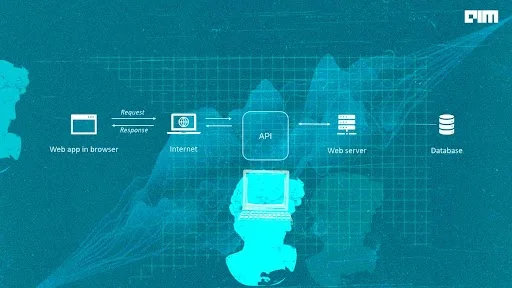
APIs are interfaces used to factor software modules into a single application or enterprise information system. In the last decade, APIs have evolved to become REST-compliant and are based on standard formats like Extensible Markup Language (XML) and JavaScript Object Notation (JSON).
The use of the API for AI is not new, but the tech has become quite robust with big tech companies and startups entering the fray.
Here are the top AI APIs in 2022.
Vertex AI
Google’s Vertex AI is a unified UI for the entire ML workflow. It brings together Google’s Cloud services for building ML under a unified UI and API. As a result, developers can easily train and compare models using custom code training or AutoML and store them in one central model repository. The solution has pre-trained APIs for vision, video, and natural language. It also allows end-to-end integration for data and AI. Vertex AI Workbench is integrated with BigQuery, Dataproc and Spark and also supports all open source frameworks and works with TensorFlow, PyTorch, and scikit-learn. Moreover, Vertex AI backs all ML frameworks and AI branches via custom containers for training and prediction.
OpenAI API
The OpenAI API can be used for any task that involves understanding or generating natural code or language. The developers can fine-tune the custom models and use if for content generation, semantic search and classification. The completion endpoint is at the centre of OpenAI API that provides a simple but extremely flexible and powerful interface to their models. The models can understand and process text by breaking it down into tokens. The number of tokens processed in a given API request depends on the length of inputs and outputs. The API is powered by models with different capabilities and price points. The base GPT-3 models include Curie, Davinci, Babbage and Ada. Open AI’s Codex series, a descendant of GPT-3, has been trained on natural language and code.
Cognitive Services
Azure Cognitive Services enables developers and data scientists of all skill levels to add AI capabilities to their apps easily. The solution has APIs for speech, language, vision and decision. Cognitive Services can be deployed from the cloud to the edge with containers. It empowers responsible use with industry-leading tools and guidelines. The decision API of Azure Cognitive Services enable faster and smarter decisions. The Anomaly Detector enables identifying potential problems early on, and the Content Moderator helps detect potentially offensive or unwanted content. Moreover, the personaliser API allows the creation of rich experiences for every user.
Distributed AI
According to IBM, Distributed AI is a computing paradigm that bypasses the need to move vast amounts of data and provides the ability to analyse data at the source. The Distributed AI APIs are a set of RESTful web services with data and AI algorithms to support AI applications across the hybrid cloud, distributed and edge computing environments. They are early access offerings from IBM Research to enable AI in distributed environments. The APIs are general purpose and support multiple data modalities: For example, acoustic, visual, sensors, network logs, natural language, and time series. Distributed AI APIs helps developers address non-trivial challenges associated with optimising data management and model management across cloud and distributed frameworks. The most used APIs under the Distributed AI include Coreset API, Federated DataOps API, Model Fusion API and Model Compression API. The trial version has a usage limit of 100 APIs / day and 20 APIs / hour.
Wit.ai
Wit.ai is an extensible NLP engine for developers. It is open-source and was acquired by Facebook (now called Meta). The solution allows developers to build conversational devices and applications for text and speech. The company provides quick learning APIs and an easy interface to understand human communication from every interaction. It helps to parse the complex message and turn it into structured data. It also helps predict the set of events based on the learning from the gathered data. Wit.ai is one of the most powerful APIs used to understand natural language. It is a free SaaS platform and has story support that allows visualising the user experience. Wit.ai supports Node.js client, Ruby client, Python client, and HTTP API.

Your reaction
Discussion
What's your take on this story?
No comments yet — be the first to share your view.