Key takeaways
- Google processes over 40,000 search queries every second, highlighting the immense scale of data generation.
- Early internet data analysis was challenging, leading to innovations like hashing for better frequency detection.
- The rise in internet usage has transformed data into a critical resource for applications like movie recommendations and political predictions.
- Real-time data analysis remains complex due to the continuous stream of information exchanged online.

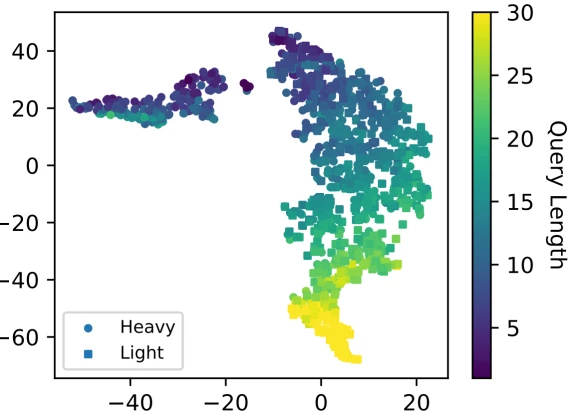
- A neural network is trained to predict the number of times a search phrase appears(AOL queries)
- To process this, a recurrent neural network(RNN) is trained with LSTM which takes these search phrases as inputs.
- The character IDs(lower or upper case, punctuation marks etc) are mapped to embedding vectors before being fed to RNN
- The final states encoded by the RNN are fed into a fully-connected layer to predict the frequency of a certain search phrase.
Key Takeaways
- Learning based algorithms reduced estimation errors by 18% to 71% when compared to non-learning based algorithms like Count Min.
- This model can identify items which go unnoticed with conventional methods.
- A full-length application would enable the users to follow spikes in web-traffic and exploit these results say, for improving e-commerce sites and other customer based recommendation platforms.