
5 min
 Introduction, growth, maturity and decline — every professional who has read any management book can tell you that these are the four pillars of a product life cycle. But as emerging technologies like artificial intelligence, machine learning, data analytics and internet of things are becoming an integral part of organisations, the very product life cycle is on the cusp of evolution.
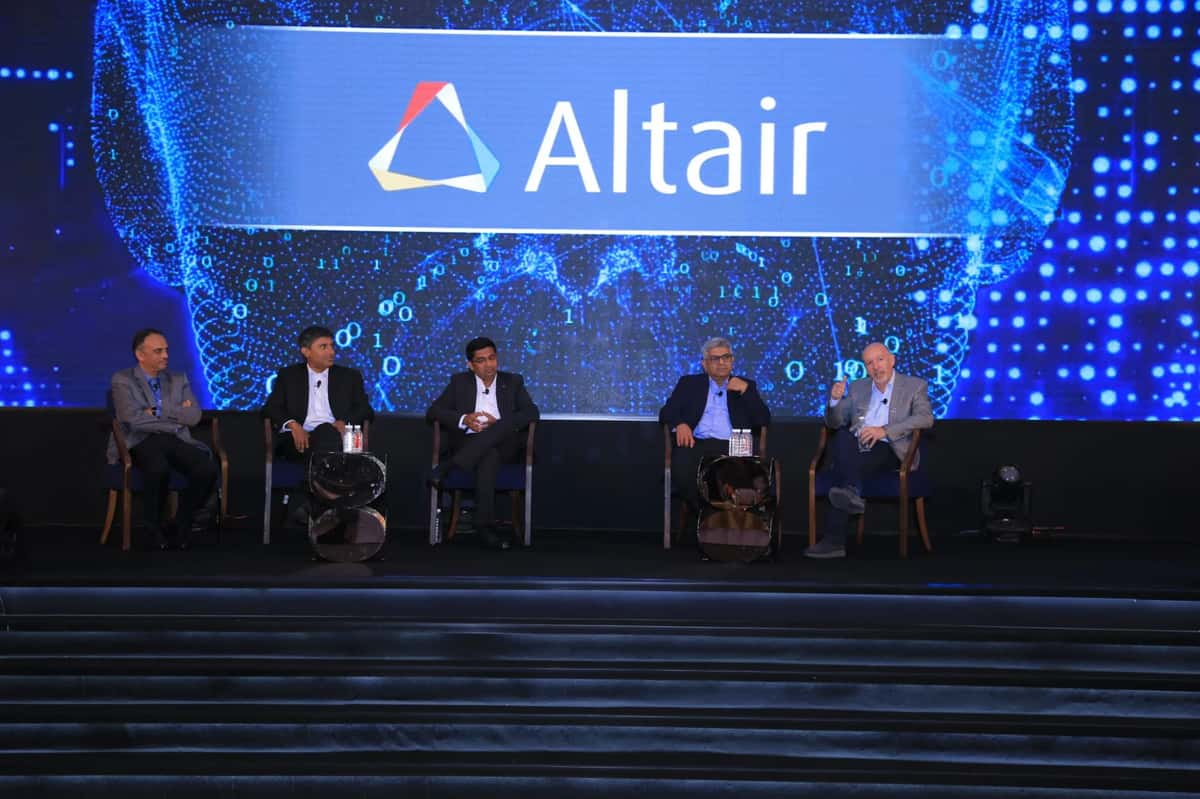
To discuss this ground-breaking phenomenon, Altair, a global tech company that provides software and cloud solutions in the areas of product development, high-performance computing and data intelligence, recently held their annual Though Leadership programme with the theme: Artificial Intelligence and the Future of Product Life Cycle.
The event revolved around the discussion about how and why engineering applications are successfully employing the use of ML to give products a competitive edge. Industry leaders from noted organisations such as Bosch, Mercedes-Benz, GE and Aptiv, among others, discussed how AI and ML are changing the way products are being designed and how organisations are now looking to leverage the transformative power of these emerging technologies.
Altair who has worked with all the above-mentioned companies is a noted provider of enterprise-class engineering software enabling innovation, reduced development times, and lower costs through the entire product lifecycle from concept design to in-service operation. Their simulation-driven approach to innovation is powered by their integrated suite of software which optimises design performance across multiple disciplines encompassing structures, motion, fluids, thermal management, electromagnetics, system modelling and embedded systems, while also providing data analytics and true-to-life visualisation and rendering.
Manu Saale, managing director and CEO at Mercedes-Benz Research & Development India Pvt. Ltd, said, “James was just asking me that if I had ever dreamt two years ago that I’d be at this conference talking about AI, I’d have said no… This digital tsunami, which is driven by AI, is now revolutionising the automotive industry, after changing the faces of other sectors like e-commerce, IT and medicine, among others.” Saale added that for Daimler, AI had redefined the business model in many ways and that they fully expected to see their future product portfolio significantly changed by AI.
Sharing his organisation’s experience in the emerging tech world, Alok Nanda, CEO at GE India Technology Centre and CTO at GE South Asia, said, “Our motivation is two-fold — increase in productivity and the potential for growth. The products that will now come out will be powered by digital insight and they’d be much more profitable and would create new and innovative revenue opportunities.” Nanda added that GE firmly believed that over the next 5-10 years (if not earlier), there won’t be any product which will not be touched by AI in some way or the other.
[caption id="attachment_41372" align="aligncenter" width="2048"]
 Altair chairman and CEO James R Scapa[/caption]
The Indian arm of $396 million global software firm Altair, is one of the leaders in its space and also ranks in the top 3 markets in Asia.
James R Scapa, the chairman and CEO at Altair talked about smart business and product design. He said that the four overarching key points that Altair was inculcating were:
- Global evolution towards smart, connected everything
- Drive for an increased variety of products with higher quality and better aesthetics
- Massive exploration of ideas driving the need for advanced HPC and cloud
- The convergence of data intelligence and simulation
- From Humanoid Robots to Telecom Trials, 12 Major Announcements at NVIDIA GTC Berlin 2026
- Anyone Can Make a Robot Move, Few Can Make It Stop
- After ISRO’s PSLV Failure, TakeMe2Space Looks to SpaceX for Reliable Launch
- Why AI Agents are the Next Frontier in Quantum Security
- Physical AI Squeezes Labour Market, And Low-Skilled Immigrant Jobs May Be First to Fall
- Rocket Math Isn’t Mathing: Why India’s Space Launches are Expensive