

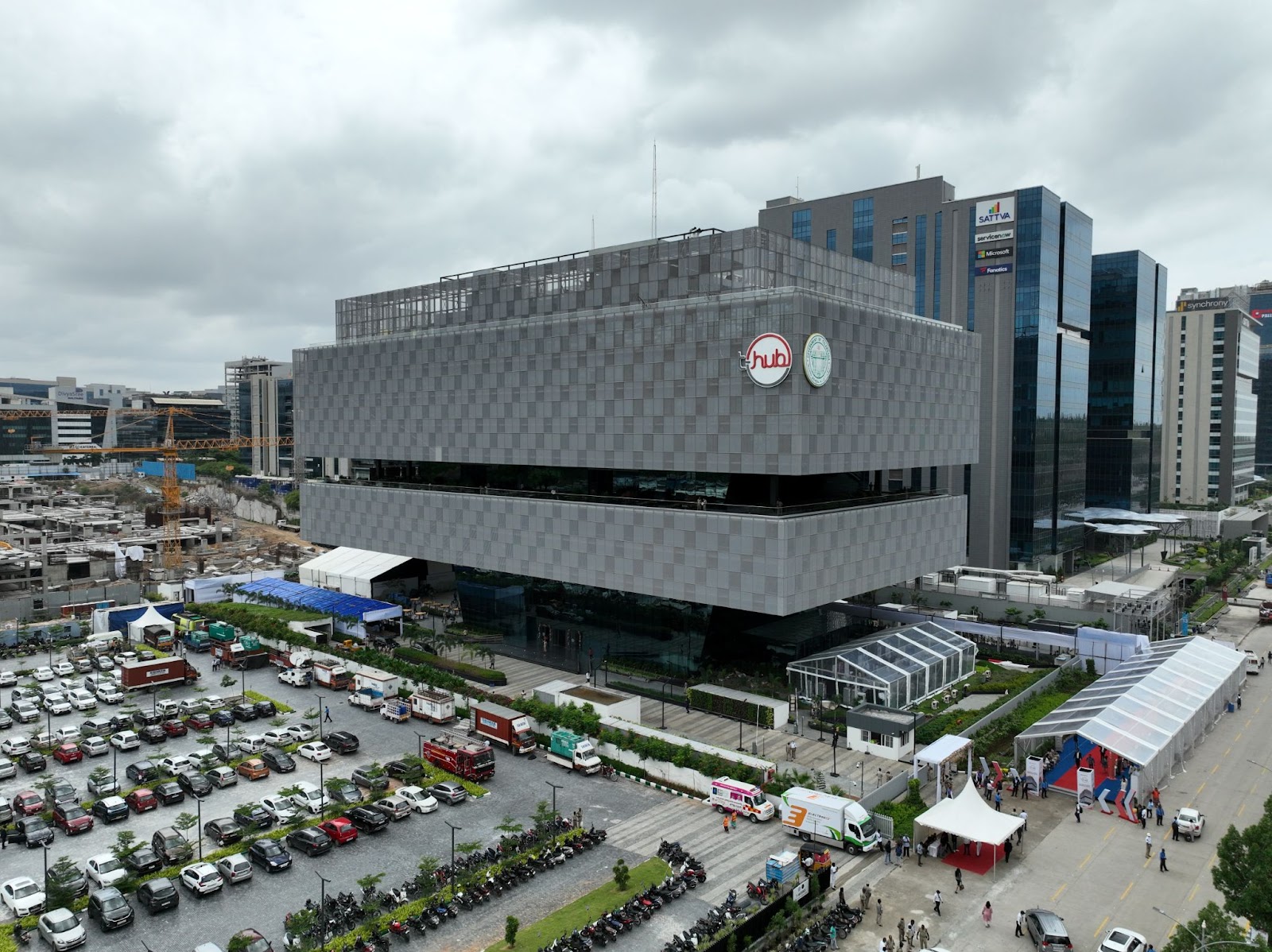
Since its inception in 2015, Telangana government-led T-Hub has incubated over 1,600 startups. Based on the triple helix model of innovation, the intermediary offers various programmes and initiatives to support startups, corporations, and other stakeholders in the innovation ecosystem.
“Cumulatively, they have raised close to about $1.9 billion in funding and created 25,000 plus jobs over the past eight years,” Mahankali Srinivas Rao (MSR), chief executive officer at T-Hub, told AIM.
So far, T-Hub has delivered over 100 innovation programmes, including incubation, and has helped startups access better technology, talent, mentors, customers, corporates, investors, and government agencies.
Over the years, T-Hub has evolved into a crucial component of Hyderabad's startup and innovation ecosystem. Its success has been so impactful that other states are exploring the adoption of a similar model to replicate the achievements of T-Hub.
It has supported and propelled startups in various sectors, including deeptech, mobility, aerospace and defence, healthcare and medtech, fintech, digital commerce, and manufacturing, among others. Notably, it has also established the world's largest startup incubation centre, covering an extensive area of 582,689 square feet.
Nurturing AI Startups
T-Hub has also launched various programmes and initiatives to fuel AI innovation in the state and nurture startups building AI tools and models.
With the Lab32 programme, launched in partnership with Hexagon, a Sweden-based tech company, T-Hub is helping AI startups get mentorship in go-to-market (GTM) strategies, support from value partners, and an opportunity to go-to-market with Hexagon.
As part of its incubation programme, T-Hub is helping several generative AI startups that are actively building Large Language Models (LLMs).
The startups selected are those building real-time language translation tools and enabling prescriptive maintenance with AI/ML models for process plants. As part of the second cohort, 12 startups were selected out of 230 that applied for the 100-day programme that will focus on digital twin, real-time language translation and predictive maintenance using an AI model.
“We've established programmes that pair participants with experienced mentors, strengthening their connections to investors. Additionally, we assist them in securing opportunities to present their ideas to prominent clients,” MSR told AIM.
Moreover, the Department of Science and Technology (DST) has established an ML and AI Technology Hub (MATH), an initiative designed to amplify the impact of AI/ML startups and explore opportunities for their elevation. According to MSR, an official announcement about the CoE will be made soon.
The initiative aims to empower over 150 startups annually and generate over 500 AI-related jobs by 2025. T-Hub also connects startups with mentors (AI experts) to provide them with the necessary knowledge, skills, and tools to leverage AI effectively.
Startups Building LLMs
Currently, T-Hub is incubating a startup named MeghaAI, which has engineered a multi-modal LLM tailored for the upstream oil and gas sector. Named 'MachineGPT’, this model surpasses the constraints of static dashboards by providing a dynamic and intelligent natural language interface.
The platform doesn't just present data; it engages in a meaningful conversation with your data, uncovering hidden patterns, detecting potential issues, and suggesting actionable solutions.
“Similarly, another Hyderabad-based startup, Genz Technologies, is developing enterprise-focused LLMs,” MSR pointed out.
Genz has developed eLLMo, which significantly reduces the information retrieval time from a few hours to a few seconds, thus saving many productive hours across the organisation resulting in increased efficiency and productivity.
Automatr is another startup that has developed an enterprise-focussed model called Document LLM, which helps in extracting data from unstructured documents.
Nurturing Semiconductor Startups
Besides AI, another field where India is trying to grow significantly is semiconductors. “Whenever you think of semiconductors, you think of fabrication units, but there is more to it. There is designing involved and also Outsourced Semiconductor Assembly and Test (OSAT) units. We have about close to 20 startups in this space,” MSR said.
One of the startups highlighted by MSR is PowerICs, which is developing GAN chargers and plans to set up a manufacturing facility in India and start production by 2025. Moreover, he also pointed out ASIP Technologies, which recently came out of stealth to announce its ATMP/OSAT project in partnership with Korea’s APACT Limited.
ASIP also signed an MoU with IIT Hyderabad to take up joint R&D in next-generation packages, develop and qualify new packaging materials and develop a skilled workforce for the OSAT industry.
- From Humanoid Robots to Telecom Trials, 12 Major Announcements at NVIDIA GTC Berlin 2026
- Anyone Can Make a Robot Move, Few Can Make It Stop
- After ISRO’s PSLV Failure, TakeMe2Space Looks to SpaceX for Reliable Launch
- Why AI Agents are the Next Frontier in Quantum Security
- Physical AI Squeezes Labour Market, And Low-Skilled Immigrant Jobs May Be First to Fall
- Rocket Math Isn’t Mathing: Why India’s Space Launches are Expensive