Key takeaways
- Machine learning algorithms for image processing have advanced significantly, enabling tasks such as object reconstruction and video colourisation.
- The core of machine vision relies on teaching models to identify patterns in images, with applications ranging from fruit classification to cancer diagnosis.
- Object detection aims to accurately localise target objects and assign correct labels using techniques like bounding boxes or pixel masks.
- Recent years have seen a surge in research on deep learning-based object detection techniques, driven by earlier successes in image classification.

- Proposal generation
- Feature vector extraction
- Region classification
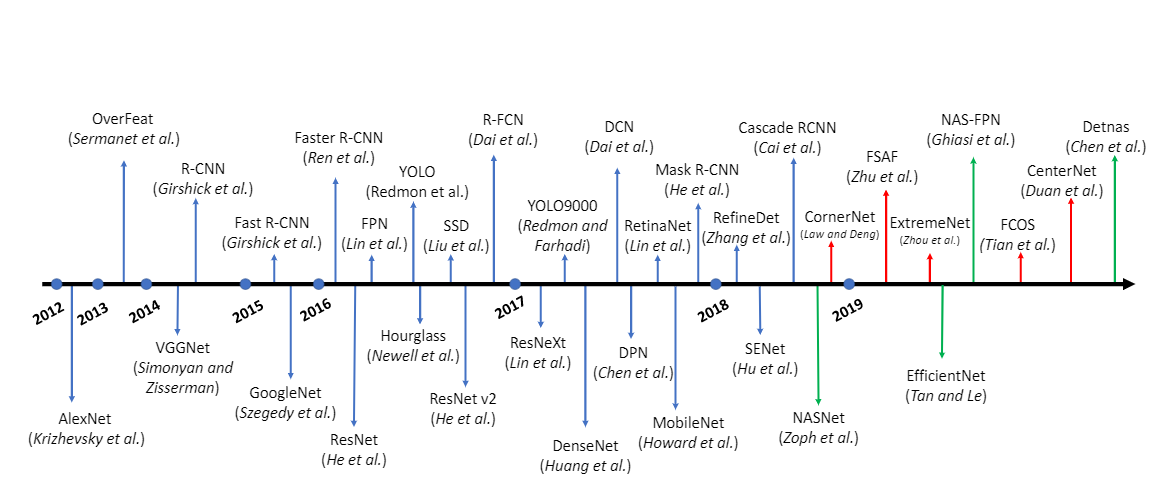
- (i) two-stage detectors, such as Region-based CNN (R-CNN) and its variants and
- (ii) one-stage detectors, such as YOLO and its variants.
Evolution Of Two-Stage Detectors
Two-stage detectors commonly achieve better detection performance and report state-of-the-art results on public benchmarks, while one-stage detectors are significantly more time-efficient and have greater applicability to real-time object. R-CNN is a pioneering two-stage object detector proposed in 2014, which significantly improved the detection performance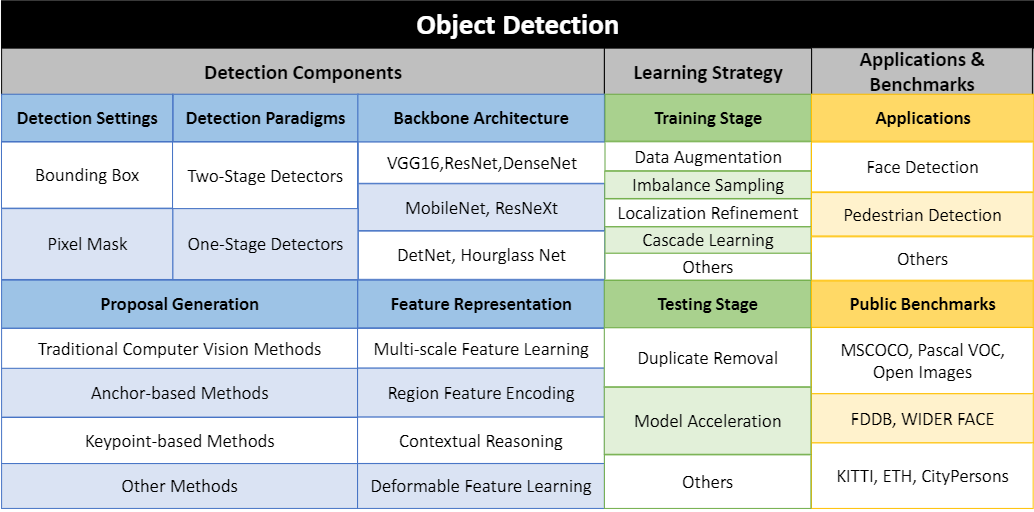
How One Stage Detectors Got Better
 Different from two-stage detection algorithms which divide the detection pipeline into two parts: proposal generation and region classification; one-stage detectors do not have a separate stage for proposal generation (or learning a proposal generation).
They typically consider all positions on the image as potential objects and try to classify each region of interest as either background or a target object
First, a real-time detector called YOLO(You Only Look Once) was developed. YOLO considered object detection as a regression problem and spatially divided the whole image into a fixed number of grid cells
However, YOLO could detect up to only two objects at a given location, which made it difficult to detect small objects and crowded objects
In 2016, another one-stage detector Single-Shot Multibox Detector (SSD) was introduced, which addressed the limitations of YOLO.
SSD also divided images into grid cells, but in each grid cell, a set of anchors with multiple scales and aspect-ratios were generated to discretise the output space of bounding boxes (unlike predicting from fixed grid cells adopted in YOLO).
SSD achieved comparable detection accuracy with Faster R-CNN but enjoyed the ability to do real-time inference. The class imbalance between foreground and background is a severe problem in the one-stage detector.
The imbalance problem was tackled with the introduction of RetinaNet. RetinaNet used focal loss which suppressed the gradients of easy negative samples instead of simply discarding them.
Going Beyond Convolutions
 The advent of large datasets and compute resources made convolution neural networks (CNNs) the backbone for many computer vision applications. The field of deep learning has in turn largely shifted toward the design of architectures of CNNs for improving the performance on image recognition.
Poor scaling properties in convolutional neural networks (CNNs) make capturing long-range interactions for convolutions challenging, especially with respect to large receptive fields.
In the paper titled Stand-Alone Self-Attention in Vision Models, the authors try to exploit attention models more than as an augmentation to CNNs. They describe a stand-alone self-attention layer that can be used to replace spatial convolutions and build a fully attentional model.
The initial layers of a CNN, sometimes referred to as the stem, plays a critical role in learning local features such as edges, which the later layers use to identify global objects.
Due to input images being large, the stem typically differs from the core block and only focuses on lightweight operations with spatial downsampling.
Selective attentional mechanism tries to ignore irrelevant objects in a scene and spatially-aware attention mechanisms have been used to augment CNN architectures to provide contextual information for improving object detection.
Every improvement in machine vision algorithms also relies on the learning strategies used. There are quite a good number of learning strategies. Here are few:
- Data Augmentation: A more intensive data augmentation strategy is used in one-stage detectors including rotation, random crops, expanding and color jittering.
- Imbalance Sampling: To address difficulty imbalance, most sampling strategies are based on carefully designed loss functions. And, adopt a similar idea from focal loss and propose a novel gradient harmonising mechanism (GHM).
- Cascade Learning: Cascade learning is a coarse-to-fine learning strategy which collects information from the output of the given classifiers to build stronger classifiers in a cascaded manner.
- Adversarial Learning: In this case, the detectors could receive more adversarial examples and thus become more robust. For examples check GANs.
Future Challenges
According to the researchers at Salesforce, the improvement of object detection relies on addressing the following challenges:- Current anchor priors are mainly manually designed which is difficult to match multi-scale objects and the matching strategy based on IoU is also heuristic.
- Developing anchor-free methods becomes a very hot topic in object detection, and thus designing an efficient and effective proposal generation strategy is potentially a very important research direction in the future.
- Incorporating contexts for object detection effectively can be a promising future direction.
- Batch size is a key factor in DCNN training but has not been well studied in the detection task.
- Making AutoML more affordable.
Spotted an error? Tell our editors. Read our editorial standards and corrections.