
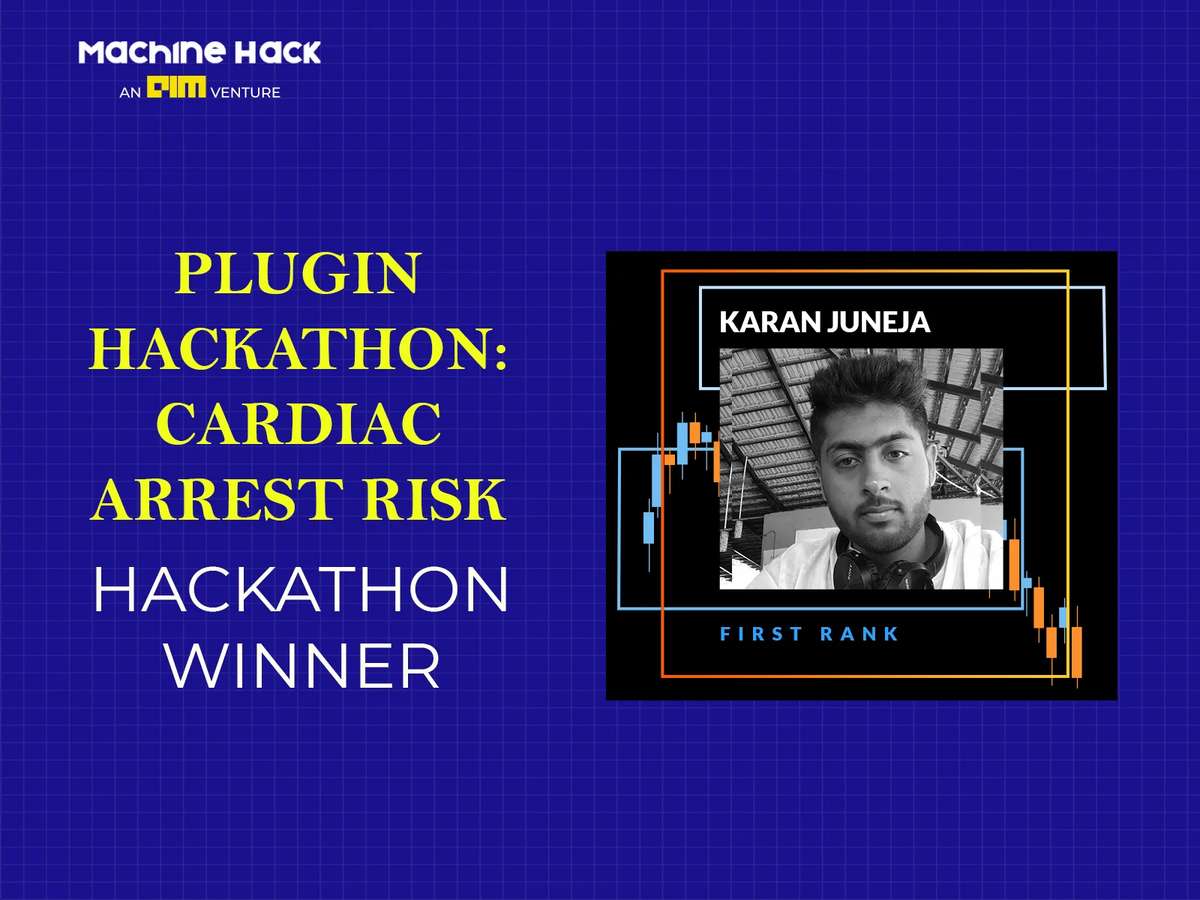
Last week, one of the biggest virtual AI conferences -- plugin -- was hosted by Analytics India Magazine. It brought in brilliant minds from around the world to the ones who sought, all in a well-integrated virtual setting unmatched by any.
Organised by Analytics India Magazine in collaboration with ADaSci, Altair, Analyttica Datalab, SAS and Kyvos Insights, the event was filled with highly informational talks and workshops. Apart from the talks, plugin also hosted a hackathon conducted by MachineHack solely for the Data Science enthusiasts looking for some fun.
In this article, we present to you the champion of the hackathon and his approach to the problem that drew the spotlight.
Karan Juneja
Karan is an Electronics and Telecommunication Engineer from PICT, Pune. His data science journey began out of his passion and curiosity for robotics. He has been acquiring new data science skills from free online resources as well as by participating in hackathons.
Karan is a regular participant in MachineHack hackathons and has been in top 3 for several of the competitions.
Approach To Solving The Problem
“The provided data was simple and straightforward, and from the initial EDA, I found out there wasn't much to do with preprocessing and model training. The most important part was just to make the model as stable as possible by selecting the best features,” said Karan.
“I also tried fitting different models such as XGBoost, Random Forest and Logistic Regression. The trick to getting the best score was to remove as much noise from the data as one possibly could,” he added.
Get the complete code here.
- From Humanoid Robots to Telecom Trials, 12 Major Announcements at NVIDIA GTC Berlin 2026
- Anyone Can Make a Robot Move, Few Can Make It Stop
- After ISRO’s PSLV Failure, TakeMe2Space Looks to SpaceX for Reliable Launch
- Why AI Agents are the Next Frontier in Quantum Security
- Physical AI Squeezes Labour Market, And Low-Skilled Immigrant Jobs May Be First to Fall
- Rocket Math Isn’t Mathing: Why India’s Space Launches are Expensive