Key takeaways
- Designing advanced chatbots requires nuanced conversational skills, including language understanding and reasoning.
- Improving chatbot capabilities involves focusing on consistency, specificity, empathy, knowledgeability, and multimodal understanding.
- Researchers are developing benchmarks to assess chatbots' ability to engage in empathetic dialogues.
- AI struggles with empathy, similar to humans, highlighting the need for better training data.
- Effective chatbot design must ensure accurate emotional responses to avoid miscommunication.

- consistency,
- specificity,
- empathy,
- knowledgeability, and
- multimodal understanding.
When Chatbots Empathise
In recent work with researchers from the University of Washington, introduce the first benchmark task of human-written empathetic dialogues centered on specific emotional labels to measure a chatbot’s ability to display empathy. We can’t be too hard on AI in this regard as we humans, too, are bad at showing empathy but without proper training data, a chatbot can convey congratulations in place of condolences. Training AI for empathy is one of the final frontiers of AGI, and is still debatable. Nevertheless, since, the improvements will be made to the models, we need to address this aspect of NLP models as well.Leveraging Knowledge
Current state-of-the-art approaches to dialogue modeling involve sequence-to-sequence models, which lack access to information outside of the conversation history. Now, new models are created with the help of Wikipedia data to retrieve knowledge and then use it to respond to dialogues.Connecting With Imagery
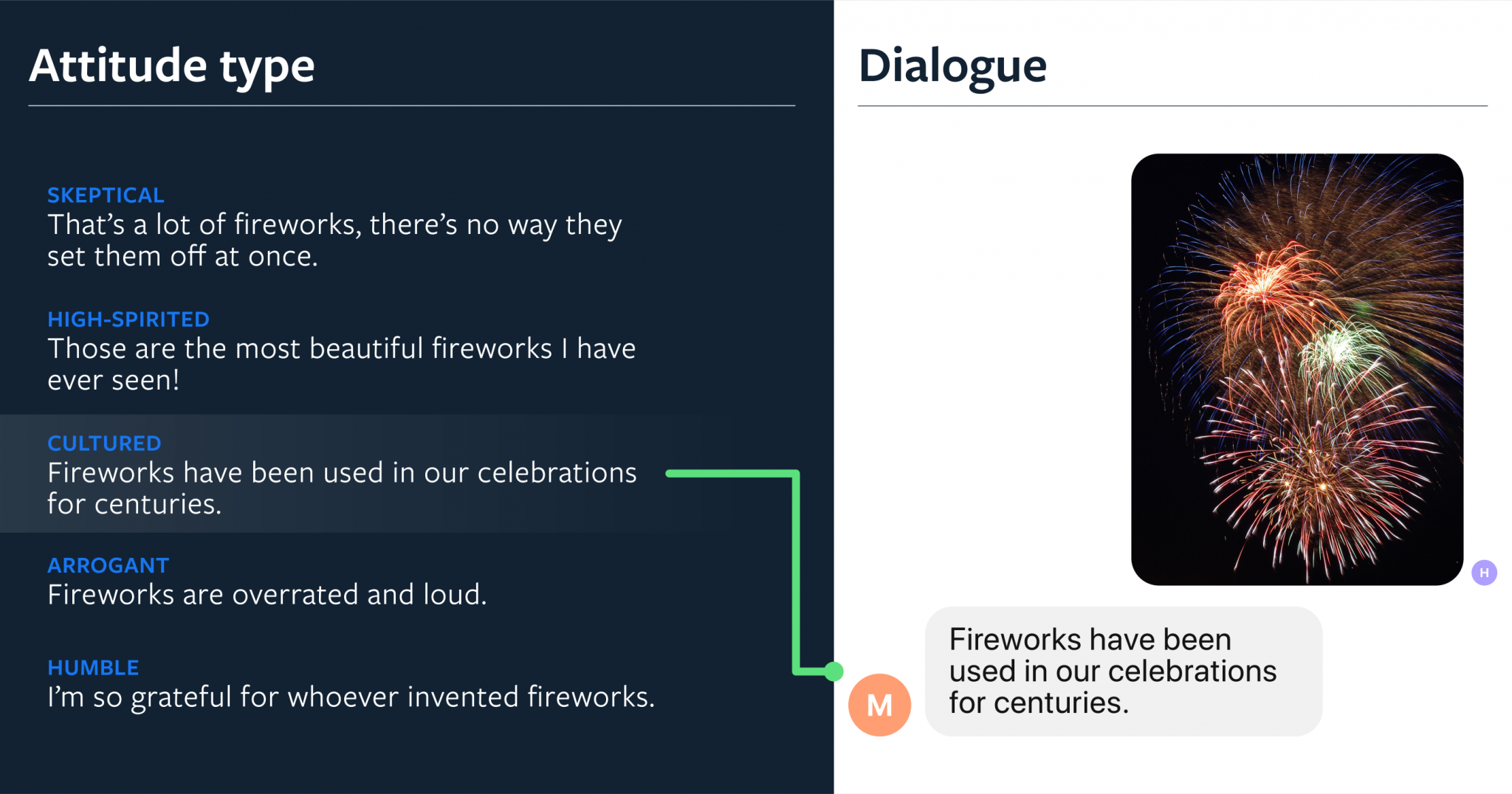 A picture speaks a thousand words. This cliche is in its truest form in the machine world where every pixel counts. It can be an edge, curve or color intensity, the information, indeed is worth a thousand words. Modern neural networks especially CNNs have mastered object detection and this aspect can be exploited to improve chatbot conversation.
Machine learning approaches that comment on images have typically focused on image captioning, which is factual and neutral in tone — like “fireworks in the sky.” In this research, the authors focussed on image captioning that is engaging for humans by incorporating personality. A large data set of human comments grounded in images was collected, and train state-of-the-art models capable of discussing images with given personalities, which makes the system much more interesting for humans to talk to.
Consistency
Dialogue natural language inference dataset was specifically created to test techniques that maintain consistency. In Dialogue NLI, two utterances in a dialogue are considered as the premise and hypothesis, respectively. Each pair is labeled to indicate whether the premise entails, contradicts, or is neutral with respect to the hypothesis. Training an NLI model on this data set and using it to rerank the model’s responses to entail previous dialogues — or maintain consistency with them — improves the overall consistency of the dialogue agent.Specificity
A Future Of Intelligent Interactions
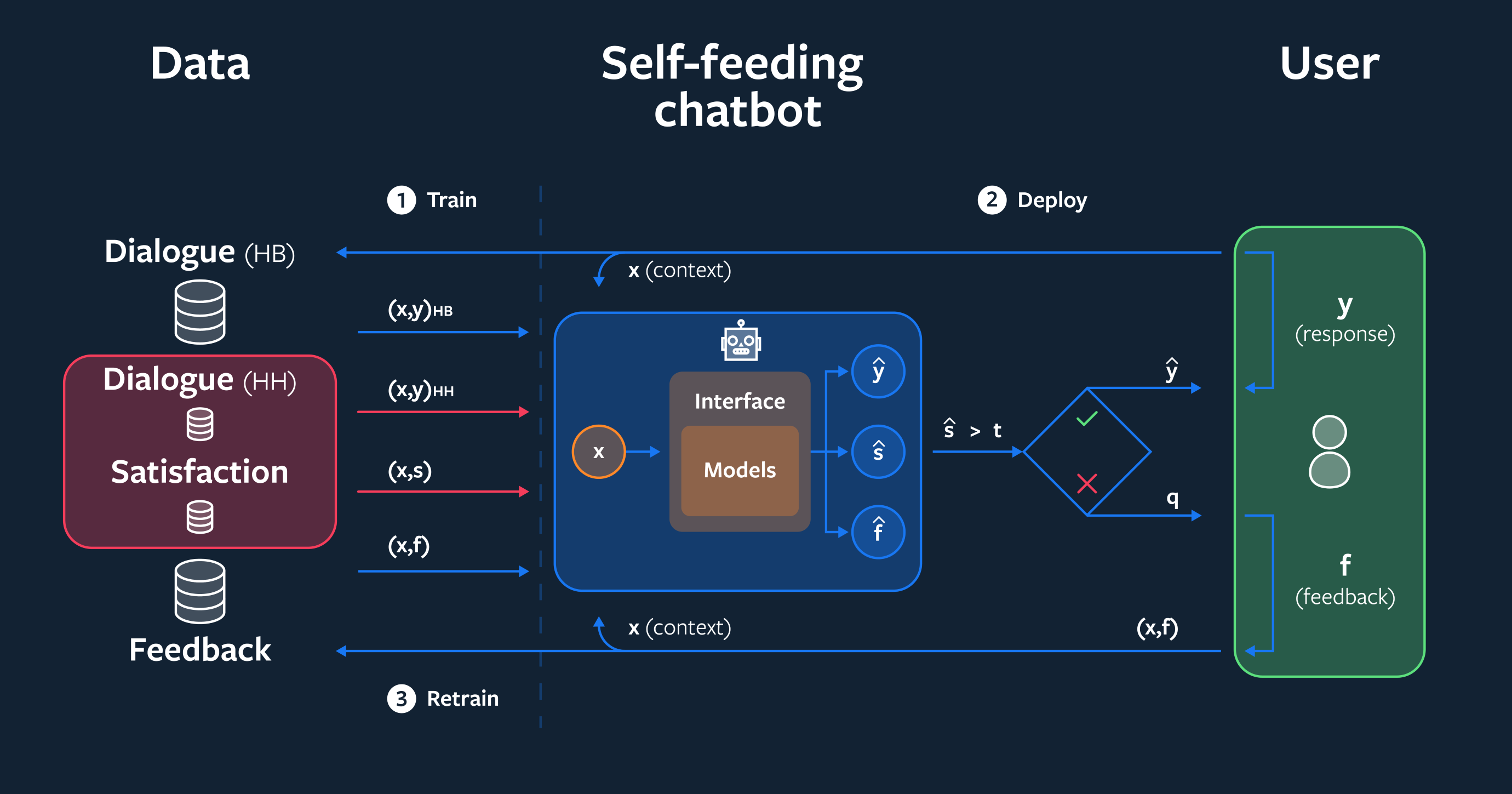
It is possible to train models to improve on some of the most common weaknesses of chatbots today. The future, intelligent chatbots will be capable of open-domain dialogue in a way that’s personable, consistent, empathetic, and engaging. The implications of conversational AI agents can be expected to be beyond the boundaries of trivial social networking chats. They could be deployed for healthcare emergency scenario where the user can type in some text or send an image indicating a distressed signal. Even if we move away from these grave scenarios, enterprises have a lot to gain from intelligent chatbots. They can be deployed for real time grievance redressal (ex:Swiggy and Zomato) or banks and insurance agencies can deploy them for quick loan approvals and answering queries. This eliminates the down time and captures a wider range of population. Access more info on open source datasets and methods here.Spotted an error? Tell our editors. Read our editorial standards and corrections.