
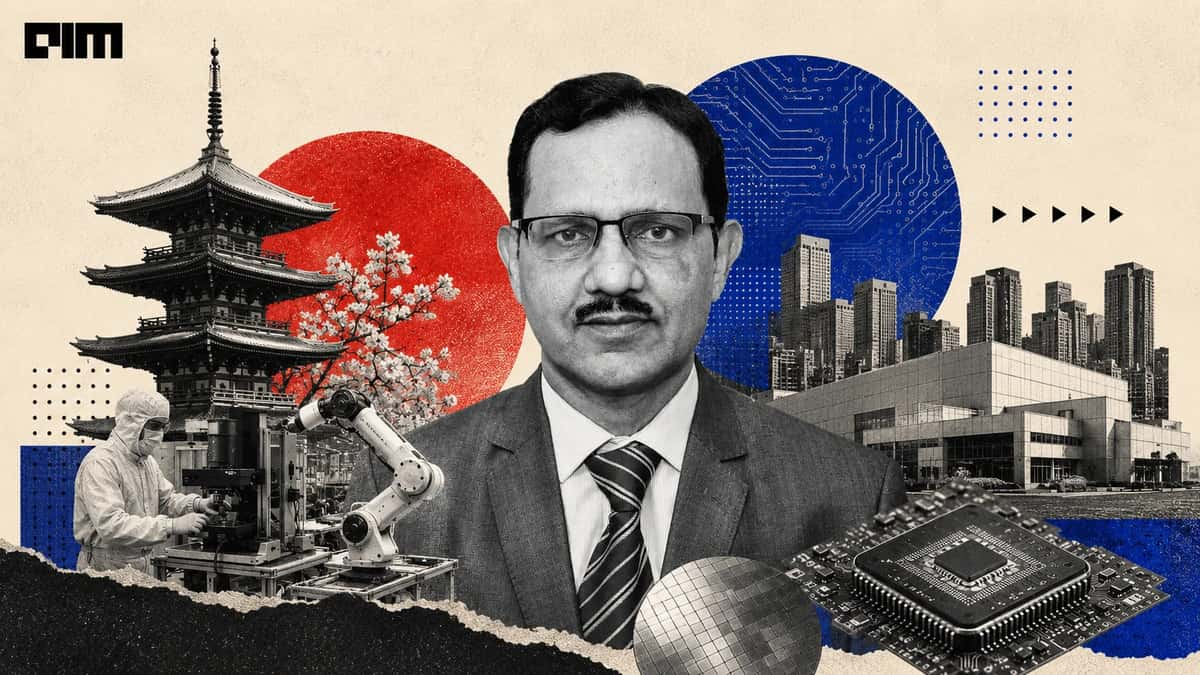

When Prime Minister Narendra Modi visited Japan last year, it was easy to dismiss the semiconductor conversations as another diplomatic talking point. But if Ashok Chandak, President of SEMI India and India Electronica and Semiconductor Association, is right, that partnership could quietly become one of the defining reasons India's semiconductor ambitions succeed.
“Japan is one of the natural allies for India, and India is one of the natural allies for Japan,” Chandak tells AIM. "For our semiconductor journey, we need Japan as a strong partner. Without Japan's partnership, without their support, it's going to become tough.”
The statement comes at a time when India's chip ambitions have moved beyond policy announcements. Within five months this year, three semiconductor packaging facilities—Micron, Kaynes, and CG Semi—have entered commercial production, while the government has expanded its semiconductor push through the ₹1.27 lakh crore Semicon 2.0 programme, taking the country's semiconductor commitment.
But Chandak believes the bigger story is about partnerships.
Japan, after all, occupies a unique position in the global semiconductor supply chain. While countries like Taiwan dominate manufacturing and the US leads in chip design, Japan supplies the chemicals, speciality gases, materials, robotics, and precision equipment that every semiconductor factory depends on.
“Japan may have lost market share in semiconductor manufacturing over the decades,” Chandak says, “but it retained the supply chain.”
According to ASEAN+3 Macroeconomic Research Office, Japanese companies today command roughly half of the global semiconductor equipment and materials ecosystem—a market expected to become even more valuable as AI drives unprecedented chip demand.
That explains why Japan keeps appearing in India's semiconductor story.
From Renesas partnering with CG Power to Japanese companies scouting India during industry events, the relationship has become much deeper than isolated investments.
The Trust Factor
Chandak recalls attending SEMICON Japan last year, where the interest from Japanese companies in India was unmistakable. “I found that Japanese companies had a strong interest in coming to India.”
The reasons, he says, go beyond business.
“There is a government-to-government dialogue, country-to-country trust and industry-to-industry engagement. All levels of engagement are now thriving.”
That trust matters because semiconductors are unlike almost any other manufacturing industry.
“No chip is made end-to-end in a single country,” Chandak says. “No country is 100% self-sufficient, and it will not happen because of the complexity.”
In other words, India’s semiconductor ambitions were never about replacing Taiwan or overtaking South Korea overnight. The objective is to become indispensable in a globally distributed supply chain.
That is precisely why Chandak repeatedly returns to one phrase throughout the conversation: credibility. India’s first phase of the semiconductor mission, he argues, was never designed to chase cutting-edge manufacturing.
“It was a very good strategy,” he notes. “India has earned the currency of trust.”
That trust, according to him, came from something surprisingly simple: announcing projects and actually completing them.
“We announce the project, we complete the project, commercial production—credibility.”
The distinction is important because much of the criticism surrounding India’s semiconductor programme revolves around one question: why isn’t India manufacturing 2-nanometre chips like TSMC?
Chandak thinks that debate misses the point entirely.
“We are not here for the race of 1-, 2- or 3-nanometres,” he says. “Our journey should be seen as establishing ourselves as a trustworthy and credible partner worldwide.”
Instead, India has deliberately entered through OSAT and ATMP facilities—assembly, testing, and packaging operations that are significantly less capital intensive than leading-edge fabrication plants and can become operational much faster.
"It is a good business decision," Chandak argues. "You create proof points. You build credibility."
That strategy also aligns with where the market is headed.
While AI chips dominate headlines, a vast portion of the semiconductor industry still depends on mature process nodes used in automobiles, industrial equipment, power electronics, and consumer devices.
Those segments continue to account for enormous production volumes even if they do not grab the same attention as frontier AI processors. Meanwhile, India's domestic semiconductor market itself is projected to cross $100 billion by 2030 as electronics manufacturing scales rapidly.
For Japan, that creates an attractive proposition.
The India Advantage
India offers engineering talent, an expanding domestic electronics market and a government willing to support long-term manufacturing. Japan brings decades of expertise in manufacturing equipment, speciality materials, and industrial precision.
Together, Chandak believes, both countries create something larger than either could build independently. But he is careful not to frame it as a geopolitical bloc.
“I don't think India and Japan need to come together and arm-twist any other country,” he said.
Instead, he argues that semiconductor supply chains should become more interdependent, not more fragmented.
“When countries become interdependent, people cooperate because otherwise everybody loses.”
It is a remarkably different way of looking at semiconductors. Most conversations today revolve around export controls, technology restrictions and supply-chain decoupling. Chandak instead argues that the industry's sheer complexity makes cooperation unavoidable.
His optimism also extends to Indian companies.
For decades, India's semiconductor ecosystem revolved almost entirely around multinational corporations running design centres. Today, Indian conglomerates are entering manufacturing with unprecedented conviction.
"You see Tata. You see HCL with Foxconn. You see Kaynes. You see CG Semi. These companies had never done semiconductor manufacturing before."
That shift, he says, may be even more important than attracting foreign investment.
"Perpetually we cannot depend only on global players. Someday we need Indian corporates to rise beyond their traditional frameworks."
Semicon 2.0 reflects that broader thinking.
Rather than focusing solely on fabrication plants, the programme expands support to advanced packaging, semiconductor-grade chemicals, specialised equipment, talent development, and research. The government's objective is to build an ecosystem instead of isolated factories.
For Chandak, that is ultimately how India's semiconductor journey should be judged.
"India's semiconductor success should not be measured only by one factory or one company. It will be measured by a vibrant ecosystem that has designs, innovation, manufacturing and exports."
And if Japan continues to strengthen that ecosystem alongside India, the partnership may end up being remembered not merely as another bilateral agreement, but as one of the foundations on which India's semiconductor industry was built.
- From Humanoid Robots to Telecom Trials, 12 Major Announcements at NVIDIA GTC Berlin 2026
- Anyone Can Make a Robot Move, Few Can Make It Stop
- After ISRO’s PSLV Failure, TakeMe2Space Looks to SpaceX for Reliable Launch
- Why AI Agents are the Next Frontier in Quantum Security
- Physical AI Squeezes Labour Market, And Low-Skilled Immigrant Jobs May Be First to Fall
- Rocket Math Isn’t Mathing: Why India’s Space Launches are Expensive