


When Tom Brown, Anthropic's Co-founder and Chief Compute Officer, joined AMD CEO Lisa Su on stage at the Advancing AI (AAI) 2026 event to discuss the companies’ partnership to deploy up to 2 GW of AMD’s Helios AI infrastructure, he offered perhaps the biggest validation the company was looking for in years.
While evaluating AMD, Brown said Anthropic had initially assumed that bringing up a new hardware platform would require a significant engineering effort.
Instead, after AMD provided an MI355X rack for evaluation, a single engineer connected the system to Claude and ran models on the machine over the weekend. By the end of the trial, Anthropic’s performance graphs were ticking in the right direction, even for its leading model.
Su responded with a laugh, recounting how she asked her team to ensure they provided assistance to Anthropic, only to be told that the engineer needed no help and had everything under control.
For years, AMD has relied on benchmarks and performance claims to make its case against NVIDIA. At AAI 2026, the company instead leaned on direct customer validation, with Anthropic, OpenAI, and Meta outlining their plans to deploy AMD hardware in production.
Demand Surpasses AMD’s Projections
At the event, AMD announced that its Helios rack-scale AI platform had entered full production. Built around AMD Instinct MI455X GPUs and 6th Gen AMD EPYC ‘Venice’ CPUs, Helios is scheduled to begin customer shipments by the end of Q3 2026, with volume deployments ramping through Q4.
OpenAI’s Head of Infrastructure, Sachin Katti, also joined Su on stage and stated that OpenAI expects to begin deploying Helios ‘at massive scale’ towards the end of this year, with deployments accelerating throughout 2027. He also confirmed OpenAI’s plans to adopt AMD's next-generation MI500 GPUs, slated for release in 2027.
Meta’s Santosh Janardhan, Head of Infrastructure, echoed that sentiment while outlining the Big Tech company’s expanding partnership. Janardhan noted that Meta has worked with AMD across multiple generations, from the MI300 to the MI350, and is now preparing to deploy MI450 systems at scale.
Su noted that demand for the MI450-powered Helios platform is already running ahead of AMD’s internal projections, prompting the company to increase production capacity over the coming quarters.
“We were always confident about AMD’s roadmap — and now we’re seeing more and more customers are seeing this too,” Ravishankar Kuppaswamy, SVP of Server and Enterprise AI Product Engineering, told AIM on the sidelines of the event.
“AMD has a leadership roadmap in GPU, CPU, and networking product line,” he noted, suggesting this is a key differentiator compared to Intel or NVIDIA, which specialise in specific compute hardware segments.
“We want to look at it from a customer standpoint to find out what workloads work best for them and what they want to accelerate—if they really care about CPUs, so be it. If they care about GPUs, so be it,” he added.
AMD’s First Rack Scale Solution is Ready
Driven by this momentum, AMD not only announced its new hardware lineup and a future roadmap extending to 2030, but also claimed superior performance over the competition.
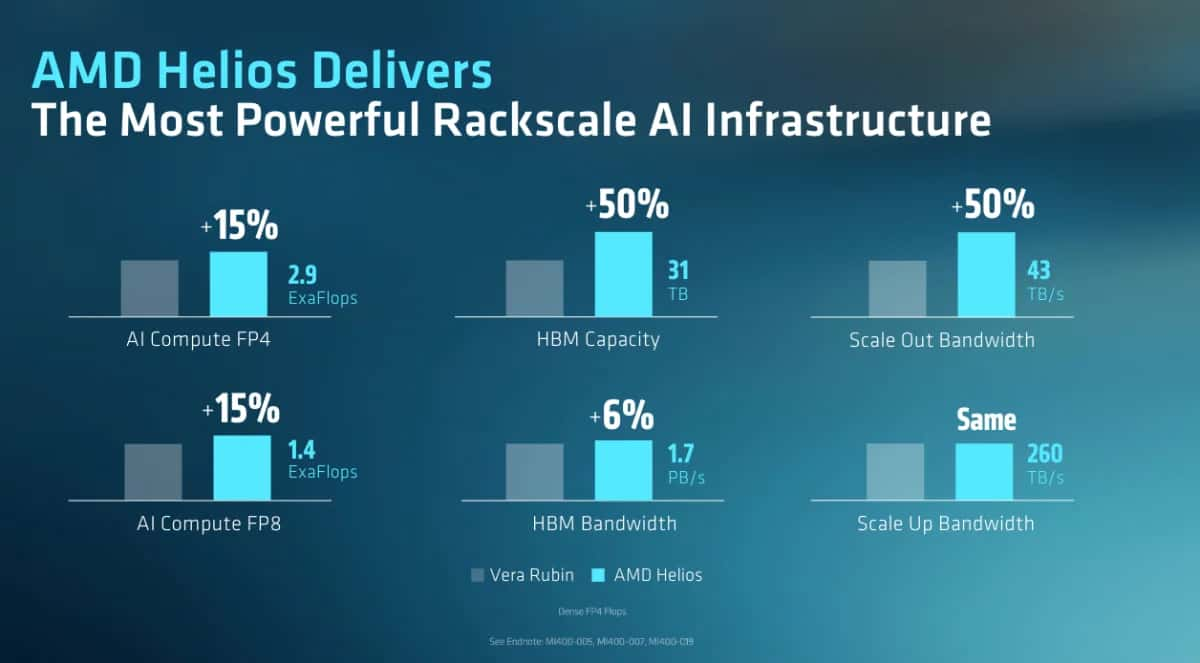
AMD stated that Helios delivers 15% more AI compute, 50% more HBM4 memory capacity and bandwidth, and 50% greater scale-out networking bandwidth than NVIDIA’s comparable rack-scale platform. Each rack integrates 72 MI455X GPUs, 18 6th Gen EPYC Venice CPUs, and Pensando networking into a single unified system.
However, AMD’s headline performance claims should be interpreted carefully. Helios is a double-wide Open Rack system, whereas NVIDIA's Vera Rubin NVL72 is a single-wide rack with a different physical footprint.
Besides, Su highlighted that Helios was co-developed alongside partners including OpenAI and Meta, rather than built in isolation and sold later, arguing that close collaboration reduces deployment risks.
However, one of AMD’s most consequential announcements was its 6th Gen EPYC ‘Venice’ server CPU line. Su argued that the rise of agentic AI is fundamentally reshaping the server CPU market, prompting AMD to raise its forecast for this segment from roughly $25 billion today to more than $200 billion by 2030.
The company also pointed to its growing market momentum, noting that EPYC now commands a record 46% server CPU revenue share as it prepares to challenge NVIDIA’s newly unveiled Vera processor.
Why Venice Could be AMD’s Biggest Success
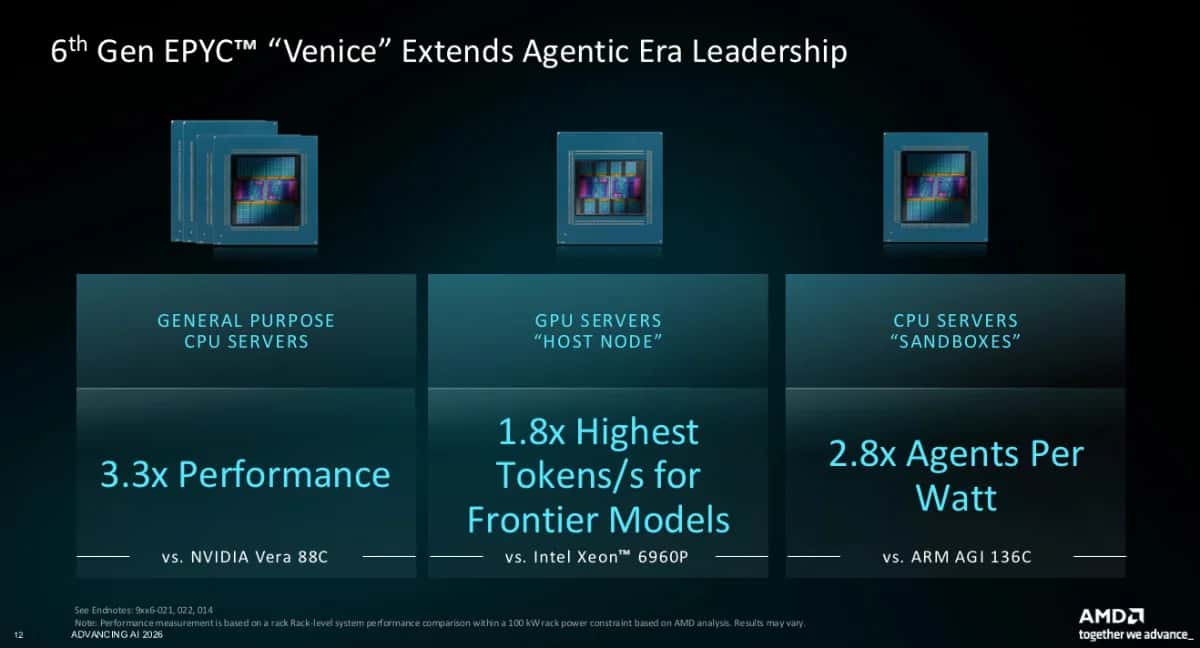
Unlike conventional server processors, Venice is built as a family of CPUs tailored to three distinct AI infrastructure roles.
The Venice HF variant is designed for GPU host nodes, prioritising high clock speeds, memory bandwidth, and I/O to keep accelerators fully utilised.
The 256-core Venice targets dense agent sandboxes, maximising core density and performance per watt to run thousands of concurrent AI agents with up to 512 threads per socket.
Meanwhile, the 128-core Venice aims at traditional enterprise and cloud workloads.
In an interaction with AIM, Austin Lyons, Senior Semiconductor Analyst at Creative Strategies, noted that Venice stands apart because AMD resisted designing a single processor for every AI workload.
He contrasted this with rival approaches, noting that several vendors have simply taken an existing server processor and repositioned it as an ‘agentic CPU’ by “taking it, lifting it, and shifting it.”
For example, Lyons added that the key innovation in the 256-core Venice is not simply its higher core count, but its focus on performance per watt. Rather than chasing peak throughput alone, the processor is designed to maximise the number of AI agents that can run within a fixed power envelope, allowing hyperscalers to pack more agentic compute into power-constrained data centres.
“This is right in AMD’s bread and butter wheelhouse. They’ve got the IP to make a portfolio of chips to fit the workload,” Lyons remarked.
The announcement also intensified AMD’s CPU rivalry with NVIDIA. Just two days before AAI 2026, NVIDIA published the first detailed benchmarks for its 88-core Arm-based Vera CPU, designed to maximise per-core performance and minimise latency for Rubin GPU systems.
AMD responded by benchmarking Venice against NVIDIA’s published SPEC CPU 2026 results, claiming 20% higher per-core performance, 2.2x greater socket-level throughput, 3.4x higher AI performance than Intel's Xeon 6980P, and 2.8x more agents per watt than competing Arm-based AI CPUs.
The comparison also highlighted a broader architectural divide. While NVIDIA is betting on a custom Arm CPU tightly coupled with Rubin GPUs, AMD argues that x86 remains better suited to enterprise AI because existing software already runs natively on the architecture.
Su said this allows customers to scale agentic AI workloads on their existing software stacks while benefiting from Venice’s higher density and performance.
AMD also expanded AI infrastructure partnerships with Microsoft, Oracle, HUMAIN, and several cloud providers, signalling that Helios is intended to underpin a broad ecosystem beyond its flagship frontier AI customers.
Demand for Compute or Demand for AMD?
The broader question is whether AMD’s momentum reflects a genuine shift in market competitiveness or simply the AI industry’s unyielding appetite for compute capacity.
Frontier AI companies are increasingly embracing multi-vendor infrastructure. Anthropic, for instance, relies on NVIDIA GPUs and Google TPUs while committing to AMD's Helios systems.
This raises the question of what primarily drives AMD's growing customer roster: an urgent need to diversify compute supply, or increasing confidence that its hardware is ready for production-scale AI workloads.
Lyons does not believe NVIDIA should be overly concerned by AMD's recent customer wins, framing them instead as ‘natural competition.’ He noted that these partnerships are driven by two parallel trends: an insatiable demand for AI compute and growing confidence in AMD's software ecosystem.
“What's exciting for AMD is that they're talking about gigawatt deployments in the back half of 2026 and into 2027. So that's more than just kicking the tyres,” he added.
For a long time, software has been AMD’s weak link. But just as Anthropic’s Tom Brown highlighted how deploying AMD GPUs has become significantly simpler, the rise of AI coding agents is accelerating the usability of AMD's software stack.
“Historically, it required more effort and investment to port workloads from NVIDIA to AMD, but clearly, we’ve now heard from Anthropic and OpenAI that it is easier than ever,” Lyons observed. “Thanks to agentic AI.”
At AAI 2026, AMD introduced ROCm.ai, an AI-native developer platform that layers AI-assisted coding, intelligent deployment, and automated software optimisation directly on top of ROCm.
The platform integrates coding agents such as Claude, Codex, and Cursor with AMD-specific tooling, enabling developers to generate, optimise, and deploy GPU code without manually tuning kernels or navigating extensive documentation.
The vast library of CUDA tools and the established community around NVIDIA made deployment far smoother. However, ROCm.ai and allied AI coding tools could trigger a structural shift, potentially encouraging more neocloud companies to deploy AMD GPUs for their end users.
Moreover, Lyons suggested that neocloud providers will likely take cues from hyperscalers as they evaluate AMD’s platform. He expects more of them to begin offering AMD compute if deployments by companies like Anthropic, OpenAI, and Microsoft continue to succeed. Existing AMD-focused providers such as TensorWave, Vultr, Crusoe, and Hot Aisle could therefore be among the earliest beneficiaries.
Still, Lyons cautioned that AMD’s long-term competitiveness will only become clear once these platforms operate at scale. He argued that NVIDIA’s core advantage is not just its hardware, but its vast installed base, which generates continuous real-world usage across diverse AI workloads.
This provides NVIDIA with a constant feedback loop to identify bugs, optimise performance, and refine its software stack. Combined with its capacity for massive R&D investment, NVIDIA's first-mover advantage remains self-reinforcing, allowing it to iterate faster than competitors.
- AMD’s Server CPU Business Faces a New AI Boom
- How an Engineer Is Using AI to Bridge the Accessible Education Gap
- AI Agents are Making Human Customer Service a Specialist Job
- Why Nandan Nilekani-Backed F2A Believes India's Investment Opportunity Lies in Edge AI
- India Needs to Build the AI 'Brain' for Robotics, Not Just Import Hardware
- Why Enterprise AI Prototypes Break in Production