The Real Story Behind GCC Layoffs
By Shalini Mondal ·
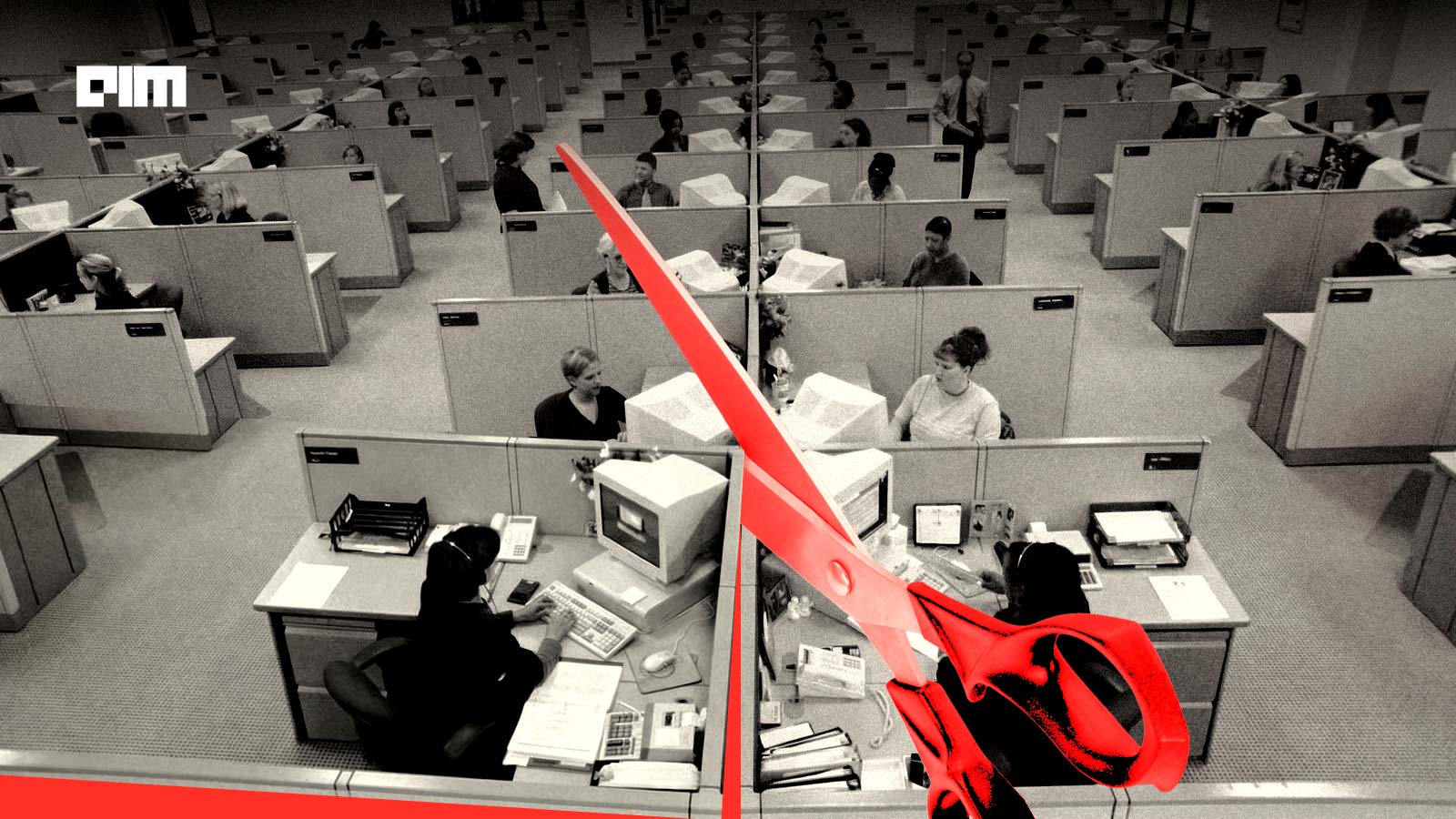
What once felt like a distant promise of efficiency is now translating into tangible workforce reductions, raising a critical question: are GCCs entering a danger zone, or are these early tremors still outliers within a larger transformation?
Across global enterprises, AI-led productivity gains are influencing headcount decisions. Microsoft cut 15,000 roles, openly attributing the move to AI-driven efficiency.
CEO Satya Nadella acknowledged the human cost, framing it as a necessary trade-off to remain competitive in an AI-first era. Google, meanwhile, took a quieter route—reducing staff while pushing employees to rely more heavily on AI tools, achieving similar outcomes without explicitly naming AI as the driver.
India’s IT services giants are undergoing a parallel, if more subdued, reset. The country’s top five IT companies are shrinking—carefully described as restructuring, AI-led transformation, or workforce optimisation.
TCS alone shed over 19,700 employees in Q2 FY26, its steepest quarterly headcount decline on record. Infosys, HCLTech, Wipro and Tech Mahindra added staff sequentially, but not nearly enough to counterbalance the scale of TCS’ contraction.
Within the GCC ecosystem, the signs are fewer but harder to ignore. Technicolor’s shutdown led to nearly 3,000 job losses, while AUMOVIO Ford has planned layoffs of around 1,000 employees in India—among the most significant workforce reductions seen in individual GCCs so far.
Taken together, these developments suggest that GCCs may not be immune to the AI-led recalibration sweeping global enterprises.
However, this is not a wave of panic layoffs, says Sunil Padmanabh, GCC Innovation Strategist. “What we are seeing in 2026 is a quiet reset. Many GCCs are trimming roles that were built around coordination, reporting, manual testing, and support work because AI tools are now handling much of that load.”
According to UnearthIQ’s data, India recorded 5,500-6,500 GCC layoffs in 2025, largely concentrated in a handful of cases, while net talent addition stood at 1.35-1.5 lakh across new and existing GCCs.
“The largest impact came from Technicolor (3,000+ roles), with the balance spread across small teams in 20 GCCs, largely due to global realignments and shutdown of experimental product units,” Gaurav Vasu, CEO and Founder, UnearthIQ, tells AIM.
Crucially, the talent displacement proved short-lived. “Most laid-off engineering and tech talent was absorbed within a quarter, driven by 101 new GCCs and continued expansion across cloud, AI, and enterprise platforms,” he adds.
Restructuring ≠ contraction
Industry leaders argue that workforce changes reflect recalibration, not retreat.
“The Indian GCC ecosystem in 2025 has been on an uptrend, though there were a few instances of downsizing or restructuring of individual GCCs,” Alouk Kumar, Founder and CEO, Inductus Group, explains to AIM. “At the outset itself, the incidence of GCC shut-downs has been extremely minimal across the country.”
Kumar noted that where reductions did occur, they were part of enterprise-wide global restructuring, often proportionate—or even lower—in India, with companies continuing to invest locally in higher-value capabilities.
Several forces are converging to drive this dual trend in India’s GCC landscape. As mandates evolve, many GCCs are shifting away from scale-driven, support-oriented roles towards higher-value work in digital engineering, data and analytics, AI, cybersecurity, and product development, making some legacy skill sets redundant while simultaneously creating strong demand for new capabilities.
This transition is unfolding alongside broader macroeconomic pressures, with global enterprises tightening capital allocation, sharpening return-on-investment metrics, and rolling out portfolio-wide efficiency programmes that are global in nature rather than India-specific.
“While some impact comes from global headquarters restructuring, it’s not direct. Indian GCCs continue to gain higher-value work and are moving from volume hiring to skill-based, smaller, sharper teams focused on innovation,” Neeti Sharma, CEO, Teamlease Digital, tells AIM.
At the same time, many organisations are consolidating their global footprints, rationalising duplicate teams and locations, and concentrating investments in a smaller number of strategically critical hubs in India, strengthening these centres instead of exiting the market.
“The coexistence of restructuring in some GCCs and expansion in others characterises a market in transition, not contraction,” Kumar says. “The landscape is becoming more sophisticated, strategically relevant, and value-creating.”
What GCCs Think?
As global industries recalibrate, workforce changes are increasingly driven not by India-specific issues, but by decisions made at the parent company level. Products are being rethought, margins reassessed, and operating models redesigned—and in a connected world, the impact is bound to ripple across geographies.
“What we are witnessing, however, is neither unprecedented nor terminal. This is not the first time it’s happened during a large disruption across the industry. And this is not the end of it either,” Dhaval Radia, CFO, Zeiss India, tells AIM.
AI-led efficiency is accelerating change across workstreams, automating routine and transactional tasks. But crucially, this shift is not eliminating capability—it is transforming it.
AI is not eliminating the need for capability. Rather, it is automating routine work, as Radia states.
The consequence is a steady shift of higher-order work being transitioned to India. Advanced areas such as data engineering, cybersecurity, product management, and deep domain expertise are gaining prominence precisely because AI is absorbing lower-value manual work.
As a result, restructuring is becoming a recurring feature of a fast-moving industry—but not necessarily a negative one.
“In net-net, we are just going through a transition,” Radia says. “Yet, among all possible scenarios, India appears better positioned. The volume of high-value work flowing into the country continues to offset the pressures created by layoffs.”
Adding to this perspective, Durga Prakash Devarakonda, Head of Technology, McDonald’s, explains that the nature of work has moved from execution to orchestration.
“The shift is from end-to-end ownership to end-to-end orchestration,” enabled by digital collaboration and remote-first infrastructure. Today, expertise matters more than geography. India’s digital maturity, combined with the rise of AI, is creating a unique moment when infrastructure and aspiration are converging.
What is unfolding is a market in transition—one where lower-order work is being automated, higher-value roles are expanding, and India is steadily moving closer to the core of global enterprise strategy, Devarakonda says.
In a conversation with AIM, Rohit Gore, CDO at Anaptyss, mentions, “If individuals are unable to keep pace, gaps emerge between expected and available expertise. This contributes to churn within GCCs, as they must carefully manage costs and productivity.”
Some global enterprises publicly disclosed workforce reductions in their India GCC operations in 2025 as part of enterprise-wide restructuring programmes, including Target, Fidelity Investments, Wells Fargo and Avaya. In most cases, however, these workforce reductions were either proportionate or lower at their India operations.
The outlook suggests selective restructuring will continue, but not in the form of wholesale or indiscriminate layoffs.