
In a short span of time, the conversation around AI has moved rapidly from early use cases to copilots that assist, to agents that act, and now to multi-agent systems capable of executing complex, end-to-end workflows.
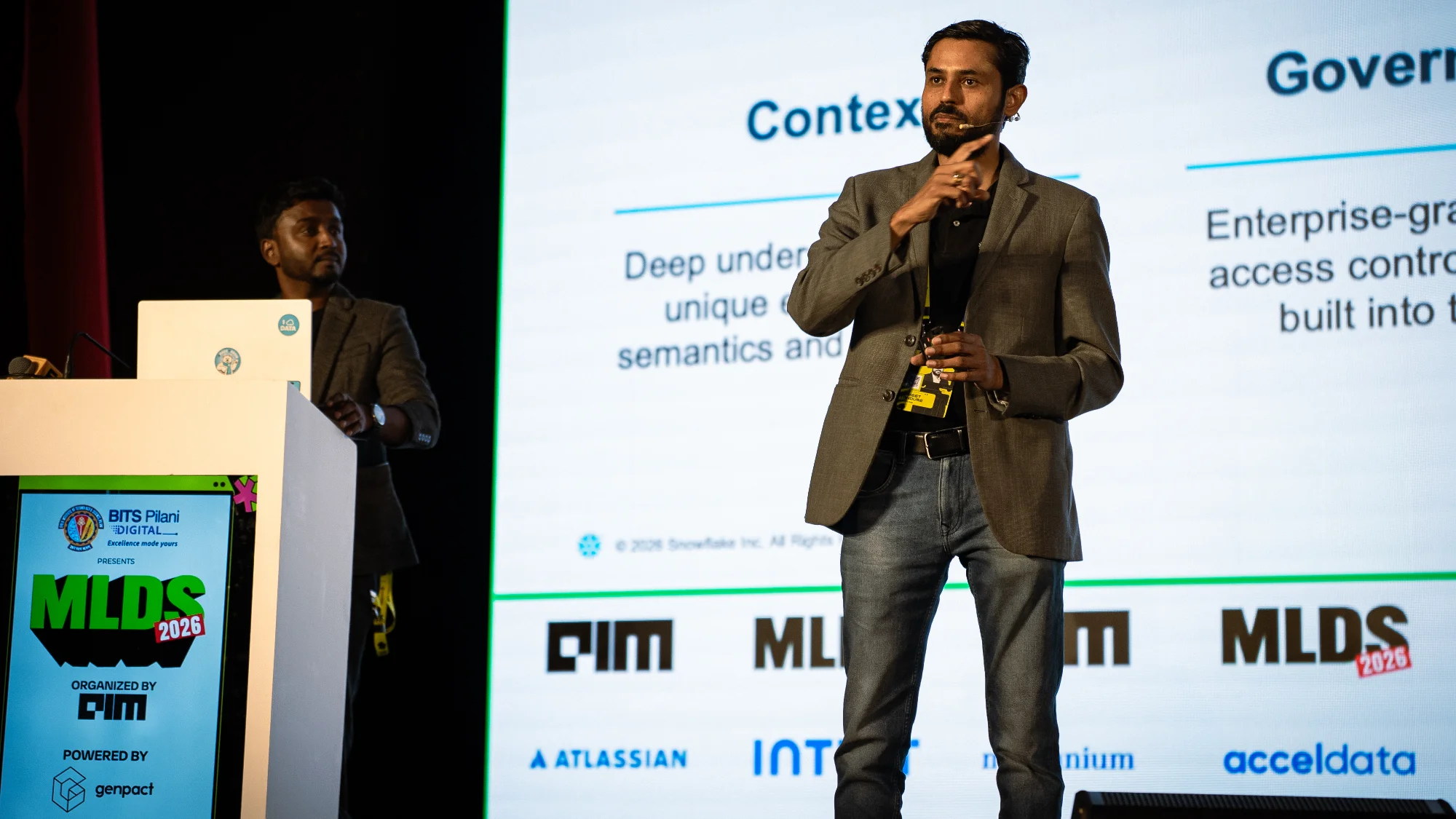
“We have come a long way from talking about vibecoding to things like agentic engineering,” says Sumeet Tandure, Senior Manager of Solution Engineering at Snowflake, during his address at MLDS 2026, India’s largest agentic AI conference organised by AIM.
According to him, multi-agent systems can build, test, and iterate on entire software programmes with minimal human input.
The Rise of Agentic Engineering
At the heart of this transformation lies a fundamental shift in how software is created.
Tandure explains that instead of developers writing every line of code, they now provide high-level specifications. AI agents take over from there, navigating codebases, making changes, testing outputs, and refining results iteratively.
To make multi-agent systems work in practice, Tandure outlines an architecture that begins with a strong context layer.
Enterprises already possess vast amounts of data, but the challenge lies in organising it into a form that agents can interpret consistently. This involves building semantic models that ensure everyone, from different departments to agents, operates with a shared understanding.
On top of this sits the intelligence layer, where agents retrieve, reason, and act. Here, workflows are dynamically orchestrated, and decisions are made in real time, often across multiple systems and data sources.
Finally, the interface layer determines how these capabilities are exposed. For developers, this may live inside IDEs. For non-technical users, it could mean a single interface that replaces multiple applications and workflows.
To better understand multi-agent systems, Tandure frames them as a natural evolution of distributed computing. The industry has already transitioned from monolithic architectures to microservices in pursuit of scale and flexibility. What AI changes is not the distributed nature, but how systems communicate.
“Rather than having these APIs be very explicitly defined and hard-coded, it allows these services to talk to each other over more semantic APIs,” he explains.
Interoperability as a Core Requirement
Tandure stresses that enterprises rarely operate within a single system. Data and workflows are distributed across platforms like Salesforce, SAP, and Microsoft. For multi-agent systems to be effective, they must operate across this fragmented landscape.
“Interoperability is very important for systems to work together,” he adds.
This requires standard protocols and flexible architectures that allow agents to communicate across platforms.
The Four Pillars of Multi-Agent Systems
Tandure outlines a set of foundational principles for building scalable multi-agent systems, particularly within enterprise platforms like Snowflake.
At the core is the need for ease of use, so AI systems are accessible not just to developers but also to business users, reducing friction in adoption.
Equally critical is the idea of connected data ecosystems. Agents require seamless access to both structured and unstructured data across environments to function effectively.
As these systems become more autonomous, trust and governance become indispensable. Robust security, observability and compliance become non-negotiable. “Governance cannot be an afterthought,” Tandure says.
Finally, predictable performance at scale remains a key requirement, ensuring that enterprise-grade AI systems deliver consistent results even as workloads grow in size and complexity.
Snowflake’s Role in the Agentic Stack
At Snowflake, these principles are being translated into a unified platform that integrates data, AI, and agentic workflows.
Tandure points to Snowflake’s architecture as an example of how these principles can be implemented in practice.
By combining data infrastructure with AI capabilities, platforms like Snowflake aim to provide a unified environment where agents can operate directly on enterprise data.
Tools like Cortex agents enable orchestration across structured and unstructured data. These agents can retrieve context, reason over it, and execute workflows—all within a governed environment.
In multi-agent systems, the value lies not just in the intelligence of individual agents but in their ability to collaborate over shared, reliable data.
Enterprises operate on vast amounts of structured and unstructured data accumulated over the years. But data alone is not enough. It must be curated, governed, and semantically aligned.
This is why Tandure suggests a subtle but profound shift in roles. “Data engineers are slowly becoming context engineers.”
Intelligence may be abundant, but context remains scarce—and that is where the real work now lies.
As AI continues to evolve, the winners will not simply be those with the most advanced models, but those who can orchestrate intelligence effectively.

Your reaction
Discussion
What's your take on this story?
No comments yet — be the first to share your view.