
Key takeaways
- The rise of digital technology has led to an increase in various forms of online crime.
- Cybersecurity costs linked to online crime are projected to escalate significantly in the coming years.
- Malicious software continues to evolve, encompassing a wide range of threats including ransomware and coin mining malware.
- Microsoft's antivirus has effectively countered Dofoil, a recent coin mining malware, through behavioural monitoring and machine learning.
 Since the advent of digital technology, crime in the online space has taken various forms, from cyberbullying to exploiting security flaws for monetary gains by ‘black hat’ hackers. Cyber security experts estimate that the costs incurred due to these crimes will rise up to $6 trillion annually by 2021.
Notably, the number of malicious code,software or tools present on the online space are also very large and exist in many types - virus, spam, malware, spyware, phishing software - the list goes on, and will continue because the vulnerabilities are innate in the Internet architecture. The possibilities are harrowing with recent ones being ransomware such as Petya, WannaCry and coin mining software entering the cryptocurrency domain. In this article, we explore how the latest attack called Dofoil, a malicious bitcoin mining software was detected and subdued by Microsoft’s antivirus, anti-malware product Windows Defender using behavioral monitoring and bits of machine learning (ML).
The Dofoil Disruption - What is it?
Dofoil, also known as Smoke Loader among cybersecurity experts, is a software application which downloads other malicious software (or called malware) onto the host computer systems and servers. It mainly infects them through spams and exploit kits, that detect vulnerabilities and security loopholes and intrudes without the host knowing it. The attackers usually use command-and-control servers (C2 servers) on the affected systems to maintain communications amongst themselves. Although developed quite earlier, Dofoil was almost undetectable until recent reports of Microsoft and Malwarebytes addressed the problem and eliminated the threat.How Microsoft’s Windows Defender smoked Dofoil
Windows Defender, the standalone antivirus product by Microsoft detected and protected users from Dofoil attack that occured on March 6, 2018.The cryptocoin mining attack was mostly concentrated in Russia and spread to regions around it, such as Ukraine and Turkey. Windows Defender initially detected the spread through its behavioral monitoring service, relaying the emergency signals to its cloud protection services. After getting alerted by Windows Defender’s behavioral signals, the metadata-based ML models in the cloud instantly blocked the threats and then proceeded to categorise the malicious software through their services’ sample-based and detonation-based ML models. This is to reinforce protection and bring out more information from those threats. Later on, the response team classified the string of threats under one name - Dofoil.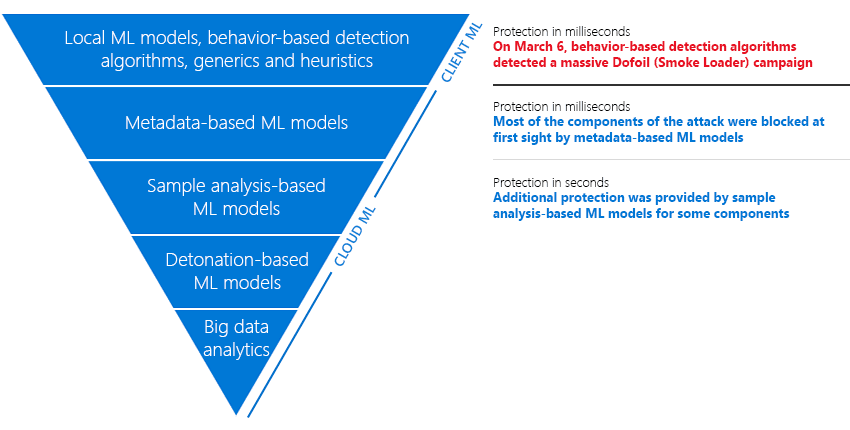
Machine Learning in Windows Defender
Earlier, we saw that the antivirus software took a layered-structure approach to ML models. Microsoft in their research has quoted that - “In Windows Defender AV’s layered approach to defense, if the first layer doesn’t detect a threat, we move on to the next level of inspection. As we move down the layers, the amount of time required increases. However, we catch the vast majority of malware at the first (fastest) protection layers and only need to move on to a more sophisticated (but slower) level of inspection for rarer/more advanced threats.” This means that the ML models won’t compromise on the performance of the system while working aggressively to hinder security threats. This way the problem of threats get resolved in minutes, if not in a few hours.Conclusion :
The world of computer technology and Internet has witnessed more setbacks than ever in the recent years. With cybercrime and threats in the digital space on the rise, cybersecurity needs to brace itself with advancements in parallel to counter cybercrime on a disastrous scale.Spotted an error? Tell our editors. Read our editorial standards and corrections.